






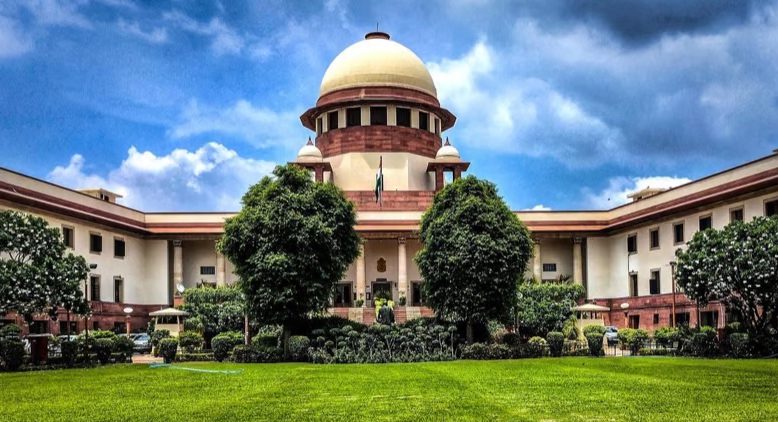
In a major setback to Satara District Central Cooperative Bank’s outgoing Vice-Chairman Anil Desai and director Rajendra Rajpure, the Supreme Court has upheld the Bombay High Court’s Kolhapur Bench ruling, which disqualified them from contesting the bank’s elections after they completed more than 10 consecutive years as directors.
Desai and Rajpure approached the Apex Court on Friday, challenging the Kolhapur Bench’s October 14 judgment. The High Court had ruled against their candidature after accepting objections raised by Sanjay More and Chandrakant Kokate.
At the first hearing, the Supreme Court declined to grant relief to the two petitioners and found no reason to interfere with the High Court’s decision. The proceedings reportedly concluded within 15–20 minutes.
Speaking to Indian Cooperative after the hearing, Rajpure confirmed that the Supreme Court had upheld the Kolhapur Bench’s decision and denied them relief. However, he questioned the 10-year tenure restriction, arguing that it could deprive cooperative banks of experienced leadership.
“Such a 10-year restriction is not good for cooperative banks. We may lose experienced people, and banks could end up in the hands of newcomers,” Rajpure said.
A key aspect of the High Court judgment was its rejection of the Maharashtra Cooperation Department’s August 21, 2026 communication, which had stated that Returning Officers did not have jurisdiction to examine candidates’ eligibility under Section 10A(2A) of the Banking Regulation Act, 1949.
The Kolhapur Bench held that executive instructions cannot override statutory provisions or judicial interpretations of law. It described the department’s opinion on the Returning Officer’s lack of jurisdiction as having “no merit and substance”.
The Court ruled that under Rule 25(2) of the Maharashtra Co-operative Societies (Election to Committee) Rules, 2014, Returning Officers are empowered to examine objections concerning a candidate’s eligibility at the nomination scrutiny stage through a summary enquiry.
On the 10-year tenure issue, the High Court held that the restriction under Section 10A(2A)(i) applies retroactively, requiring the previous period of directorship to be counted while determining eligibility. The Court also clarified that the Returning Officer’s scrutiny is limited to a prima facie examination and does not amount to a final determination of substantive disqualification. Such findings do not prejudice the remedies available under the Maharashtra Co-operative Societies Act or the Banking Regulation Act.
The Court observed that the tenure restriction aims to prevent concentration of power and monopoly on cooperative bank boards while providing equal opportunities to other eligible candidates.
The Supreme Court’s decision not to interfere with the Kolhapur Bench ruling is significant for Maharashtra’s cooperative banking sector, where the interpretation of the 10-year tenure cap has triggered debate ahead of several bank elections.