
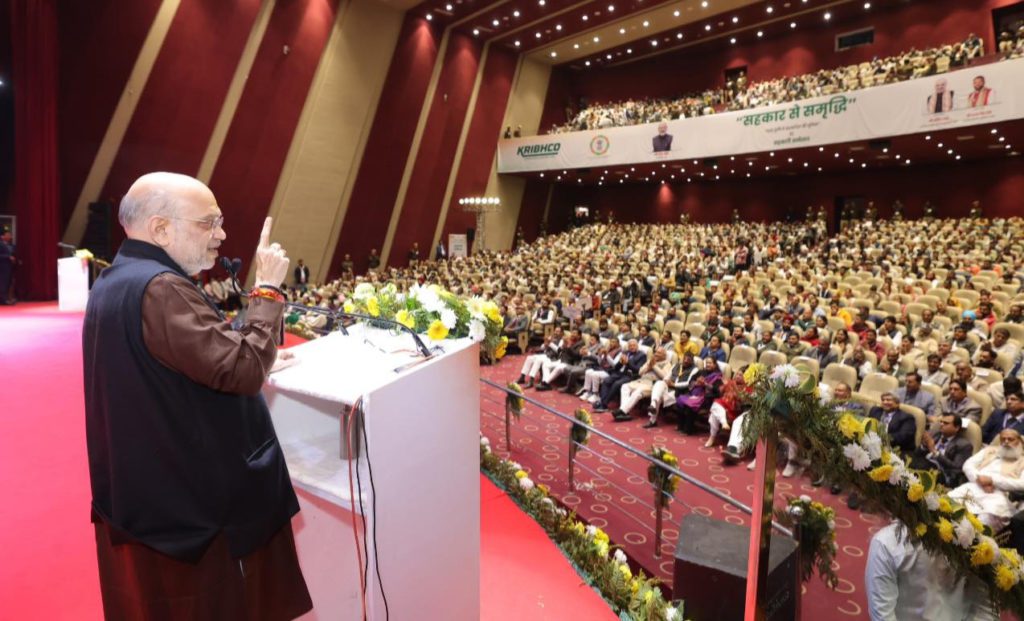
Union Home and Cooperation Minister Amit Shah on Tuesday cited Amul as India’s most successful cooperative experiment, saying its journey clearly demonstrates how cooperation can transform agriculture and allied activities from subsistence-level employment into engines of prosperity.
Addressing a cooperative conference in Panchkula, Haryana, Shah said the Amul model has not only changed the economic fortunes of millions of farmers but has also reshaped the social fabric of rural India by empowering producers, particularly women.
Shah pointed out that Amul today distributes nearly Rs 90,000 crore annually to around 36 lakh women milk producers across the country. He contrasted this with the estimated Rs 12,000 crore that the same quantity of milk would fetch if sold individually at market prices, saying the massive difference highlights the true strength of cooperative value addition, collective bargaining and farmer ownership.
According to him, this additional income has translated into better living standards, financial security, education for children and greater participation of women in household and community decision-making.
Recalling Amul’s modest beginnings, Shah said the cooperative started with a collection of just about 2,000 litres of milk per day. Over the decades, driven by trust, transparency and farmer-centric governance, it has grown into a nationwide institution collecting close to three crore litres of milk daily, with an annual turnover of around Rs 1.23 lakh crore. He emphasised that Amul’s growth was achieved without diluting farmer ownership, making it a rare model where scale and equity have progressed together.
The Union Minister said the success of Amul has convinced the government that the cooperative model must be expanded beyond dairy to other sectors of the rural economy. He noted that similar farmer-owned, professionally managed cooperatives are now being promoted in areas such as agriculture marketing, exports, organic produce, seed production, storage, processing, transport and even services.
Institutions like the National Cooperative Exports Limited, National Cooperative Organics Limited and the Bharatiya Beej Sahkari Samiti Limited have been created to replicate Amul’s principles in new domains, ensuring that profits reach producers rather than intermediaries.
Shah said the establishment of the Ministry of Cooperation under Prime Minister Narendra Modi was aimed precisely at scaling up such models across sectors. The objective, he added, is to build strong, transparent and technology-enabled cooperatives that can compete in national and global markets while remaining rooted in farmer ownership.
He expressed confidence that in the coming years India would witness the emergence of several Amul-like institutions across multiple cooperative sectors. These, he said, would not only enhance farmers’ incomes but also make cooperation a central pillar of sustainable and inclusive rural development, turning villages into hubs of economic growth driven by collective strength.