







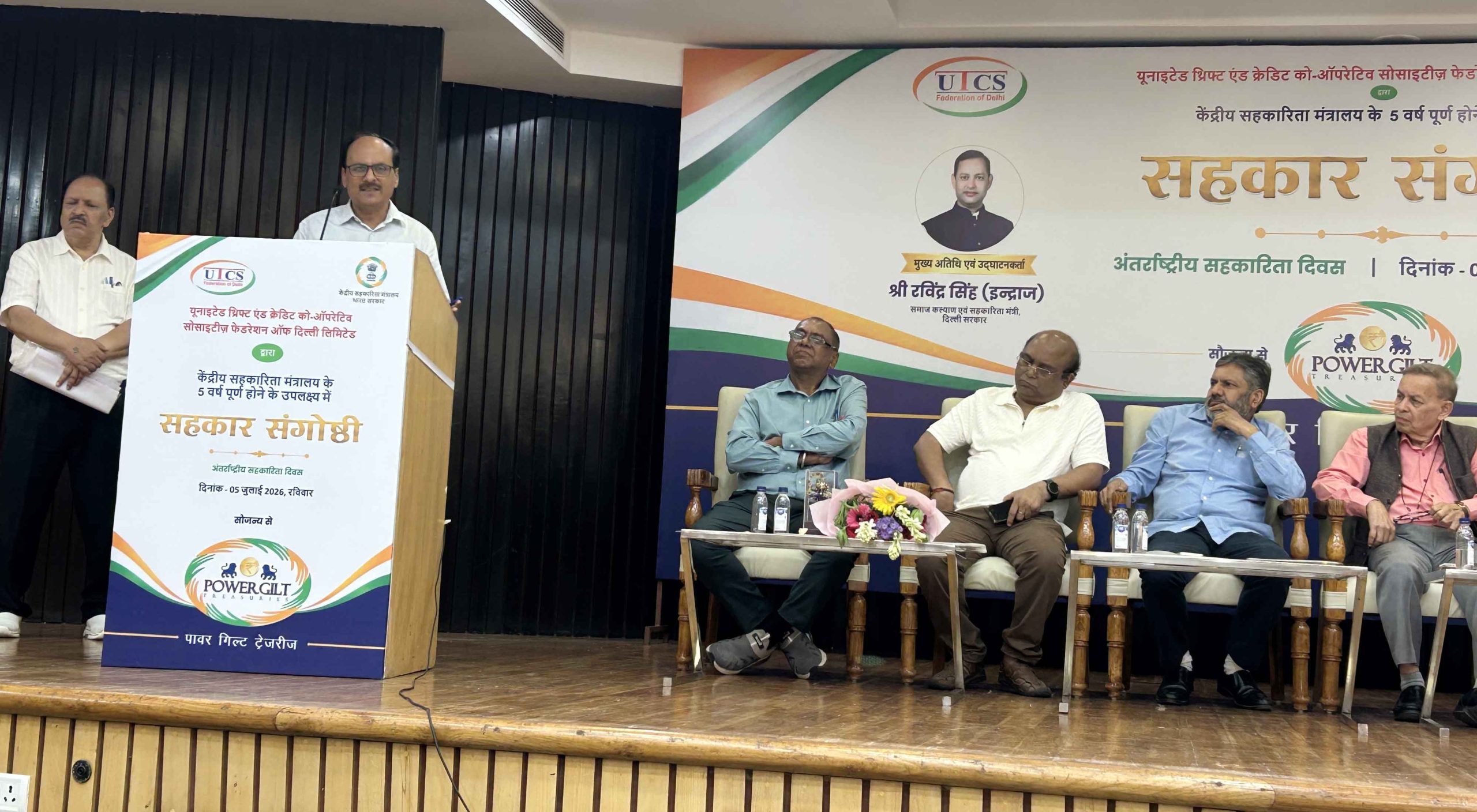
Delhi-based United Thrift and Credit Cooperative Societies Federation, in association with Power Gilt Treasuries, organised a seminar at the India International Centre on Sunday where major reforms for Delhi’s cooperative sector were announced, including an Aadhaar-based loan tracking system, a new Cooperative Policy and amendments to the Delhi Cooperative Societies Act.
Although Delhi Cooperation Minister Ravinder Indraj Singh was scheduled to inaugurate the event, he could not attend. The programme was attended by Delhi Registrar of Cooperative Societies (RCS) Krishan Kumar Singh, RBI Central Board Director Satish Marathe, Power Gilt Treasuries Managing Director Vineet Nahata and representatives of thrift and credit cooperative societies.
Making the key announcement, Krishan Kumar Singh said the draft Delhi Cooperative Policy has been prepared and is awaiting Cabinet approval before being placed before the Assembly. “If all goes as planned, the policy could be implemented within six months,” he said.
Singh also announced that the RCS office is creating an Aadhaar-linked digital database for thrift and credit cooperative societies to prevent borrowers from taking multiple loans by concealing existing liabilities. The system, he said, will improve due diligence, enhance transparency and significantly reduce financial fraud.
He added that the department is also reviewing existing directions to ensure they are fully aligned with statutory rules.
In his welcome address, Federation Chairman Sunil Gupta called for an urgent overhaul of Delhi’s cooperative framework, saying the Delhi Cooperative Societies Act, last amended in 2003 with rules notified in 2007, no longer reflects present-day realities.
Gupta also highlighted the absence of a dedicated cooperative cadre in Delhi and said nearly 14 of the capital’s 17 apex cooperative federations are facing financial stress, poor infrastructure and delayed audits. He urged the government to create a financial assistance mechanism similar to the Cooperative Union Education Fund.
Responding to these concerns, Singh acknowledged the financial challenges faced by apex federations and appealed to member societies to strengthen them through greater participation. He pointed out that while Delhi has nearly 2,500 thrift and credit cooperative societies, only around 100 are members of the United Thrift and Credit Cooperative Societies Federation.
Power Gilt Treasuries Managing Director Vinit Nahata stressed the importance of sound financial management and safe investment practices. He urged cooperative institutions to align their activities with the United Nations Sustainable Development Goals (SDGs), saying cooperatives can become important drivers of sustainable and inclusive development.
Delivering the keynote address, RBI Central Board Director Satish Marathe said India today has the world’s largest cooperative movement, with over 65 per cent of rural households connected to cooperative institutions.
While crediting the creation of the Union Ministry of Cooperation as a landmark step, he said the sector now requires modern legislation, easier access to long-term capital, stronger prudential regulation and professional supervision to realise its full potential and contribute to the vision of Viksit Bharat.