





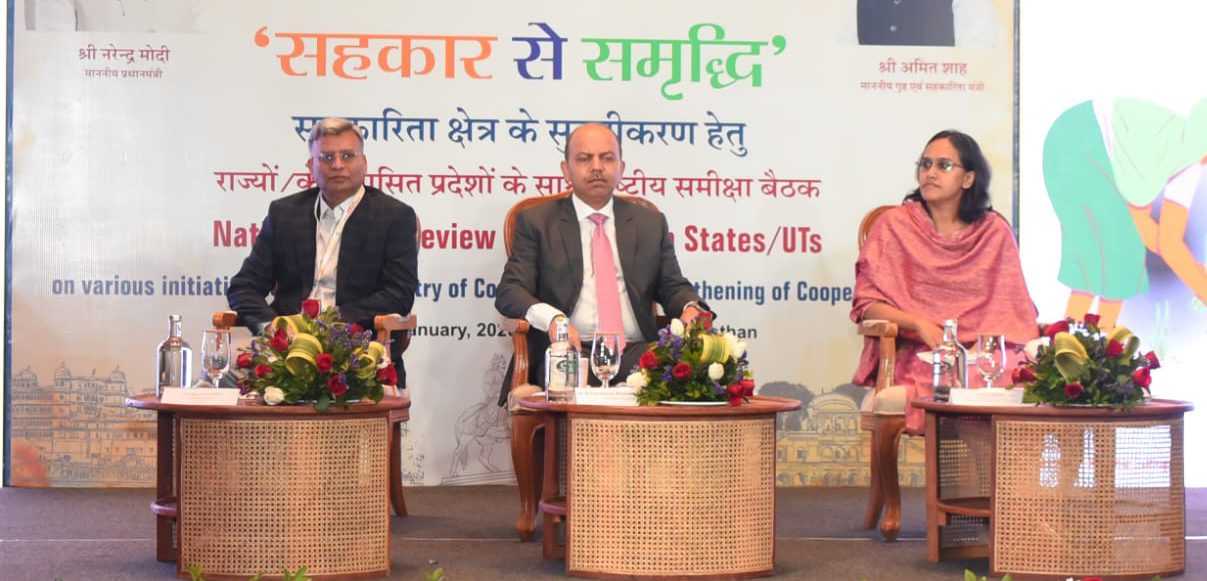
The two-day National-Level Review Meeting of the Ministry of Cooperation commenced on Thursday in Udaipur, Rajasthan, marking an important step towards strengthening India’s cooperative ecosystem.
The inaugural session was addressed by Dr. Ashish Kumar Bhutani, Secretary, Ministry of Cooperation, who outlined the vision and priorities of the Ministry while interacting with representatives from States and Union Territories.
Dr. Bhutani shared insights on key initiatives aimed at reinforcing the cooperative sector, including the implementation of Model Bye-Laws, the role of the Reserve Bank of India in cooperative banking, reforms in cooperative banks, the expansion of Multi-Purpose PACS, and planned interventions in the dairy sector. He presented a structured roadmap for a detailed, phase-wise review of these areas over the next two days.
Emphasizing the goal of “Sahkar Se Samriddhi”, Dr. Bhutani called upon States and Union Territories to ensure effective implementation of cooperative schemes through coordinated and participative efforts. He underlined the importance of institutional strengthening, active stakeholder engagement, and making cooperatives a strong pillar of inclusive and sustainable development.
The second session of the day featured deliberations led by Pankaj Kumar Bansal, Additional Secretary, and Siddharth Jain, Joint Secretary, who engaged with State representatives on challenges in the cooperative sector and the ground-level implementation of schemes. The session witnessed appreciation for notable progress made by Uttar Pradesh, Rajasthan, and Karnataka.
Officials of the Ministry issued key directions to States, focusing on business diversification, computer training, faster utilization of funds, initiation of credit and commercial activities in newly formed PACS, and mandatory completion of DCCB affiliation processes within the February–March 2026 timeline.
In the subsequent session, a comprehensive review of District Central Cooperative Banks (DCCBs) and initiatives linked to NCOL, NCEL, and BBSSL was undertaken. The review was chaired by Pankaj Kumar Bansal, Additional Secretary, along with Raman Kumar, Joint Secretary, Smt. S. Satya, Director, and Kumar Ramakrishna, Director.
Special emphasis was laid on strengthening weak and underperforming DCCBs, ensuring an annual growth rate of 11–12 percent, and implementing the Aadhaar Enabled Payment System (AEPS) in select banks to enhance digital inclusion.
A dedicated workshop titled “Strategic Dialogue on NCD Strengthening & MSCS Reforms” was also held during the day, chaired by Anand Kumar Jha, Joint Secretary, Ministry of Cooperation, with participation from Cooperative Secretaries and representatives of various States and Union Territories. Dr. Mukesh Kumar, Director, Ministry of Cooperation, actively contributed to the discussions.
The workshop reviewed the current status of National Cooperative Development (NCD) institutions, identified gaps, and prioritized action areas such as digital integration, data updation, GeM onboarding, and e-commerce initiatives.
Key reforms under the Multi-State Cooperative Societies (MSCS) Act were also discussed, including deemed registrations under Section 103, expediting liquidation processes, finalizing panels of liquidators and arbitrators, and constituting State-level Election Authorities.
The first day concluded with in-depth discussions on strengthening governance, improving operational efficiency, addressing regulatory and supervisory challenges, and accelerating digital transformation in cooperative banking.
The deliberations set a strong foundation for the remaining sessions, reaffirming the Ministry’s commitment to building a robust, inclusive, and future-ready cooperative sector across the country.