
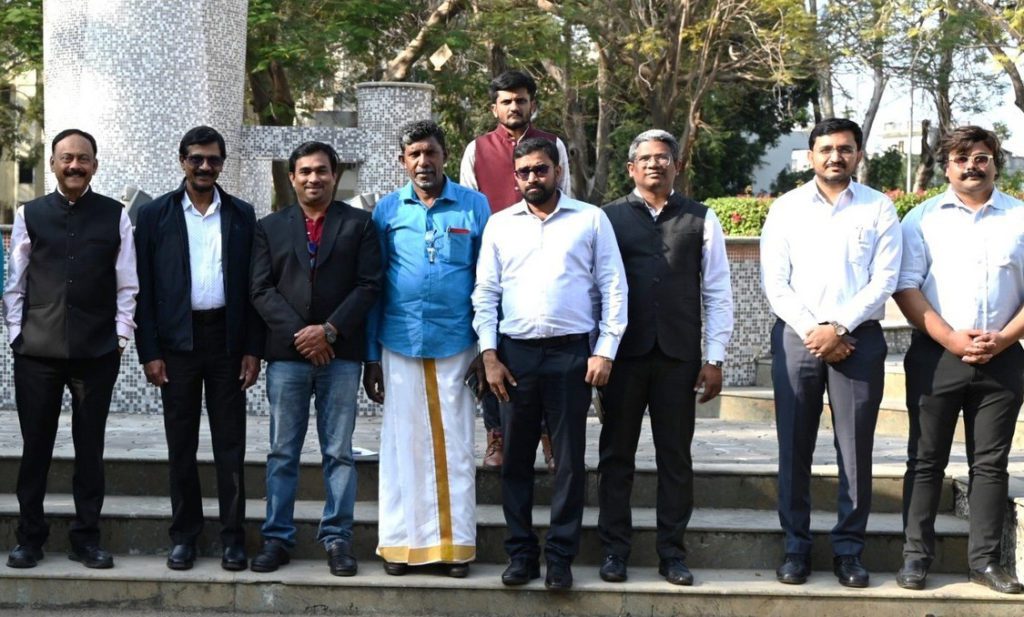
A delegation from Sri Lanka, led by Shri Tilvin Silva, General Secretary of the Janatha Vimukthi Peramuna (JVP), visited the IRMA–Tribhuvan Sahkari University (TSU) campus in Anand last week as part of an exposure programme to gain first-hand understanding of India’s cooperative framework and its institutional evolution.
The delegation was welcomed by Dr. Saswata Biswas, Director of the Institute of Rural Management Anand (IRMA) and Dean of the School of Cooperative Management at TSU, along with senior faculty and staff members. The visit provided an opportunity for detailed interactions on the legacy of IRMA, the vision and mandate of TSU, and the ongoing transformation of India’s cooperative sector.
TSU has recently emerged as India’s first national university dedicated exclusively to cooperative education, research and capacity building. Built on the strong academic and institutional foundation of IRMA, the university aims to professionalise the cooperative movement by offering specialised programmes in cooperative management, rural development, governance, finance and innovation.
During the discussions, faculty members outlined how TSU is positioned to act as a national hub for cooperative learning, with plans to support and guide affiliated institutions across the country.
The Sri Lankan delegation was briefed on the university’s role in strengthening cooperatives through structured training programmes, leadership development initiatives and applied research aligned with the needs of grassroots institutions. Particular emphasis was laid on TSU’s focus on improving governance standards, transparency and managerial efficiency within cooperatives operating in agriculture, dairy, fisheries, credit, transport and emerging service sectors.
The interaction also covered new initiatives within India’s cooperative ecosystem. These included discussions on innovative cooperative ventures such as the recently launched Bharat Taxi initiative and proposed models in the health sector, which seek to combine member ownership with technology-driven service delivery.
Faculty members explained how such initiatives reflect the evolving nature of cooperatives in India, moving beyond traditional sectors to address contemporary economic and social challenges.
Members of the delegation expressed keen interest in India’s approach to integrating education, policy support and grassroots participation within the cooperative framework. The exchanges explored the potential relevance of India’s experience for Sri Lanka, particularly in strengthening farmer organisations, worker collectives and community-owned enterprises through professional management and institutional support.
The visit also highlighted TSU’s growing international outlook. By engaging with overseas delegations and promoting cross-country knowledge exchange, the university aims to contribute to global dialogue on cooperative development.
The interaction with the Sri Lankan delegation marked an important step towards fostering long-term academic and institutional collaboration in the cooperative domain, reinforcing TSU’s role as a centre of learning for cooperative movements beyond India’s borders.