






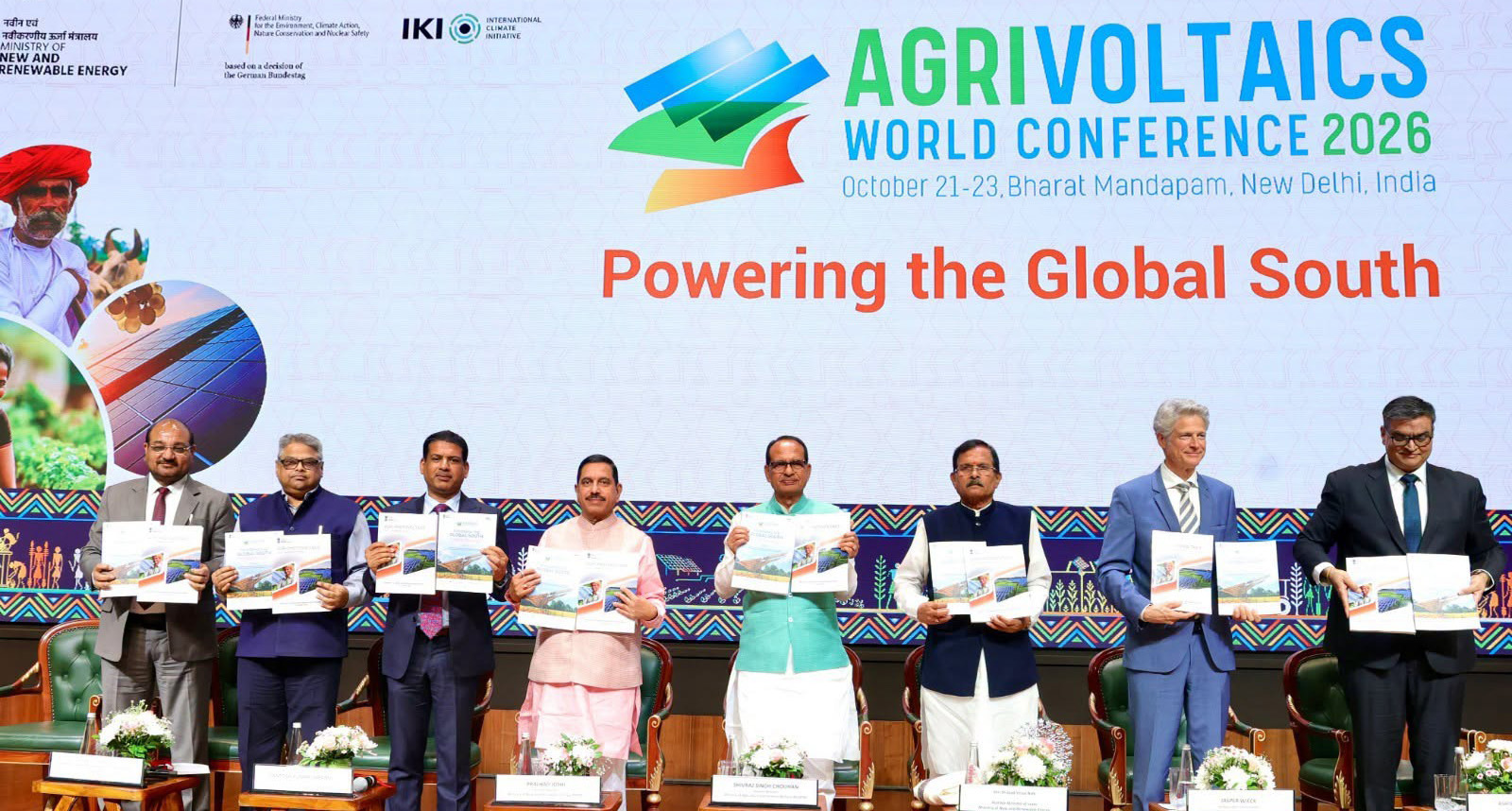
Union Agriculture Minister Shivraj Singh Chouhan has called for a farmer-centric AgriVoltaics policy that enables Indian farmers to produce food and electricity simultaneously, stressing that solar installations must not compromise agricultural productivity, particularly on the small holdings of marginal farmers.
Addressing the inaugural session of the three-day 7th AgriVoltaics World Conference at Bharat Mandapam, New Delhi, on Wednesday, Chouhan said farmers could emerge as both ‘annadatas’ and ‘urjadatas’ by integrating solar power generation with crop cultivation. He emphasised that the model must work for the country’s 85 per cent small and marginal farmers, whose average landholding is just 0.96 hectares.
Under AgriVoltaics, solar panels are installed above agricultural fields, allowing crops to grow underneath while electricity is generated overhead. Chouhan said panel height, spacing, farm machinery movement, crop choices and cultivation cycles must be carefully planned to ensure that farmers can continue normal agricultural operations.
He also called for effective rainwater drainage and collection systems to prevent soil erosion and conserve water. Reliable grid connectivity, assured power procurement and transparent, timely payments to farmers were equally important. Farmer Producer Organisations should be involved, while rural youth and women should receive training in equipment operation, repair and maintenance.
Chouhan stressed that safeguards must protect farmers if companies abandon projects midway or panels need to be removed after contracts expire. He assured Union Minister for New and Renewable Energy Pralhad Joshi of close coordination between the two ministries to make the initiative successful.
Joshi said India had substantial potential to expand AgriVoltaics. Citing a study by The Energy and Resources Institute (TERI), he noted that 47.5 million hectares of the country’s agricultural land were technically suitable for the technology. Maharashtra, Rajasthan, Andhra Pradesh, Madhya Pradesh, Karnataka and Uttar Pradesh together accounted for around half of this potential.
According to Joshi, studies indicate that AgriVoltaics could increase crop yields by 10–20 per cent. He announced that the government would soon launch an ambitious AgriVoltaics programme under the next phase of the PM-KUSUM scheme. The sector could generate approximately 3.32 lakh full-time local jobs, creating employment opportunities within rural communities.
Highlighting India’s renewable energy progress, Joshi said total installed electricity generation capacity had risen from around 249 GW before 2014 to more than 560 GW, while non-fossil energy capacity had crossed 308 GW. He added that 30 lakh agricultural pumps had already been connected to solar energy under PM-KUSUM, helping farmers access daytime electricity for irrigation.
The conference brought together national and international delegates, policymakers, scientists and farmers. Technical tools and communication materials to support informed, field-level implementation of AgriVoltaics were also released.
The central message was clear: solar energy expansion must complement agriculture, not displace it, enabling farmers to earn from both crops and clean electricity while creating new rural employment opportunities.