






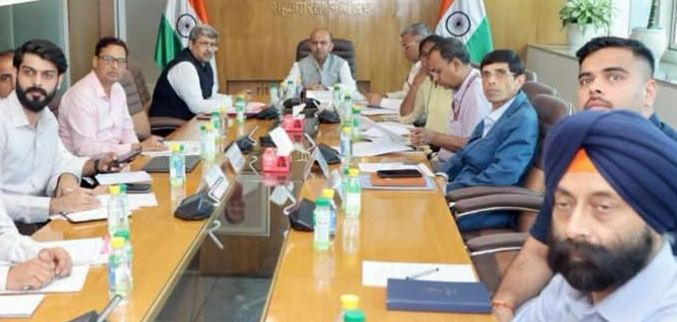
The National Level Coordination Committee (NLCC) on Tuesday reviewed the progress of the government’s initiative to form and strengthen 2 lakh new Multipurpose Primary Agricultural Cooperative Societies (MPACS), Dairy Cooperative Societies (DCS) and Fisheries Cooperative Societies (FCS) across Panchayats and villages.
The meeting, held in New Delhi on Tuesday, was chaired by Dr. Ashish Bhutani, Secretary, Ministry of Cooperation. It brought together senior officials and representatives from the Ministry, States and Union Territories to assess the implementation of the initiative and identify areas requiring greater coordination and timely intervention.
The State/UT-wise progress was reviewed with particular attention to membership expansion, credit flow, business diversification and adoption of Model Bye-laws. The discussions underlined the need to develop cooperatives as sustainable, financially viable and member-centric institutions capable of addressing the economic needs of local communities.
Representatives of NABARD, the National Dairy Development Board (NDDB) and the National Fisheries Development Board (NFDB) presented updates on the progress being made in the respective sectors. The discussions covered the development of MPACS, DCS and FCS, increased member participation, improved access to credit and resources, and initiatives such as Model Cooperative Villages.
The meeting stressed that the expansion of cooperatives at the Panchayat and village level should go beyond merely increasing the number of societies. The focus, officials noted, needs to be on ensuring that newly formed and strengthened cooperatives have adequate membership, access to finance, diversified business activities and effective governance systems.
The adoption of Model Bye-laws was also discussed as an important step towards bringing greater uniformity and strengthening the institutional framework of primary-level cooperatives. Diversification of business activities is expected to help cooperatives generate additional revenue streams and become more economically sustainable.
The NLCC also emphasised stronger coordination among the Centre, States, Union Territories and sectoral institutions to ensure that implementation remains on schedule and available resources are utilised effectively.
The initiative is aimed at taking the cooperative movement deeper into rural India by ensuring that Panchayats and villages have access to functional and economically viable cooperative institutions. Strengthening these grassroots entities is also expected to improve farmers’ access to credit, dairy producers’ market linkages and fisheries communities’ access to resources and organised economic opportunities.
The meeting was attended by Pankaj Kumar Bansal and Siddharth Jain, Additional Secretaries in the Ministry of Cooperation, along with NLCC members and senior Ministry officials. Registrars of Cooperative Societies and senior officials from all States and UTs participated virtually.
The deliberations reaffirmed the government’s focus on strengthening the cooperative ecosystem at the grassroots in line with the vision of “Sahkar se Samriddhi.”