
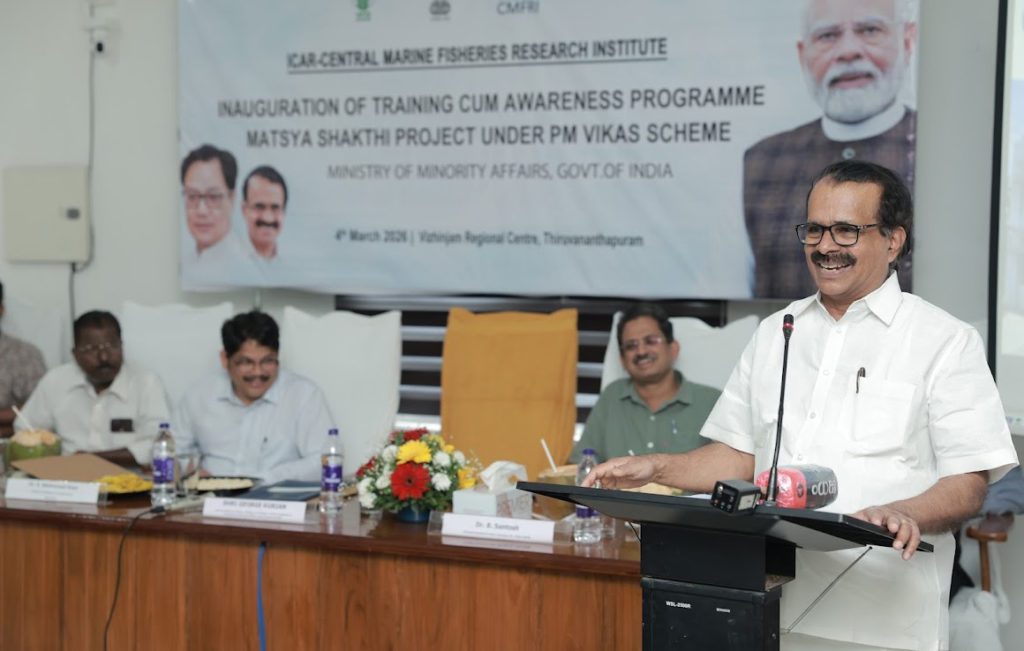
Union Minister of State for Fisheries, Animal Husbandry and Dairying George Kurian has said that the Central Government is willing to support the transformation of Kerala’s MatsyaFed into a national-level cooperative institution similar to the successful dairy cooperative model of Amul, provided the Kerala government submits a formal proposal for the initiative.
Kurian made the remarks while inaugurating a workshop held under the Matsya Shakti project at the ICAR–Central Marine Fisheries Research Institute (CMFRI) in Vizhinjam, near Thiruvananthapuram. The workshop was organised as part of the PM VIKAS scheme and focused on strengthening livelihoods in the fisheries sector through skill development, entrepreneurship and institutional support.
Addressing participants, the Minister said that cooperatives have historically played a transformative role in strengthening rural and sectoral economies in India. He noted that if the Kerala government proposes a comprehensive development plan, the Centre would extend financial and technical support to scale up MatsyaFed into a nationwide cooperative framework on the lines of the dairy sector’s cooperative success story.
Kurian emphasized that sustainable and meaningful growth in the fisheries sector requires close coordination between the Centre and the states. According to him, cooperative institutions can help fishermen improve market access, strengthen value chains and ensure fair returns for their produce.
By expanding cooperative networks and modernizing infrastructure, the fisheries sector can replicate the success achieved by dairy cooperatives in empowering producers and building strong national brands.
The workshop formed part of the Matsya Shakti initiative, which aims to empower fishing communities—especially those from minority groups—through skill development and entrepreneurship opportunities. The project is being implemented under the Pradhan Mantri Virasat Ka Samvardhan (PM VIKAS) scheme of the Ministry of Minority Affairs and is supported by the Central Marine Fisheries Research Institute.
Under the programme, around 690 beneficiaries are expected to receive training in various fisheries-related activities. These include hatchery production, cage culture fish farming, aquaculture management and other modern techniques that can enhance productivity and income generation in coastal communities.
The training modules are designed to equip participants with both technical and entrepreneurial skills. For instance, a group of trainees is undergoing intensive training in hatchery operations covering broodstock management, artificial breeding, larval rearing and water quality management. Another set of beneficiaries will receive practical training in cage culture practices, which are increasingly being promoted as a sustainable mariculture option.
A significant component of the initiative also focuses on women’s empowerment. As part of the programme, more than 400 women are expected to receive leadership and entrepreneurship training, including modules on financial literacy, communication skills and collective enterprise development.
Officials said that the project is intended not only to enhance technical capabilities but also to encourage fisherfolk to become entrepreneurs and community leaders capable of generating employment in coastal areas.
Kurian said that initiatives such as Matsya Shakti demonstrate the potential of combining research institutions, government schemes and cooperative structures to create a robust fisheries ecosystem. With proper institutional support and collaborative policymaking, he added, India’s fisheries sector could emerge as a major driver of coastal economic growth and livelihood security.