
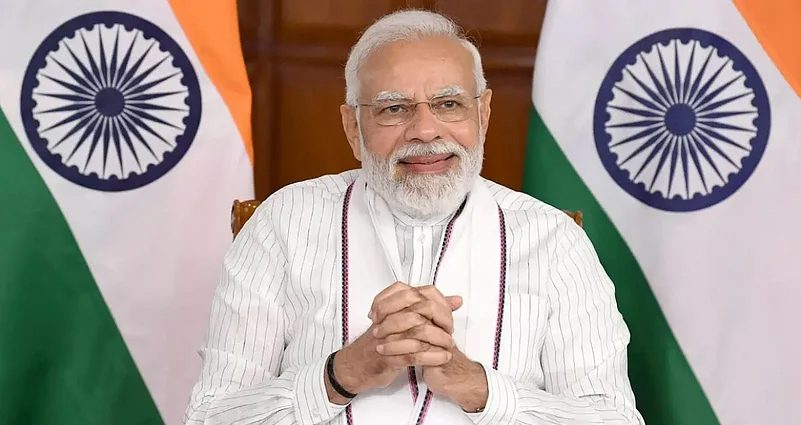
Under the leadership of Prime Minister Narendra Modi, the central government is preparing to host a landmark programme on August 11, 2025, in Jhunjhunu, Rajasthan, aimed at safeguarding farmers’ livelihoods and bolstering rural agricultural resilience.
The event, focused on the Pradhan Mantri Fasal Bima Yojana (PMFBY), will see the disbursement of over Rs 3,200 crore in crop insurance claims to more than 30 lakh farmers nationwide through Direct Benefit Transfer (DBT), marking the largest single-day payout in the scheme’s history.
The programme will be chaired by Union Minister for Agriculture & Farmers’ Welfare and Rural Development, Shivraj Singh Chouhan, with Rajasthan Chief Minister Bhajanlal Sharma as the Chief Guest. Union Minister of State for Agriculture Bhagirath Choudhary, Rajasthan Agriculture Minister Kirodi Lal Meena, farmer leaders, cooperative representatives, and senior government officials will also be in attendance.
Farmers from Jhunjhunu, Sikar, Jaipur, Kotputli-Behror, and surrounding districts are expected to gather at the Jhunjhunu Airstrip, while lakhs more from across India will participate virtually.
The scale of this payout highlights the government’s commitment to protecting farmers from the economic shocks of crop losses. Of the total disbursement, Madhya Pradesh farmers will receive Rs 1,156 crore, Rajasthan’s farmers Rs 1,121 crore, Chhattisgarh Rs 150 crore, and other states collectively Rs 773 crore. Notably, over 7 lakh farmers in Rajasthan alone will benefit from this historic release.
Chouhan stressed that technology and transparency lie at the heart of the PMFBY reforms, ensuring claims are processed swiftly and directly credited to farmers’ accounts. This strengthens their financial stability, improves their ability to reinvest in agriculture, and builds resilience against unpredictable weather patterns and market challenges.
In line with these reforms, a new settlement system has been introduced under which claims can be proportionately paid based on the central subsidy alone, without waiting for state government contributions. To enforce accountability, from the Kharif 2025 season, any delay in state subsidy contributions will attract a 12% penalty, and insurance companies delaying claim payments will also owe farmers 12% interest.
Since its inception by Prime Minister Modi in 2016, PMFBY has transformed agricultural risk management. Over 78 crore farmer applications have been covered, with Rs 1.83 lakh crore paid in claims against just Rs 35,864 crore in farmer premiums, an average payout exceeding five times the amount paid. This massive multiplier effect demonstrates the scheme’s farmer-friendly orientation and its role in supporting the cooperative farming sector.
Technological innovations have been pivotal in making the scheme more effective. Platforms like YES-TECH, the WINDS portal, the AIDE mobile app, the Krishi Rakshak Portal, and the dedicated helpline 14447 have improved claim processing, enhanced weather data accuracy, and brought registration facilities closer to villages. These tools empower cooperative societies, enabling them to guide members through claim settlements and policy renewals efficiently.
Beyond financial security, PMFBY also supports the cooperative model in agriculture. Cooperatives often act as intermediaries between farmers and government schemes, ensuring timely dissemination of information, facilitating collective enrolment, and helping members file claims. By reducing the administrative burden on individual farmers, cooperatives enhance scheme participation and encourage the adoption of crop insurance as a standard practice in rural economies.
Chouhan reaffirmed that the scheme is not just about compensating losses but also about enabling farmers, especially those linked through cooperatives, to take calculated risks, invest in better inputs, and explore sustainable farming techniques without the constant fear of ruin from a single bad season. He linked PMFBY to the larger vision of Atmanirbhar Bharat, where strong rural economies driven by secure and confident farmers form the backbone of national self-reliance.
Jhunjhunu event is set to be a defining moment in agricultural policy execution, combining the reach of digital technology with the trust networks of cooperatives to deliver a direct, transparent, and unprecedented financial lifeline to farmers.
It reflects the government’s integrated approach to agriculture, one that sees technology, policy reform, and cooperative strength working together to ensure that farmers can face the future with resilience and optimism.