
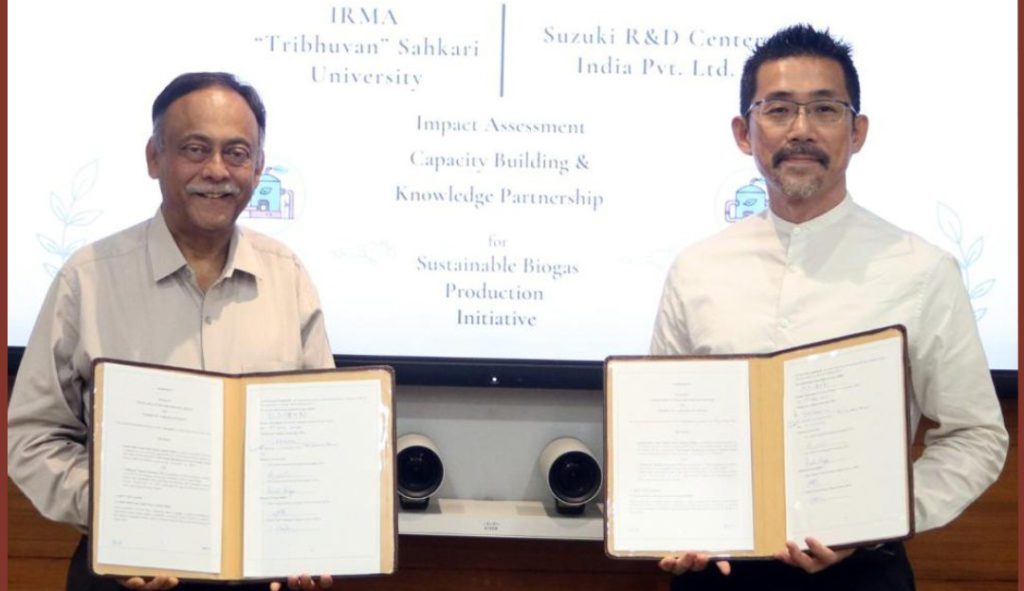
In a major boost to India’s cooperative-led green energy mission, the Institute of Rural Management Anand (IRMA), Tribhuvan Sahkari University (TSU), and Suzuki R&D Center India Private Limited have signed a Strategic Project Agreement to strengthen sustainable energy initiatives and rural empowerment in Gujarat.
The partnership is aimed at supporting the social and community impact of upcoming biogas plants being developed with the support of the National Dairy Development Board (NDDB), the United Nations Industrial Development Organization (UNIDO), and dairy cooperatives across the state.
The initiative is expected to strengthen Gujarat’s emerging circular economy ecosystem while creating new livelihood opportunities in rural areas.
Under the collaboration, IRMA and TSU will act as knowledge partners and undertake Social Impact Assessment, Monitoring and Evaluation, and gender mainstreaming activities linked to the biogas projects.
The institutions will help ensure that the benefits of the clean energy transition directly reach village communities, dairy farmers, and women associated with cooperative networks.
The agreement aligns with India’s Viksit Bharat 2047 vision and complements Maruti Suzuki India Limited’s long-term carbon neutrality goals. Suzuki has been steadily expanding its biogas initiatives in Gujarat in partnership with dairy cooperatives, recognising the state’s strong milk cooperative network and abundant cattle-based resources.
The company has already collaborated with organisations such as Banas Dairy and NDDB to establish compressed biogas plants that convert cattle dung and agricultural waste into clean fuel for CNG vehicles.
The initiative is expected to contribute significantly to reducing carbon emissions while promoting scientific waste management and renewable energy generation in rural areas. Apart from producing green fuel, the projects are also likely to generate organic manure and create supplementary income streams for farmers and dairy members.
The agreement was guided by key leaders from academia and industry and is being seen as another milestone in cooperative-driven climate resilience and inclusive rural development.
Experts believe the partnership could emerge as a scalable national model where cooperatives, educational institutions, and industry work together to accelerate sustainable development while ensuring community participation at the grassroots level.