





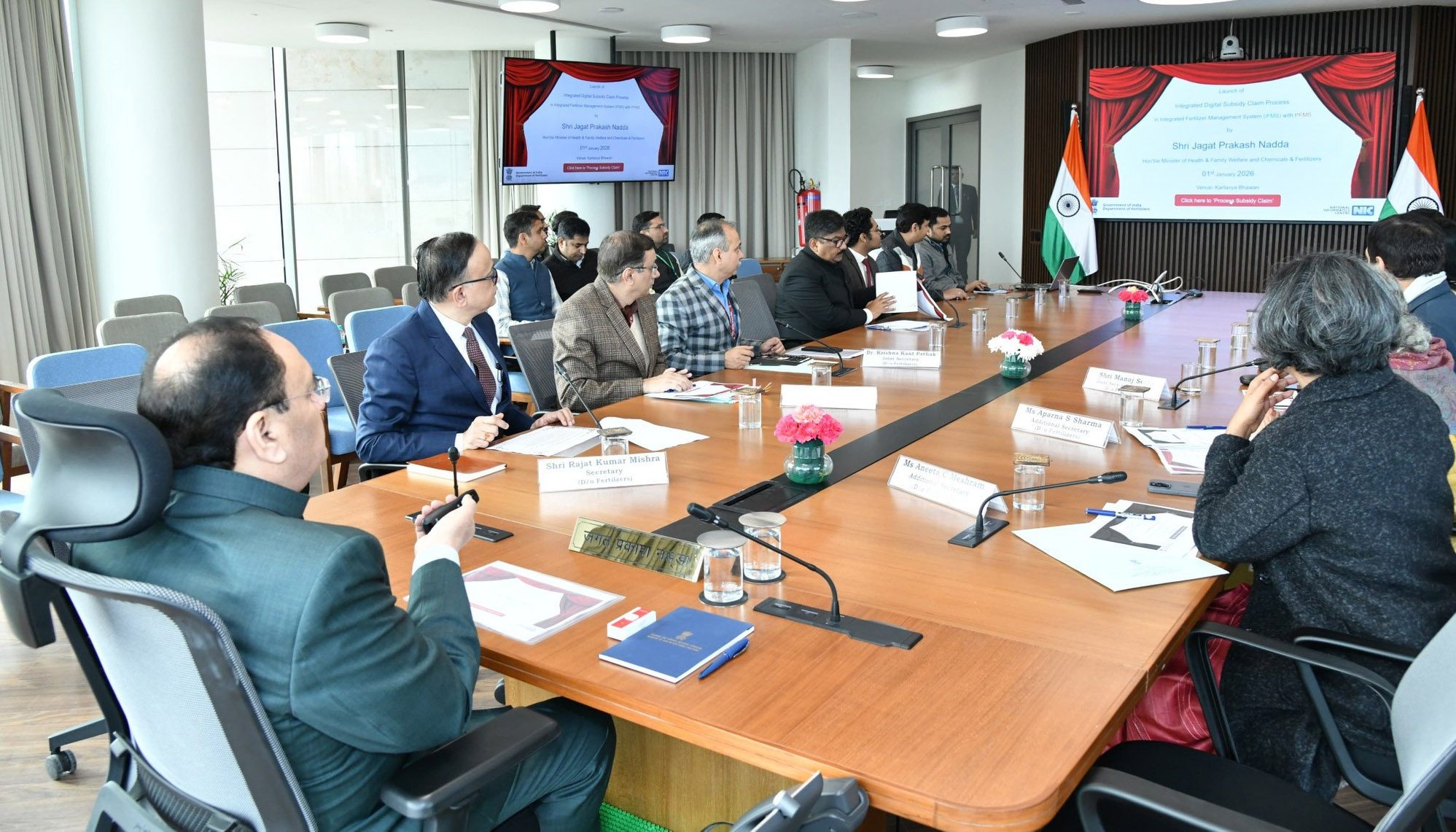
In line with Prime Minister Narendra Modi’s vision of Digital India and the national goal of achieving Viksit Bharat by 2047, the Department of Fertilizers has taken a major step towards strengthening digital governance and financial reforms with the launch of an integrated e-Bill System.
The new platform, inaugurated by Union Minister for Health and Family Welfare and Chemicals and Fertilizers Jagat Prakash Nadda at Kartavya Bhawan in New Delhi, will enable the government to digitally process fertilizer subsidy payments amounting to nearly Rs 2 lakh crore annually.
The e-Bill System marks a decisive transition from manual, paper-based procedures to a fully digital, system-to-system workflow, eliminating the physical movement of subsidy bills. This reform is expected to significantly improve transparency, efficiency and accountability in fertilizer subsidy management, an area vital to India’s agricultural ecosystem and to major cooperative fertilizer institutions such as IFFCO and KRIBHCO, which play a central role in production, distribution and farmer outreach across the country.
Speaking at the launch, Nadda said the new online platform would strengthen technology-driven governance and ensure smoother and faster delivery of large public expenditures. He noted that digital reforms in subsidy administration are essential for improving trust, reducing delays and ensuring that benefits reach the intended stakeholders in a timely manner.
Secretary, Department of Fertilizers Rajat Kumar Mishra described the launch as a milestone in modernising the department’s financial operations. He said the system represents a paradigm shift in subsidy administration and is the outcome of a unique technological integration between the Department of Fertilizers’ Integrated Financial Management System and the Public Financial Management System of the Controller General of Accounts under the Ministry of Finance.
For fertilizer companies, including large cooperative producers and marketers such as IFFCO and KRIBHCO, the new system brings practical operational advantages. Subsidy claims can now be submitted online, tracked in real time and processed more quickly, helping ease working capital pressures and enabling smoother supply of fertilizers to farmers. The platform is designed to support timely weekly release of subsidy payments, improving predictability and financial planning for fertilizer companies.
Controller of Communication Accounts Santosh Kumar said the system enhances transparency and accountability by creating a centralized and tamper-proof digital audit trail for all transactions. Senior officials will have real-time visibility of expenditures, enabling improved monitoring, audits and financial control.
Joint Secretary (Finance and Accounts) Manoj Sethi said the e-Bill System enables end-to-end digital bill processing and enforces a standard electronic workflow, including first-in-first-out bill handling, ensuring consistency and compliance with financial rules. The integration also reduces duplication of data entry, minimizes manual errors, and supports informed decision-making through real-time financial information.
The system has been developed and implemented by the National Informatics Centre, whose technical team demonstrated its architecture and functionality during the event. The integrated e-Bill platform is expected to significantly strengthen financial governance, reduce risks of misuse, and reinforce the government’s commitment to transparent, efficient and technology-driven administration, while supporting cooperative institutions like IFFCO and KRIBHCO in delivering timely fertilizer supplies to farmers.