





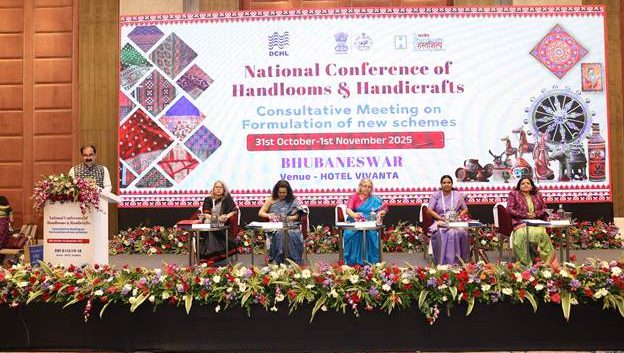
The National Conference on Handlooms and Handicrafts 2025 concluded in Bhubaneswar with a strong call for coordinated and collective action to revitalise India’s handmade economy as a vital pillar of Viksit Bharat 2047. Organised by the Offices of the Development Commissioners for Handlooms and Handicrafts under the Ministry of Textiles, the two-day meet underscored the importance of design innovation, digital empowerment and collaborative governance in strengthening artisan livelihoods.
The emphasis on collaboration naturally resonated with India’s long-standing cooperative tradition in the textile sector. According to reports by the Ministry of Textiles and NABARD, over 60 percent of organised handloom weavers are connected to primary cooperative societies. Odisha, the host state, exemplifies successful cooperative marketing through federations like Boyanika and Utkalika, both of which have given traditional weavers collective market access, brand visibility and income security.
Presiding over the deliberations, Smt. Neelam Shami Rao, Secretary (Textiles), urged institutions such as the National Institute of Fashion Technology (NIFT) and the Indian Institute of Handloom Technology (IIHT) to forecast design and colour trends that can help artisan clusters and producer groups stay ahead of market cycles. She called for smoother inter-State movement of raw materials and announced that such conferences would be held every six months to ensure continued Central-State coordination and review of sectoral initiatives.
Smt. Anu Garg, Additional Chief Secretary and Development Commissioner of Odisha, highlighted the ecological and cultural value of local textiles such as Kotpad and Dongria shawls and announced plans for a Sustainability Cell to promote eco-textiles like Katha Silk. Odisha’s craft institutions, including Boyanika and Utkalika, were cited as models of how collective enterprise can bridge heritage and modern markets.
Presenting the blueprint for the National Traditional Textile Mission (2026–31), Dr. M. Beena, Development Commissioner (Handlooms), said the new initiative would build cluster infrastructure, promote skill and design upgradation, encourage women-led development, and ensure universal financial and innovation support for artisan networks. Its cooperative-federal approach draws on State-level examples where artisans, designers and marketing bodies work together for sustainable growth.
Ms. Amrit Raj, Development Commissioner (Handicrafts), outlined governance reforms under a proposed three-tier National-State-District framework designed to empower local artisan collectives through digital governance and transparent monitoring.
Delegates also visited Kala Bhoomi, Boyanika and Utkalika, witnessing how community-based systems preserve craft heritage while generating livelihoods. The two-day deliberations reaffirmed that India’s handmade sector can flourish only through collaboration, weaving together artisans, institutions and markets in a network of shared strength. The conference closed with a clear message: the cooperative spirit, economic, institutional and creative, remains central to a resilient handmade economy and to the nation’s vision of Viksit Bharat 2047.