






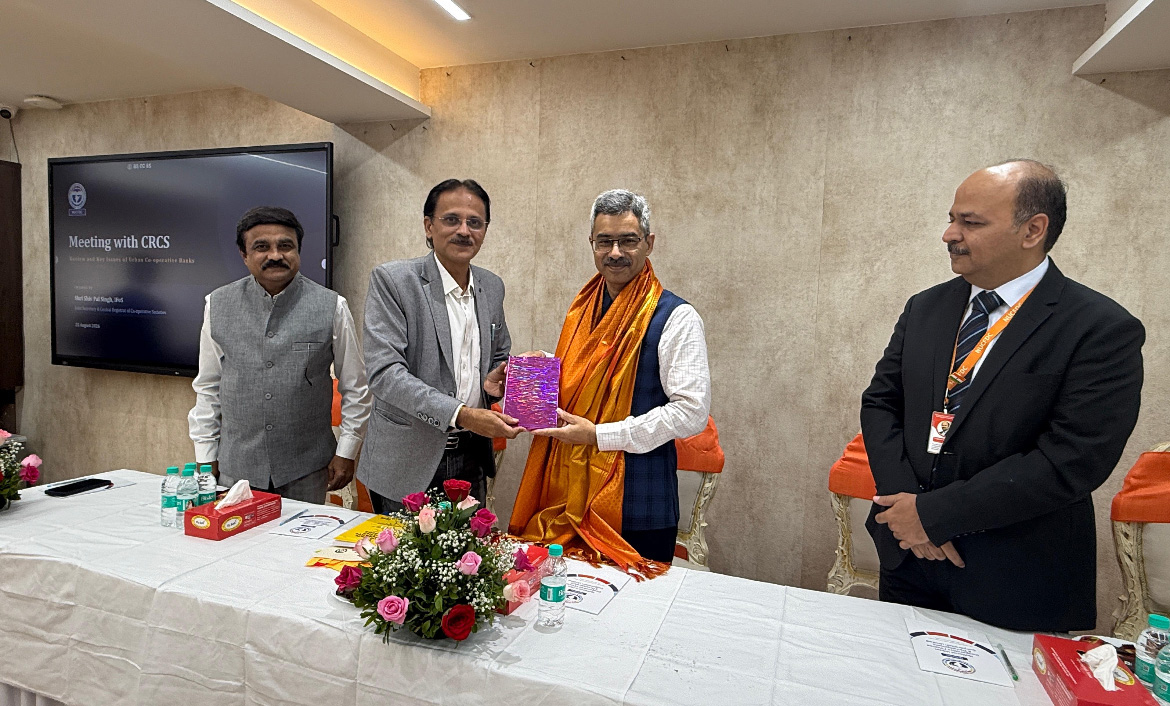
The Central Registrar of Cooperative Societies (CRCS), Shiv Pal Singh, on Tuesday held a meeting with senior leaders of Maharashtra-based Multi-State Cooperative Banks at the newly inaugurated office of the National Urban Cooperative Finance and Development Corporation (NUCFDC) in Mumbai.
The two-and-a-half-hour meeting focused on challenges faced by Multi-State Cooperative Banks and suggestions for improving provisions under the Multi-State Cooperative Societies Act.
Representatives of around 15 cooperative banks participated, including Saraswat Cooperative Bank, Cosmos Cooperative Bank, SVC Cooperative Bank, DNS Bank, Kalyan Janata Sahakari Bank, Janata Sahakari Bank, Pune, Solapur Janata Sahakari Bank, CitizenCredit Co-operative Bank and others.
A key issue raised was Priority Sector Lending (PSL). Participants said urban-centric cooperative banks face difficulties in achieving PSL targets due to limited opportunities in agricultural and export credit. Concerns were also raised over the purchase of Priority Sector Lending Certificates (PSLCs) and the need to revisit the definition of weaker sections.
The arbitration and recovery process also figured prominently. Bank representatives sought faster resolution of NPA and stressed asset cases and suggested increasing the number of arbitrators. The CRCS observed that appointing a bank official as an arbitrator could raise issues of conflict of interest.
The acceptance of bank guarantees issued by cooperative banks, delays in receiving CIBIL reports and the possibility of increasing the DICGC deposit insurance cover beyond Rs 5 lakh were also discussed.
Participants further raised the issue of delays in the registration of partnership firms in Maharashtra, which affects lending to small businesses. Concerns over certain credit cooperative societies allegedly charging high interest rates were also brought to the CRCS’s notice.
Digitisation of CRCS processes was another major suggestion. Representatives sought completely online applications and approvals for changes in area of operation, expansion to other states and other regulatory permissions.
Employee membership in cooperative banks, employee representation on boards, redemption of shares and the treatment of non-banking assets were also discussed.
The CRCS also discussed model bye-laws, with participants referring to the recent work of the RBI-constituted committee on the subject. The possibility of holding AGMs through video conferencing or in hybrid mode also came up for discussion.
The meeting provided a platform for direct interaction between the CRCS and Multi-State Cooperative Bank leadership. The CRCS assured participants that issues requiring intervention would be taken up with the RBI, Ministry of Cooperation and other concerned authorities.