






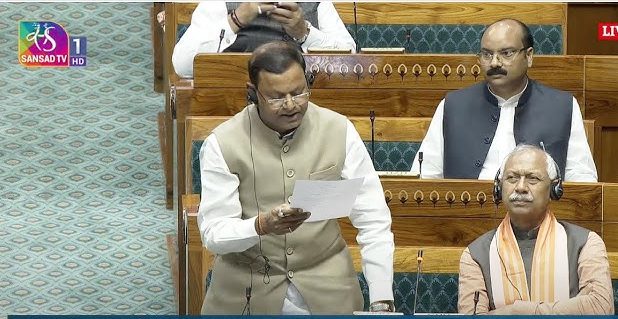
In the Lok Sabha on Monday, Union Minister of State for Finance Pankaj Chaudhary informed that 105 Urban Cooperative Banks (UCBs) reported cumulative losses of Rs 885.14 crore in the financial year 2024–25, with their operating expenses exceeding Rs 1,714.27 crore.
However, a year-on-year comparison reveals that losses among UCBs have declined significantly, from Rs 1,468.10 crore in FY 2022–23 to Rs 1,236.37 crore in FY 2023–24, and further to Rs 885.14 crore in FY 2024–25.
Notably, the data for State Cooperative Banks (StCBs) and District Central Cooperative Banks (DCCBs) for FY 2024–25 is not available.
In FY 2023–24, 104 UCBs, 39 DCCBs, and 2 StCBs reported losses. DCCBs incurred the highest losses at Rs 1,403.46 crore, followed by UCBs with Rs 1,236.37 crore and StCBs with Rs 35.46 crore.
Similarly, in FY 2022–23, 134 UCBs, 46 DCCBs, and 2 StCBs were in losses. UCBs topped the list with Rs 1,468.10 crore in losses, followed by DCCBs with Rs 997.91 crore and StCBs with Rs 59.83 crore.
The previous year, FY 2021–22, witnessed even greater distress in the cooperative banking sector, with 198 UCBs, 49 DCCBs, and 3 StCBs recording total losses of Rs 1,194.19 crore, Rs 996.17 crore, and Rs 50.25 crore, respectively.
To address the financial challenges faced by UCBs, Chaudhary informed the House that the Reserve Bank of India (RBI) has undertaken several reform measures.
These include an increase in housing loan limits for individuals, expanded lending scope in non-priority sectors (up to 40%), and relaxation in prudential norms, such as redefining small-value loans up to Rs 25 lakh or 0.4% of Tier I capital, capped at Rs 3 crore per borrower.
In addition, NABARD is implementing a Turn Around Plan (TAP) aimed at improving the financial health of StCBs and DCCBs.
The plan encompasses strategic interventions like financial parameter monitoring, governance reforms, business diversification, technology adoption, cost rationalization, and efforts to boost financial inclusion.
These steps, the government believes, will pave the way for a more resilient and accountable cooperative banking structure in the coming years.














































Very informative news and updates