





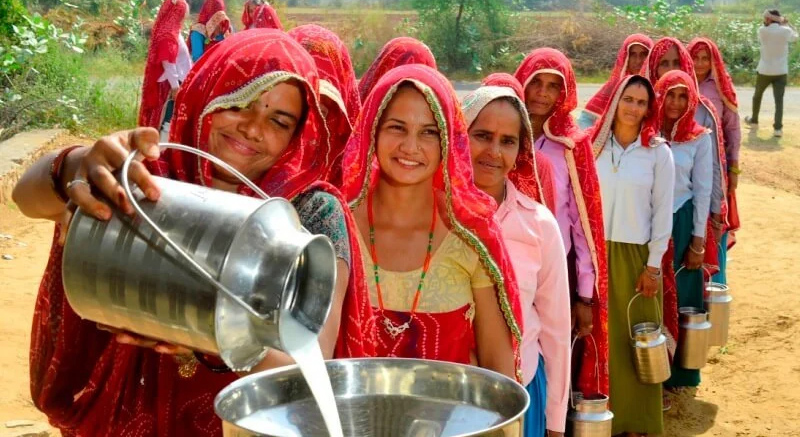
India’s efforts to strengthen dairy cooperatives are gaining momentum with the Cooperative Milk Producers’ Organization Multi-State Limited, a national-level multi-state cooperative society anchored through the National Dairy Development Board (NDDB), Anand, Gujarat.
The initiative aims to integrate existing milk pooling points across nine states, Andhra Pradesh, Bihar, Gujarat, Maharashtra, Madhya Pradesh, Punjab, Rajasthan, Uttar Pradesh and West Bengal, through a network of around 20,000 Multipurpose Village Cooperative Societies (VCS).
The initiative is designed to bring small-scale dairy producers into a stronger cooperative network, providing them with direct market access and fairer payment terms. By integrating village-level milk collection infrastructure, the cooperative seeks to improve farmers’ access to markets, strengthen collective bargaining and ensure that dairy producers receive a better share of the value generated by their milk.
The initiative reflects the broader vision of the Ministry of Cooperation to expand the reach of cooperatives and make them effective instruments of rural prosperity. Dairy cooperatives, in particular, have the potential to transform rural livelihoods by connecting individual producers with organised procurement, processing and marketing systems.
Union Home and Cooperation Minister Amit Shah has repeatedly highlighted the benefits that dairy farmers can derive from joining the cooperative system. In a recent message, he said the biggest beneficiaries of the Ministry of Cooperation’s initiatives would be dairy farmers, who often struggle to obtain remunerative prices in the open market because of intermediaries.
Shah pointed out that farmers selling milk in the open market might receive around ?35 per litre, whereas joining the cooperative system could enable them to receive as much as ?55 per litre. The comparison underlines the potential gains from reducing dependence on middlemen and strengthening farmers’ direct links with organised cooperative marketing networks.
However, actual returns depend on factors such as milk quality, fat and solids-not-fat content, procurement costs, local market conditions and the cooperative’s payment structure.
The proposed network of around 20,000 village societies across nine states could help expand the institutional reach of dairy cooperatives, particularly among small producers who may lack access to organised markets. Pooling milk through village-level institutions can also help create economies of scale, improve operational efficiency and facilitate stronger links with dairy processing and distribution networks.
With NDDB providing the institutional anchor, the initiative seeks to build on India’s cooperative dairy experience, in which collective procurement and marketing have played a significant role in connecting rural producers with consumers.
The effort also aligns with the government’s broader Sahkar Se Samriddhi vision, which seeks to strengthen existing cooperatives, expand their economic activities and establish cooperative institutions as engines of inclusive growth.
By bringing village-level milk collection points under a coordinated national framework, the initiative aims to make dairy cooperatives more accessible and commercially effective. Its ultimate success will depend on efficient implementation, transparent payments, professional management and the ability to ensure that the benefits reach milk producers at the grassroots.
For small dairy farmers, a stronger cooperative network could mean more reliable market access, greater bargaining power and improved prospects for sustainable rural incomes.