
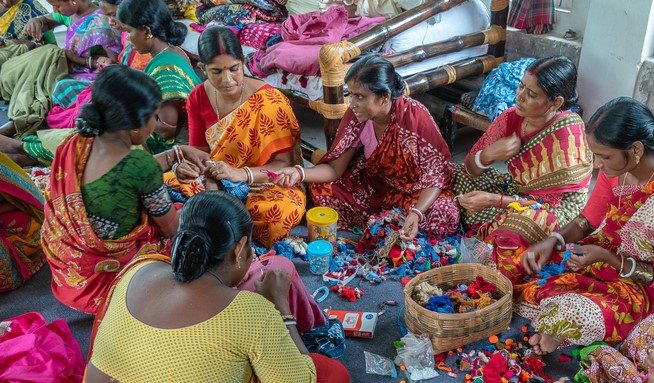
Women’s cooperative institutions are being positioned as a central driver of inclusive growth and social equity under the National Cooperation Policy 2025, with a renewed focus on strengthening their legal, financial and institutional capacities.
The policy underscores women’s participation as a priority, envisaging cooperatives as platforms for economic empowerment through supportive regulations, digitalisation, improved access to finance and expansion into diverse sectors. It identifies women-focused cooperatives in areas such as dairy, handicrafts, food processing, textiles and community services as key instruments for livelihood generation and local economic development.
In line with this vision, the Ministry of Cooperation, working in coordination with agencies including NABARD, the National Cooperative Development Corporation (NCDC), the National Council for Cooperative Training (NCCT) and the Ministry of Rural Development, has rolled out a series of initiatives aimed at deepening women’s participation in the cooperative movement.
While Self Help Groups under the Deendayal Antyodaya Yojana–National Rural Livelihood Mission function as informal collectives, their Cluster Level Federations are being formalised under cooperative laws. So far, 10,381 such federations have been registered under State Cooperative Acts, the Multi-State Cooperative Societies Act or the Mutually Aided Cooperative Act, giving women-led collectives a stronger institutional footing.
Financial support has emerged as a major enabler. NCDC has been promoting and financing women cooperatives across production, processing, marketing, storage, supply chains and services ranging from agriculture and livestock to tourism, renewable energy, healthcare and education.
Over the past three years, financial assistance of Rs 1,000 crore in 2022–23, Rs 756.11 crore in 2023–24 and Rs 1,754.60 crore in 2024–25 has been released to women cooperatives, benefiting more than 6.7 lakh women members.
Alongside credit and institutional support, emphasis is being laid on financial literacy and capacity building. Under the National Livelihood Mission, trained Financial Literacy Community Resource Persons drawn from women SHGs are spearheading grassroots awareness programmes.
As of now, 56,727 women SHG members have been trained and deployed as FL-CRPs, conducting regular sessions on savings, credit, digital transactions, insurance and pension products. During FY 2025–26 up to December, nearly 2.94 crore SHG members have received training on various aspects of financial inclusion through this mechanism.
Capacity building efforts have also been scaled up through NCCT, which has trained over 3.12 lakh women participants since 2021 through long- and short-term programmes focused on leadership, governance, financial literacy and managerial skills. Together, these measures are strengthening women’s role not just as members, but as decision-makers in cooperatives.
The information was shared by Union Minister for Home and Cooperation Amit Shah in a written reply in the Rajya Sabha.