





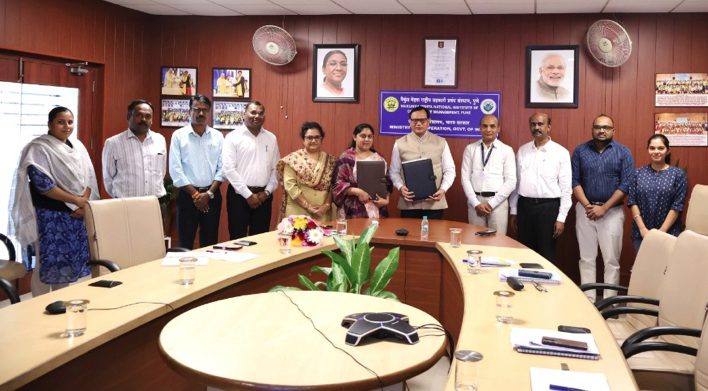
Vaikunth Mehta National Institute of Cooperative Management (VAMNICOM), Pune, has entered into a strategic partnership with the Gujarat State Women’s SEWA Cooperative Federation Pvt. Ltd., Ahmedabad, through a newly signed Memorandum of Understanding (MoU) aimed at strengthening gender-inclusive and women-led cooperative development across the country.
The MoU, formalised by VAMNICOM Director Dr. Suva Kanta Mohanty and SEWA Federation representative Ms. Jigisha Maheta, marks a significant step toward building sustainable livelihood systems for informal women workers through structured collaboration between a premier academic institution and a grassroots cooperative federation.
At the core of this partnership is the shared objective of enhancing the capabilities of women-owned and worker-led cooperatives, many of which operate in the informal sector where income security, institutional support, and access to professional training remain limited.
SEWA Cooperative Federation, with over four decades of experience in organising, mentoring, and incubating more than 112 women-led cooperatives, brings deep knowledge of ground realities, sector-specific challenges, and successful community-based strategies. Its model of collective strength and economic independence has been instrumental in transforming the lives of thousands of informal women workers across Gujarat and beyond.
VAMNICOM, as India’s apex cooperative management institute, complements this experience by offering academic depth, research strength, and domain expertise in cooperative governance, policy, and enterprise management. The collaboration allows VAMNICOM to embed gender-responsive and field-based learning within its curriculum, while SEWA Federation gains access to advanced management tools, professional training frameworks, and research insights needed to expand and strengthen women-led cooperative enterprises.
The MoU outlines a wide spectrum of collaborative activities. These include the design and delivery of joint training programmes focusing on cooperative governance, financial literacy, enterprise development, digital transformation, and leadership building—especially tailored to the needs of informal sector women.
Another important component is action-oriented research that documents successful cooperative models, identifies emerging challenges, and develops policy briefs capable of influencing cooperative policies at state and national levels.
Students of VAMNICOM will benefit from expanded internship and field exposure opportunities within SEWA-led cooperatives, enabling them to learn directly from grassroots cooperative enterprises. This exposure is expected to enhance their understanding of gendered work realities and strengthen their ability to contribute to inclusive cooperative development in their future roles.
The partnership also envisions the preparation of case studies, consultancy support to women-led cooperatives, and wider knowledge-sharing initiatives aimed at promoting sustainable cooperative models. Both institutions see this collaboration as aligned with India’s national priorities of modernising cooperatives, strengthening institutional resilience, and ensuring greater participation of women in the cooperative movement.
By combining VAMNICOM’s academic leadership with SEWA Federation’s on-ground experience, the MoU sets the stage for a long-term collaboration that aspires to deepen democratic participation, nurture women’s leadership, and promote economically viable cooperative enterprises owned and governed by informal women workers.