





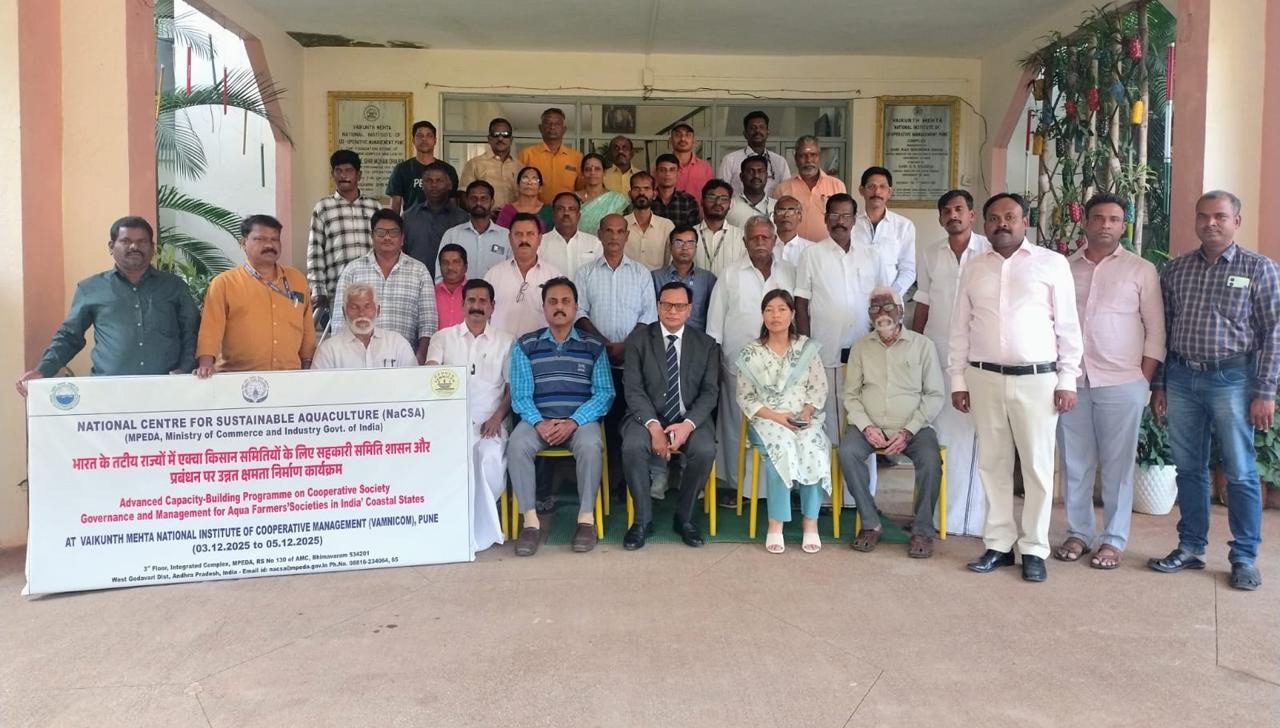
The Vaikunth Mehta National Institute of Cooperative Management (VAMNICOM) successfully concluded a three-day Advanced Capacity-Building Programme on Cooperative Society Governance and Management, aimed at strengthening newly registered aqua farmer cooperative societies across India’s coastal belt.
The programme took place at VAMNICOM, Pune, from 3 to 5 December 2025 and trained 36 officers and cooperative farmers representing 10 aquaculture cooperatives from Tamil Nadu, Andhra Pradesh, Kerala and West Bengal. It focused on enabling emerging cooperatives to adopt strong governance practices, improve financial management skills and align themselves with the growing national thrust on aquaculture-led economic development.
The delegation was led by Daiahun Khonglam, Chief Executive Officer of the National Centre for Sustainable Aquaculture (NaCSA) under MPEDA, Ministry of Commerce & Industry. Participants attended classroom sessions, interactive workshops and peer discussions that introduced them to management tools and modern frameworks needed for cooperative functioning at the grassroots.
The curriculum centered around three themes—cooperative governance and sustainable aquaculture, financial literacy and business management with a focus on digital empowerment, and market linkage development supported by climate resilience and leadership-building modules.
A key feature of the programme was an exposure visit to the ICAR–Central Institute of Fisheries Education (CIFE), Mumbai, on 4 December. Guided by Senior Scientist Dr. Ankush Kamble, the participants interacted with members of the Versova and Vesava Fisheries Cooperative Societies to understand field operations, member engagement systems, market strategies and value-chain processes adopted by successful fisheries groups.
 The group toured the Fish Museum, Aquaculture Complex and Agri-Business Incubation Unit, followed by a technical lecture on “Cooperatives in Fisheries: Opportunities, Challenges and Governance Mechanisms”. The visit allowed trainees to observe firsthand how organised cooperatives improve earnings, scale production, promote technology adoption and nurture entrepreneurship among fisher communities.
During the training, participants were also briefed on cooperative bylaws and ongoing efforts of the Ministry of Cooperation to enhance transparency, efficiency and accountability across cooperative institutions in the country. Trainers emphasised digital record-keeping, collective marketing, sustainable resource management and methods for increasing member participation.
Sessions also highlighted the potential of the aquaculture sector in the context of India’s Blue Economy ambitions, underlining how well-governed cooperatives can help boost marine exports, create jobs and ensure equitable income distribution in coastal villages.
The programme was organised under the guidance of Director Dr. Suva Kanta Mohanty, with registrar D. S. Dharmaraj facilitating planning and coordination. Assistant Professor and Programme Director Dr. Amit Borkar steered the course design and implementation, acknowledging the efforts of VAMNICOM faculty for their technical support and academic contributions throughout the event.
VAMNICOM stated that the initiative represents a critical step in equipping cooperatives with applied knowledge and operational competencies, enabling them to function as strong community institutions rather than merely producer groups.
The institute expressed confidence that trained aqua cooperative leaders would return to their states better prepared to strengthen governance norms, tap new markets, build climate-resilient business practices and improve member livelihoods through collective enterprise.