






The Souharda Cooperative Movement in Karnataka is emerging as a potential case study for the newly established Tribhuvan Sahakari University (TSU), with its Vice-Chancellor Sanjay Pratap Singh visiting the Karnataka State Souharda Federal Cooperative Ltd. (KSSFCL) in Bengaluru to study its functioning and institutional model.
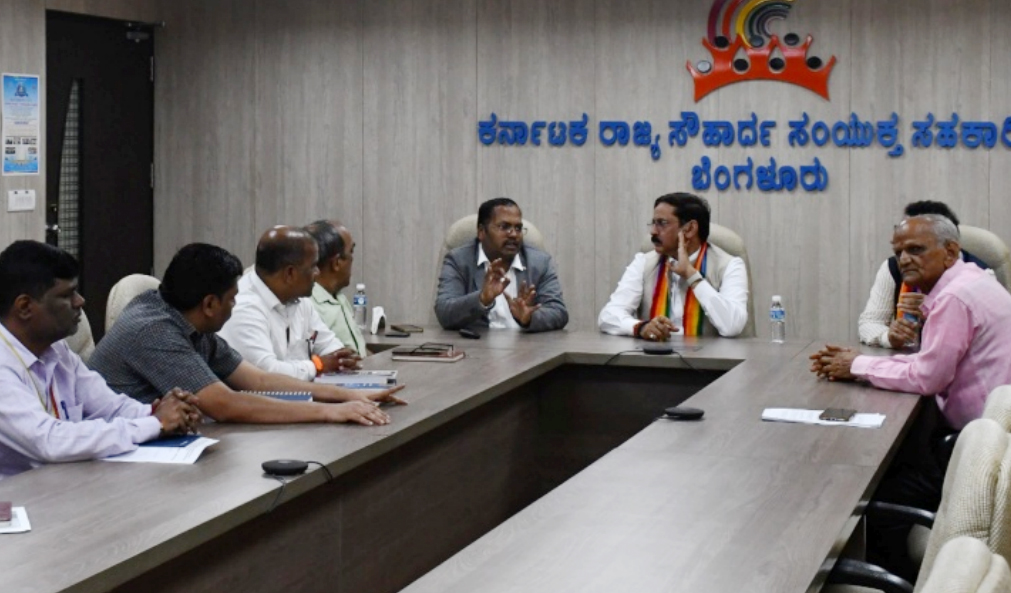
Singh, accompanied by TSU Co-Chair Rajesh Jain, visited KSSFCL on October 3, 2026, for an in-depth understanding of the evolution, structure and working of the Souharda cooperative system. The delegation was received by KSSFCL Managing Director Sharanagouda G. Patil, Deputy General Manager Narayana Hegde, AGM Shridhar and other officials.
Describing the Souharda system as a “unique” cooperative movement, Singh said he was happy to study a model based on autonomy, self-administration and self-control. He observed that Souharda cooperatives represent a model under a liberal legislative framework that could potentially be considered by other states.
The visit assumes significance as TSU seeks to develop itself as a specialised centre for cooperative education, training, research and capacity building. Karnataka’s Souharda experience, with its emphasis on cooperative autonomy and member-driven administration, offers an institutional model for academic study as well as practical learning.
During the interaction, KSSFCL officials made a detailed presentation on the evolution and objectives of the Souharda Cooperative Movement and its institutional framework. The delegation was also briefed on KSSFCL’s role as the federal institution supporting Souharda cooperatives across Karnataka.
The presentation covered cooperative education and training, capacity building, institutional development, member-oriented services, research and development and other initiatives aimed at strengthening the cooperative sector.
KSSFCL’s role extends beyond federation and representation, with the institution providing guidance, training, support services and institutional assistance to Souharda cooperatives. The visit therefore provided TSU officials an opportunity to understand how a state-level cooperative federation can contribute to strengthening primary cooperatives while supporting their autonomy.
The presence of both TSU Vice-Chancellor Singh and Co-Chair Jain also highlighted the importance being attached to direct interaction with established cooperative institutions as the university develops its academic and training framework.
For TSU, the Karnataka experience could prove particularly relevant in developing curriculum and research around cooperative governance, self-regulation, member participation and institutional sustainability. The Souharda model’s experience of operating with greater autonomy may offer lessons for discussions on cooperative reforms and strengthening member-owned institutions.
The interaction concluded with knowledge sharing between the two institutions, with KSSFCL expressing appreciation to Singh and Jain for their visit and engagement with the Karnataka Souharda movement.