




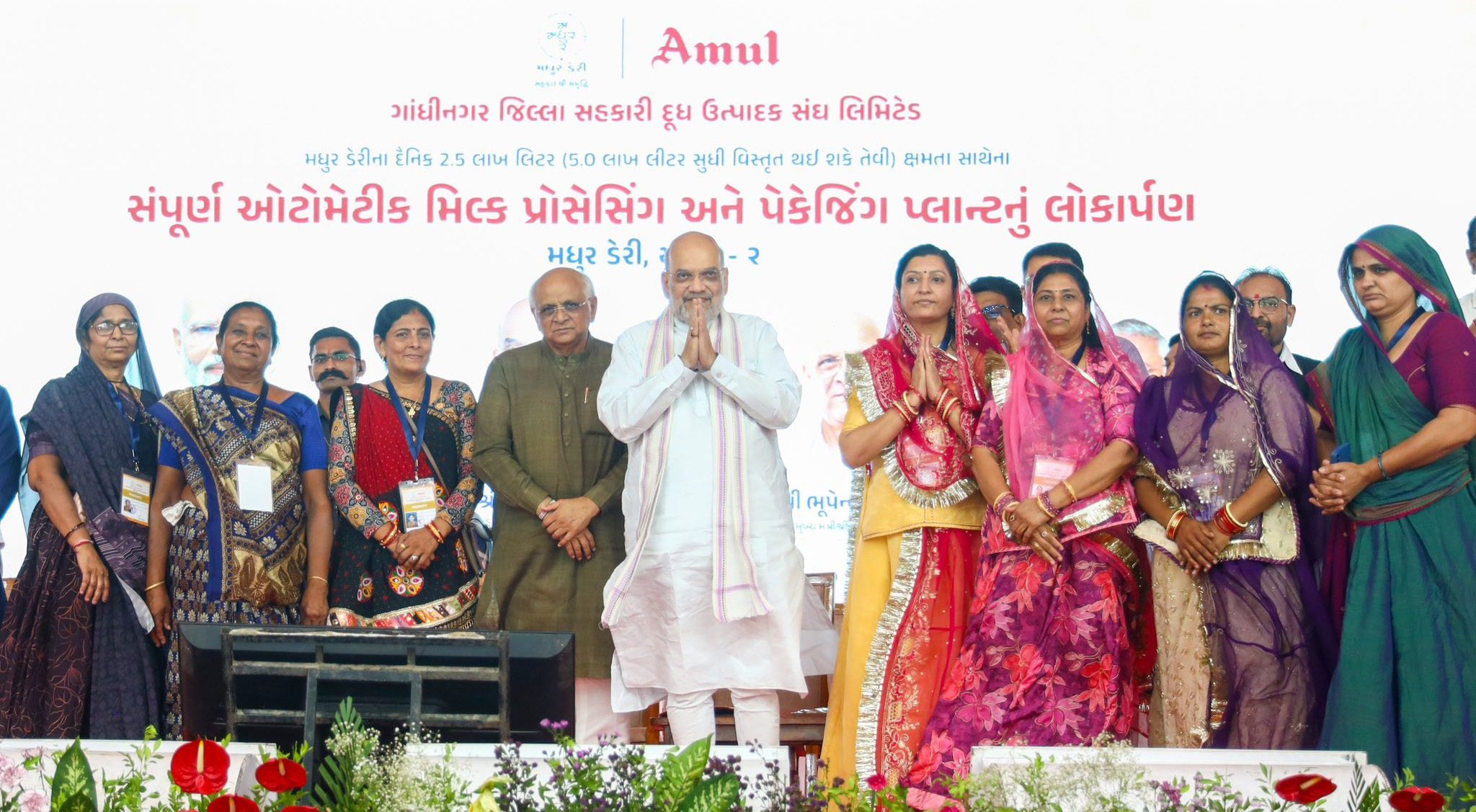
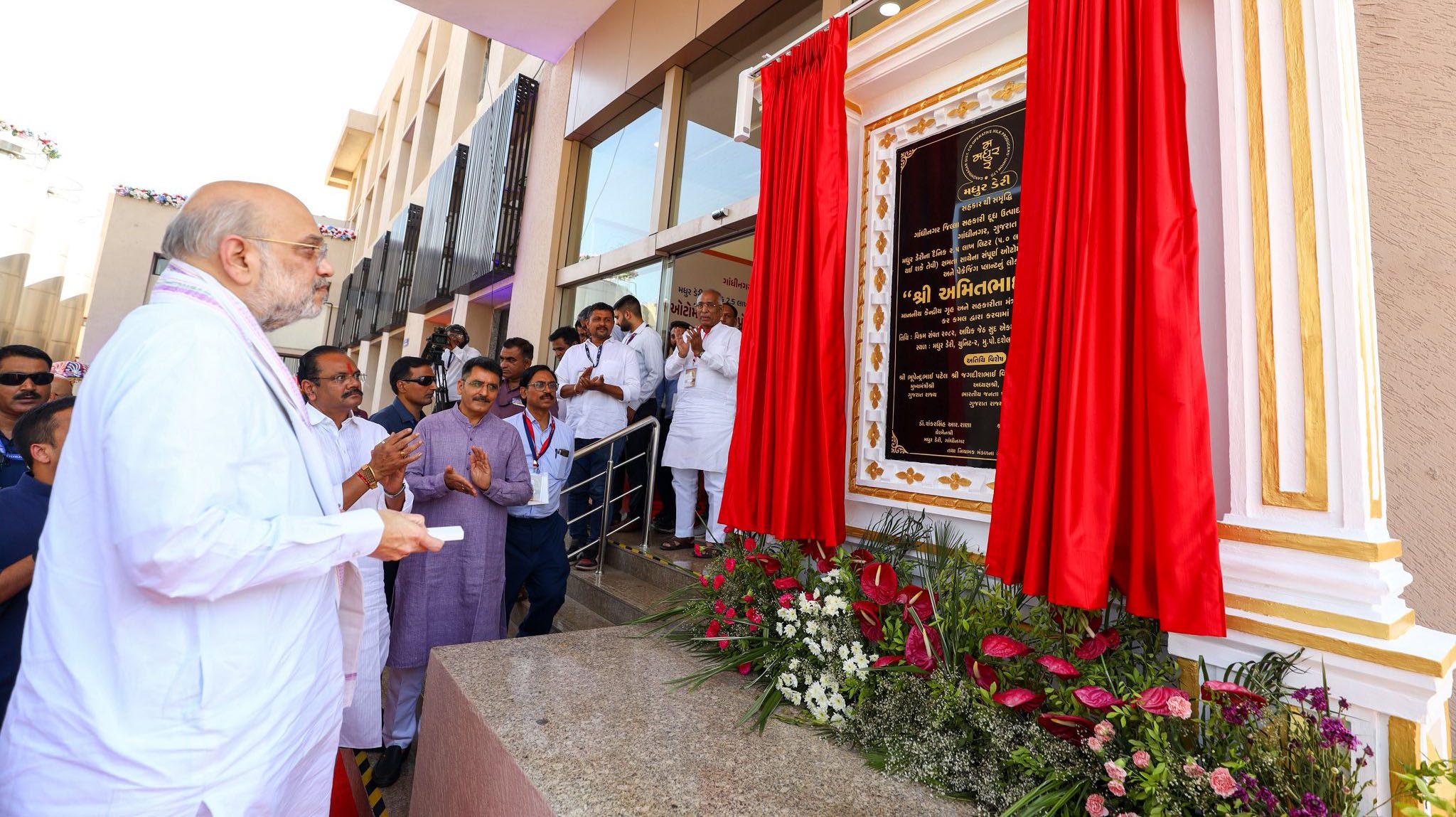
Union Home and Cooperation Minister Amit Shah inaugurated the state-of-the-art automated milk processing and packaging plant of Madhur Dairy Unit-2 at Dashela in Gandhinagar, Gujarat, describing it as a major milestone in strengthening the vision of “Sahkar Se Samriddhi.”
Built at a cost of around Rs 128 crore across 15 acres, the modern dairy facility is expected to significantly strengthen Gujarat’s cooperative dairy ecosystem while creating better livelihood opportunities for rural milk producers, especially women.
The newly inaugurated plant currently has the capacity to process 2.5 lakh litres of milk per day, which will eventually be expanded to 5 lakh litres daily. Addressing the gathering, Shah said the expansion would directly benefit lakhs of dairy farmers by ensuring a larger share of profits reaches milk producers through cooperative channels.
He emphasized that the project is not merely an industrial investment but a transformative initiative aimed at empowering rural families and strengthening the grassroots economy.
Highlighting the success story of Madhur Dairy, Shah said the institution has evolved remarkably since its establishment in 1971. Beginning with milk collection of only 6,000 litres and a turnover of merely Rs 7,000, the dairy has now grown into a major cooperative institution with an annual turnover of Rs 628 crore.
He termed Madhur Dairy a “living example” of the success of India’s cooperative model and credited the foundations laid by cooperative pioneers such as Sardar Vallabhbhai Patel, Tribhuvandas Patel and Verghese Kurien.
Shah also linked the inauguration to the larger national vision of “White Revolution 2.0” being pursued under the leadership of Prime Minister Narendra Modi. He said the initiative aims to triple India’s milk production over the next decade through modern technology, innovation and cooperative-led expansion.
 According to him, Gujarat’s leading cooperative dairies, including Amul, Banas Dairy and Mehsana Dairy, are increasingly adopting world-class technologies and value-added production models to raise farmers’ incomes.
The minister noted that cooperatives are now moving beyond traditional milk products into segments such as protein shakes, probiotic curd and high-protein beverages. The real strength of the cooperative structure, he said, lies in ensuring that the economic gains from these products are transferred directly to livestock rearers and dairy farmers.
A significant part of Shah’s address focused on women’s empowerment through the dairy cooperative movement. He revealed that nearly 36 lakh women in Gujarat are collectively trading around 3 crore litres of milk every day, generating business worth nearly Rs 200 crore daily. He described this as a large-scale movement of economic self-reliance and social transformation in rural India.
Shah also highlighted the role of technology in modernising the dairy sector. Referring to Amul’s AI-powered digital assistant “Sarlaben,” inaugurated during the AI Summit by Prime Minister Modi, he said the platform would simplify access to technological guidance for rural women and livestock farmers. The initiative aims to make digital tools more accessible at the village level.
The Union Minister further stressed that the adoption of circular economy principles in the dairy sector could increase farmers’ incomes by nearly 20 percent in the coming years. He reiterated the government’s commitment to strengthening India’s cooperative dairy sector through sustainable and technology-driven growth.