





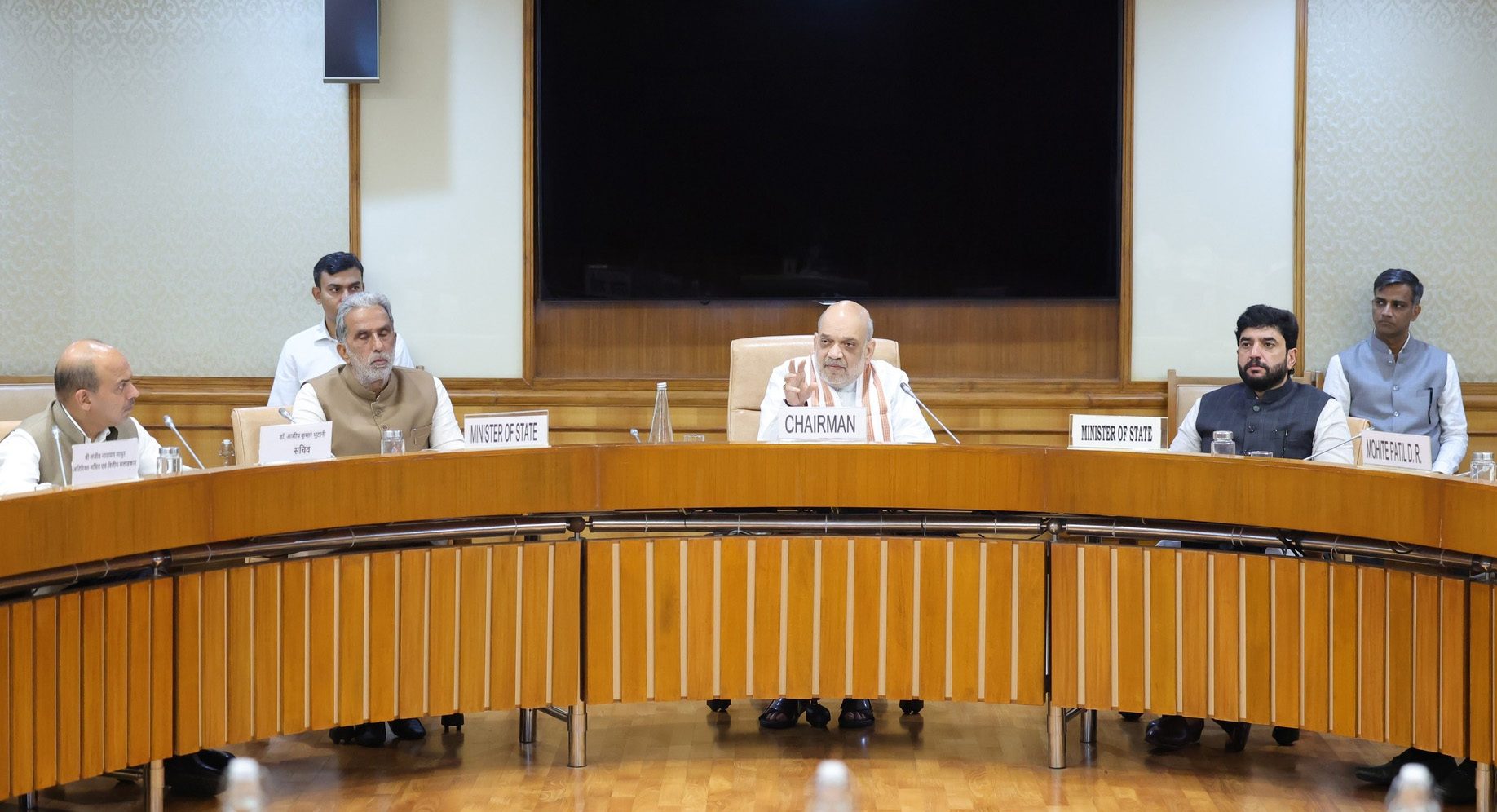
Union Home Minister and Minister of Cooperation Amit Shah chaired the second meeting of the Parliamentary Consultative Committee of the Ministry of Cooperation in New Delhi on Tuesday. The meeting focused on reviewing the ministry’s initiatives over the past four years and charting the path ahead to strengthen India’s cooperative ecosystem. Also present were Union Ministers of State for Cooperation Krishan Pal and Murlidhar Mohol, committee members, senior officials, and the Secretary of the Ministry.
In his address, Shah reaffirmed the Modi government’s commitment to turning cooperatives into vibrant, commercially viable business units. He said the ministry had taken over 100 initiatives in the last four years to support Primary Agricultural Credit Societies (PACS), dairy and fisheries cooperatives, sugar cooperatives, cooperative banks, and overall governance reforms. This, he said, reflects Prime Minister Narendra Modi’s vision of making cooperatives a central pillar of inclusive growth.
Highlighting the Ministry’s flagship initiative to create two lakh multipurpose cooperative societies in five years, Shah informed the committee that 35,395 new cooperatives have already been formed. Of these, 6,182 are multipurpose PACS, 27,562 are dairy societies, and 1,651 operate in the fisheries sector. He stressed that such efforts are laying the foundation for economic empowerment, especially for the landless and the rural poor.
Shah also elaborated on the creation of three new national-level cooperative entities aimed at enhancing farmer incomes and promoting sustainable practices. The National Cooperative Organic Limited (NCOL) is facilitating certification, branding, and marketing of organic produce. The National Cooperative Export Limited (NCEL) is enabling access to international markets so farmers can reap the full benefits of exports. The Bharatiya Beej Sahkari Samiti Limited (BBSSL) focuses on conservation and distribution of India’s traditional seeds. To ensure wider reach and impact, the Centre plans to enter into contracts directly with small farmers for traditional seed production.
The Union Minister urged committee members to actively promote the dairy sector in their respective states to drive the cooperative movement further. Under White Revolution 2.0, the government aims to increase milk procurement through cooperative societies by 50% over the next five years.
So far, 15,691 new dairy cooperatives have been registered and 11,871 existing ones strengthened. In another key development, NDDB and 25 milk unions across 15 states have signed MoUs to set up biogas plants, making dairy cooperatives environmentally sustainable.
He also underlined the importance of the new National Cooperative Policy-2025, which offers a roadmap for sustainable growth of the sector. This includes convergence with schemes like the Pradhan Mantri Matsya Sampada Yojana (PMMSY) and the National Dairy Development Program (NPDD) to bring greater synergy and impact.
During the meeting, the Ministry made a detailed presentation on its institutional framework, which now includes Inter-Ministerial and National Level Coordination Committees, as well as State and District Cooperative Development Committees. These bodies ensure effective monitoring and implementation of various cooperative schemes.
The ministry also shared an update on the establishment of Tribhuvan Sahkari University, now declared an institution of national importance through an Act of Parliament. The university will offer standardized cooperative education and training and produce a skilled workforce to meet the growing needs of the sector.
Members of the Consultative Committee shared their feedback and suggestions to further improve cooperative development. Concluding the session, the Ministry reiterated its commitment to empowering cooperatives as engines of inclusive growth, prosperity, and self-reliance across rural India.