
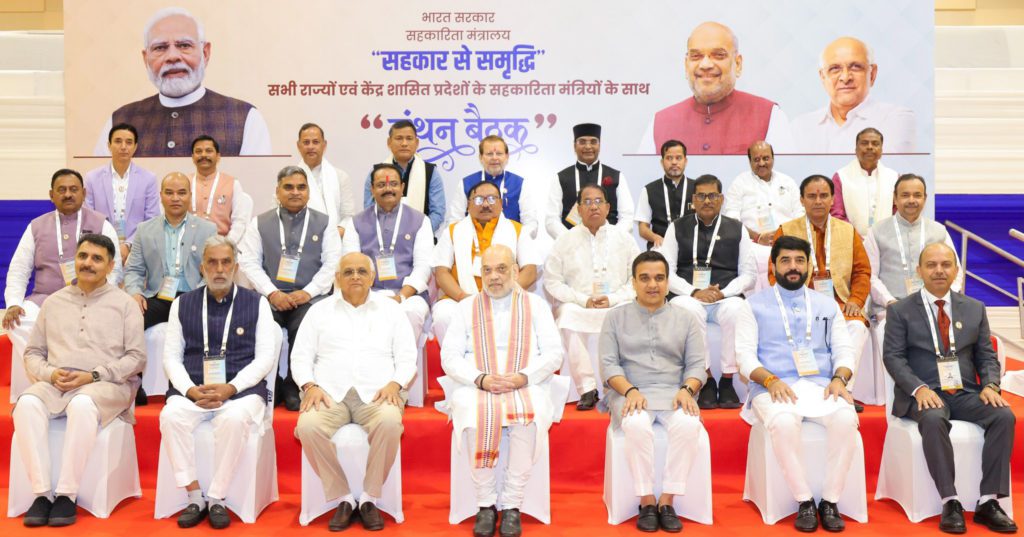
Union Home and Cooperation Minister Amit Shah on Tuesday chaired a high-level Manthan Meeting with Cooperation Ministers of all States and Union Territories in Gujarat’s capital, outlining an ambitious roadmap to position cooperatives at the heart of India’s journey toward becoming a fully developed nation by 2047.
Held under the theme ‘Sahkar se Samriddhi’ at Gandhinagar, the meeting focused on strengthening the cooperative sector through scientific planning, structural reforms and deeper Centre-State coordination. Shah said that under the leadership of Prime Minister Narendra Modi, the government has adopted a systematic and scientific approach to revitalise cooperatives, with positive outcomes now visible across sectors.
In his address, Shah stressed that a fully developed India is not defined merely by economic indicators but by the creation of a system in which 140 crore citizens can live with dignity. He asserted that cooperatives can serve as the most effective vehicle to ensure inclusive and grassroots-driven development.
The Union Minister inaugurated and laid foundation stones for cooperative-linked projects worth Rs 265 crore, spanning ethanol, energy, organic potash, warehouse infrastructure and protein powder plants. He also released the International Year of Cooperatives report and a compendium of best practices, and reviewed an exhibition showcasing cooperative achievements.
A key focus area was food grain storage. Shah underlined that while production has grown substantially, storage capacity must be increased nearly threefold in the coming years. Of this expansion, he said, two-thirds should be led by the cooperative sector.
He called for a coordinated, universally accessible storage system, with participation from Primary Agricultural Credit Societies (PACS), district cooperative banks, marketing federations and dairy cooperatives. Aligning procurement, storage and distribution at the regional level, particularly in grain-surplus states such as Punjab and Haryana, could cut transport costs by 30–40 percent, he noted.
The Minister urged States to revive closed sugar mills and adopt diversified production models. He said financially stressed mills could be transformed into multi-product units, including fertilizer and gas production, with national-level cooperative support. A detailed operational framework, he informed, would be finalised in early March.
Emphasising “Sahkarita mein Sahkar” (Cooperation Amongst Cooperatives), Shah directed that cooperative institutions maintain their accounts with District Cooperative Banks. He said Cooperative Banks could be made nodal agencies for implementing Central schemes and called upon States to route funds such as PM-Kisan and pension payments through these institutions to strengthen the cooperative banking ecosystem.
The meeting also reviewed progress on establishing two lakh new multipurpose PACS, dairy and fisheries cooperatives to accelerate rural growth. Discussions highlighted expanding modern warehouses under the world’s largest grain storage initiative and increasing State participation in national cooperative bodies such as National Cooperative Exports Limited, National Cooperative Organics Limited and Bharatiya Beej Sahkari Samiti Limited.
Shah also encouraged States to learn from successful models such as Banas Dairy and to collaborate with Amul and National Dairy Development Board for expanding dairy networks.
Looking ahead, he announced that Bharat Taxi services would soon expand to every Municipal Corporation city, with over three lakh drivers already enrolled. Cooperatives for retail workers, carpenters, plumbers and electricians are also planned to ensure fair wages and dignity of labour.
The Manthan Meeting concluded with States reaffirming their commitment to legal reforms, digitisation of PACS, strengthening cooperative banks and building a unified, technology-driven cooperative ecosystem to power India’s inclusive growth vision for 2047.