





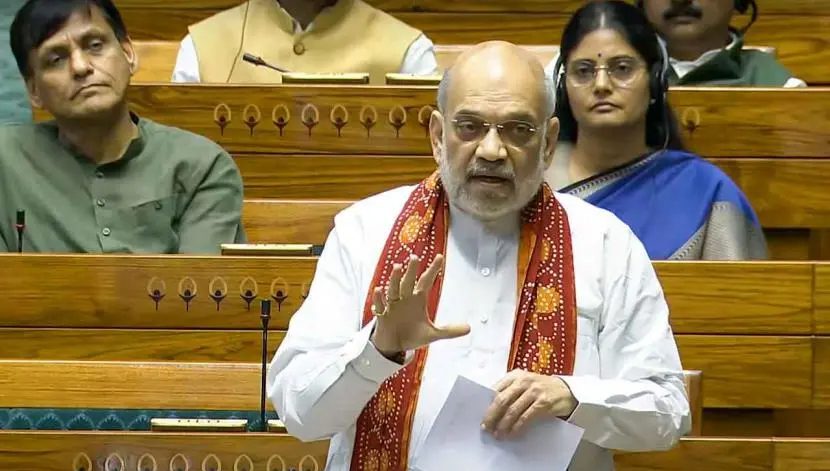
In a significant clarification on transparency in the cooperative sector, Union Home and Cooperation Minister Amit Shah told the Lok Sabha that the Right to Information Act, 2005 applies only to those cooperative institutions that are substantially financed by the government.
Replying to a parliamentary query, Shah explained that milk unions, cooperative banks, APMCs and state federations largely fall under the jurisdiction of state governments, which extend financial assistance through their own schemes. However, central initiatives like the National Programme for Dairy Development (NPDD), SATAT Mission and Pradhan Mantri Matsya Sampada Yojana also support cooperative growth.
Emphasising transparency, the Minister highlighted the Multi-State Cooperative Societies (Amendment) Act, 2023, which introduces key reforms to strengthen governance, improve accountability and streamline elections.
The amendments aim to enhance openness in cooperative functioning, even as RTI coverage remains limited to government-funded entities, striking a balance between autonomy and accountability in the sector.
The debate over the applicability of the Right to Information Act, 2005 to cooperative societies has long occupied courts, policymakers, and stakeholders, with conflicting interpretations creating uncertainty for both members and managements. Against this backdrop, the recent clarification by the Minister has been widely welcomed as a step toward resolving a persistent grey area that has led to extensive litigation and administrative confusion.
For years, members of cooperative societies have invoked the RTI Act to seek transparency in financial dealings, elections, and governance practices. Their argument has largely rested on the premise that cooperatives, particularly those receiving government aid or enjoying statutory backing, perform public functions and should therefore be accountable under transparency laws. However, cooperative bodies have often resisted such demands, citing their autonomous, member-driven character.
The legal position began to take clearer shape with landmark judicial pronouncements. One of the most significant rulings came in the case of Thalappalam Service Cooperative Bank Ltd vs State of Kerala, where the Supreme Court of India held that cooperative societies are not “public authorities” under the RTI Act unless they are substantially financed or controlled by the government. The judgment emphasized that mere regulatory supervision by the state does not bring cooperatives within the ambit of the Act.
This ruling set a precedent that was subsequently relied upon in several High Court decisions across the country. Courts have consistently examined the degree of government control, financial assistance, and functional character of individual cooperatives before deciding on RTI applicability. In states like Maharashtra and Kerala, where cooperatives play a significant role in sectors such as banking, dairy, and housing, the issue has been particularly contentious.
In another notable instance, the Bombay High Court dealt with petitions concerning cooperative banks and housing societies, reiterating that unless there is deep and pervasive state control, such entities cannot be treated as public authorities. Similar views have been echoed by the Kerala High Court, further reinforcing the principle laid down by the apex court.
Despite these judicial clarifications, ambiguity persisted at the ground level. Many Public Information Officers continued to receive RTI applications directed at cooperatives, leading to inconsistent responses and frequent appeals. Members often argued that denying RTI access weakened democratic accountability within cooperatives, while managements feared overreach and administrative burden.
The Minister’s recent clarification appears to align with the judicial consensus, providing much-needed administrative guidance. By reiterating the conditions under which cooperatives may or may not fall under the RTI framework, the move is expected to reduce unnecessary litigation and streamline grievance redressal mechanisms.
Experts believe that while the clarification strengthens legal certainty, it also highlights the need for robust internal transparency mechanisms within cooperatives. Voluntary disclosure practices, stronger audit systems, and member-centric governance could help bridge the trust deficit without relying solely on statutory compulsion.
As India continues to promote the cooperative model as a key pillar of rural and economic development, balancing autonomy with accountability remains crucial. The latest development signals a maturing policy approach, one that respects the unique character of cooperatives while acknowledging the legitimate demand for transparency from their members.