
In a significant move to assess and quantify the economic strength of India’s vast cooperative sector, the National Statistics Office under the Ministry of Statistics & Programme Implementation (MoSPI) has initiated groundwork for the Rapid Survey of Functional Cooperatives (RSFC), a first-of-its-kind nationwide exercise. The survey, scheduled to begin in April 2026, aims to generate comprehensive and reliable data on the contribution of cooperatives to the Indian economy.
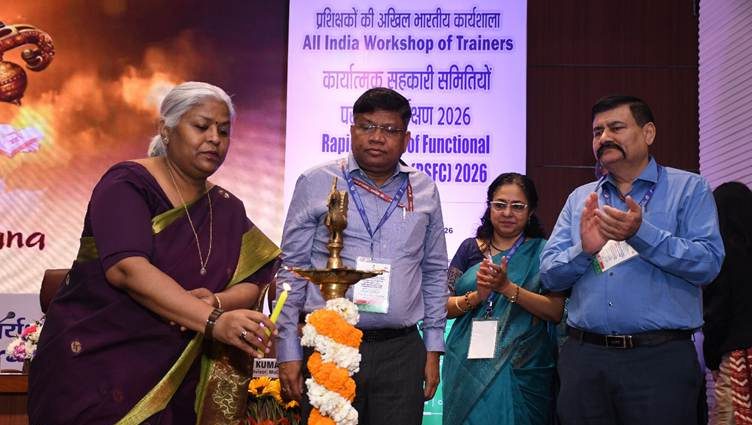
As part of the preparatory process, a one-day All-India Workshop of Trainers (AIWOT) was organized at the Scope Convention Centre, witnessing the participation of around 225 officials drawn from across States and Union Territories. The workshop marked a crucial step in building capacity and ensuring uniformity in data collection methodologies ahead of the six-month-long survey.
Inaugurating the workshop, Geeta Singh Rathore, Director General of the National Sample Survey (NSS), emphasized the pivotal role played by cooperatives in India’s socio-economic framework. She noted that the sector continues to serve as a backbone for rural development, fostering inclusive growth, employment generation, and grassroots empowerment.
Rathore highlighted that the RSFC will generate key economic indicators such as Gross Value Added (GVA), Gross Value Output (GVO), and employment figures across nearly 30 major cooperative sectors. These estimates are expected to provide policymakers with a clearer understanding of the sector’s actual economic contribution, which has often remained underrepresented due to the absence of structured and standardized data.
Senior officials from various divisions, including the Field Operations Division (FOD), Enterprise Survey Division (EnSD), and Coordination and Quality Control Division (CQCD), along with representatives from the Ministry of Cooperation, underscored the importance of robust statistical systems in achieving the national goal of Viksit Bharat 2047. They stressed that credible and high-quality data would play a critical role in shaping evidence-based policy decisions and strengthening the cooperative ecosystem.
The survey will utilize the National Cooperative Database (NCD) as its sampling frame, ensuring comprehensive coverage and representation. Additionally, a modern web-based data collection system will be deployed to enhance efficiency, transparency, and real-time monitoring of the survey process.
According to officials, the RSFC will generate sector-wise estimates for 12 key cooperative segments, including Primary Agricultural Credit Societies (PACS), dairy, housing, fisheries, sugar, labour, and agro-processing cooperatives. These segments collectively form the backbone of the cooperative movement and have a direct bearing on rural livelihoods and economic activities.
Following the workshop, master trainers from all States and Union Territories will conduct regional-level training sessions for field investigators and supervisory staff. This cascading training model is aimed at ensuring consistency, accuracy, and adherence to standardized protocols during field operations.
The Ministry of Cooperation has assured full support from state and district-level cooperative authorities to facilitate smooth execution of the survey. Coordination between central and state agencies is expected to be key to the success of this ambitious exercise.
The RSFC represents a landmark initiative in India’s statistical and cooperative landscape. By bringing the cooperative sector into sharper economic focus, the survey is expected to not only strengthen the country’s statistical framework but also highlight the true scale and impact of cooperatives in driving sustainable and inclusive development.