






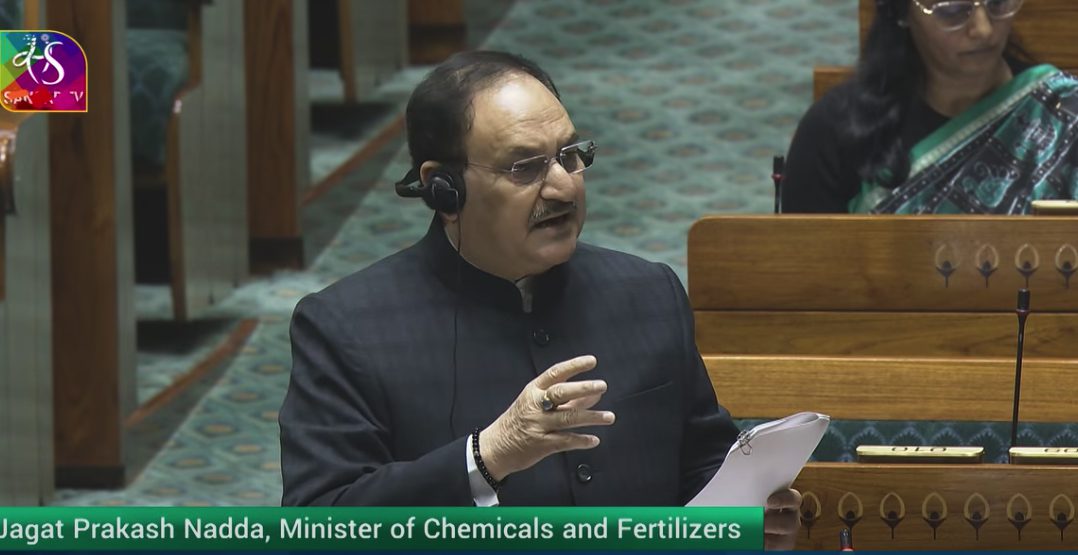
Union Minister for Chemicals and Fertilizers Jagat Prakash Nadda has informed the Lok Sabha that there has been no shortage of chemical fertilizers across states, including Uttar Pradesh, during the Kharif 2025 and ongoing Rabi 2025–26 seasons.
In a written reply to a question raised by MP Virendra Singh, the Minister stated that the availability of key fertilizers such as Urea, DAP, MOP and NPK remained adequate throughout the country.
He said the Department of Agriculture and Farmers Welfare assesses state-wise and month-wise fertilizer requirements before every cropping season. Based on this assessment, the Department of Fertilizers allocates supplies and monitors movement through the Integrated Fertilizer Management System (iFMS) to ensure timely distribution.
Emphasising the role of Indian Farmers Fertiliser Cooperative Limited (IFFCO), the Minister shared that the cooperative’s total fertilizer production increased from 88.93 lakh metric tonnes (LMT) in 2023–24 to 93.10 LMT in 2024–25. Key plants such as Kandla, Paradeep, Anola and Phulpur contributed significantly to the rise in output.
During April–January of FY 2025–26, IFFCO produced 41.24 lakh metric tonnes of urea, higher than 40.66 lakh metric tonnes produced during the corresponding period of FY 2024–25. The Minister clarified that no shortfall has been reported in IFFCO’s fertilizer production and supply against the targets assigned by the Department of Fertilizers.
The Minister also highlighted broader government measures to boost domestic production. Under the New Investment Policy (NIP)–2012, six new urea units have been commissioned, including projects of Ramagundam Fertilizers and Chemicals Limited, Hindustan Urvarak & Rasayan Limited, Matix Fertilizers and Chemicals Limited and Chambal Fertilizers and Chemicals Limited. These additions have raised India’s indigenous urea production capacity from 207.54 LMT in 2014–15 to 283.74 LMT in 2023–24.
India recorded a historic urea production of 314.07 LMT in 2023–24, while 306.67 LMT was produced in 2024–25. The government has reiterated that proactive planning, capacity expansion and close monitoring have ensured uninterrupted fertilizer availability across the country.