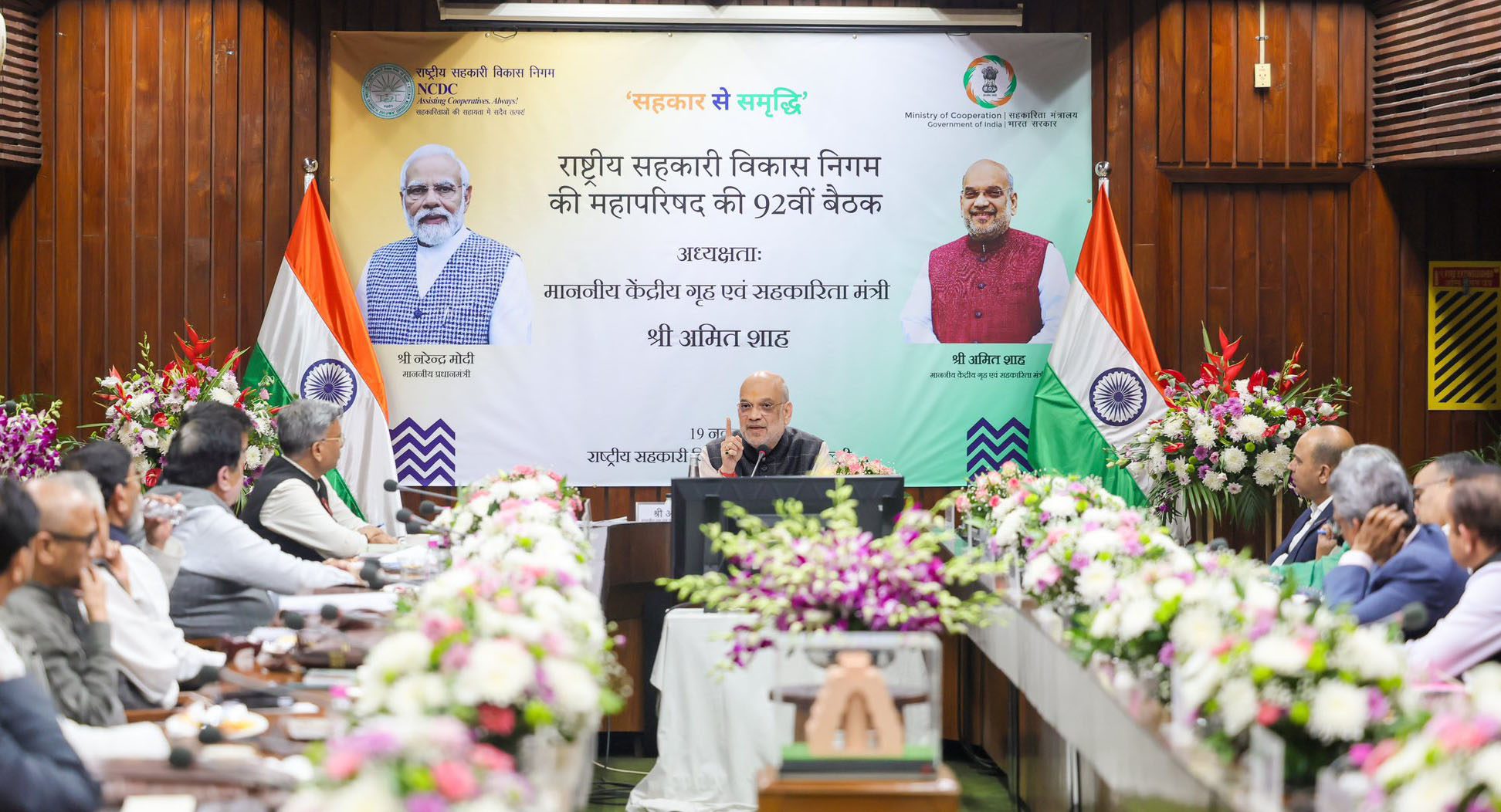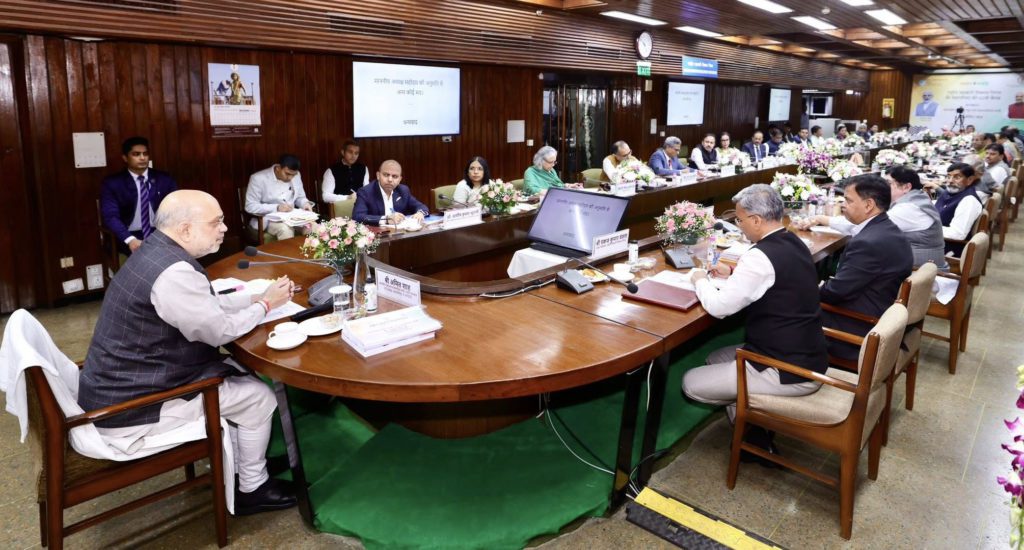
Addressing the 92nd General Council Meeting of the National Cooperative Development Corporation (NCDC) in New Delhi on Wednesday, Union Home and Cooperation Minister Amit Shah said the NCDC has emerged as the “principal foundation of cooperative transformation” in India.
The meeting brought together top cooperative leaders including NCUI President Dileep Sanghani, senior officials from Union ministries, state governments, major cooperative bodies, and representatives from NITI Aayog. The 51-member General Council serves as NCDC’s apex policy-making body for financing cooperative development across agriculture, rural infrastructure, and allied sectors.
Shah said the government aims to bring “positive, tangible change” to the lives of farmers, rural households, fisherfolk, small producers, and micro-entrepreneurs through the cooperative movement, which he described as a powerful model for achieving India’s goal of a self-reliant economy. Cooperation, he said, ensures broad participation, livelihood generation, and equitable growth in rural India.
Highlighting NCDC’s rapid expansion, Shah noted that the Corporation has scaled its total disbursement from Rs 24,700 crore in 2020-21 to Rs 95,200 crore in 2024-25. Over the past four years, he said, NCDC has set new benchmarks in financial inclusion, innovation, responsible lending, and sectoral expansion.
“NCDC has registered a compound annual growth rate of over 40 percent, maintained zero net NPA, and achieved its highest-ever net profit of Rs 807 crore,” Shah said, adding that such performance has bolstered the institution’s credibility nationwide.

He also emphasized the ongoing work to develop Primary Agricultural Credit Societies (PACS) as Farmer Producer Organizations (FPOs), enabling farmers to get fair prices, access better markets, and shift from individual gains to community-centred benefits.
Shah said the government is prioritizing organic farming, processing, and exports in the post-Green Revolution era. Multi-state cooperative institutions such as National Cooperative Export Limited (NCEL), Bharatiya Beej Sahakari Samiti Limited (BBSSL), and National Cooperative Organic Limited (NCOL) are working to accelerate growth in these segments.
In the fisheries sector, NCDC has already achieved its target of forming and strengthening 1,070 Fisheries Farmer Producer Organizations (FFPOs). Work is under way to support 2,348 additional FFPOs under the Pradhan Mantri Matsya Kisan Samriddhi Sah-Yojana. Shah said financial assistance for purchasing deep-sea trawlers in Maharashtra and Gujarat has contributed significantly to the Blue Economy, boosting incomes and strengthening the economic participation of women in coastal communities.
Calling for a strong push toward circular economy practices in the sugar and dairy sectors, Shah highlighted government initiatives for modernizing cooperative sugar mills. Against a central government grant of Rs 1,000 crore, NCDC has disbursed Rs 10,005 crore to 56 sugar mills for establishing ethanol plants, co-generation units, and providing working capital, enabling cooperatives to diversify revenue streams and benefit from low-interest credit.
A major new initiative, Shah said, is NCDC’s support in establishing the cooperative-based “Bharat Taxi” ride-hailing service. The multi-state cooperative society for Bharat Taxi has been registered, and driver enrolment and technology development are in progress. The platform aims to emerge as a cooperative alternative in India’s growing mobility sector.
To expand cooperative outreach, NCDC has opened a new regional office in Vijayawada and sub-offices across Jammu & Kashmir, Ladakh, Sikkim, Manipur, Mizoram, Tripura, Arunachal Pradesh, Meghalaya, and Nagaland, enabling deeper penetration into the Northeast and other underserved regions.
Shah also said that following the approval of a Rs 2,000 crore central grant on 31 July 2025, NCDC is mobilizing Rs 20,000 crore to provide long-term and working-capital loans at concessional rates to cooperatives across dairy, livestock, fisheries, sugar, textiles, food processing, cold storage, agriculture, and women-led sectors.
Substantial support is also being extended to the umbrella organization for urban cooperative banks and through Sahakar Sarathi, which provides technology services to both rural and urban cooperative banks.
To nurture future cooperative leaders, NCDC’s “Cooperative Intern” programme is being expanded, with selected interns offering technical and managerial support to cooperative institutions across the country.