
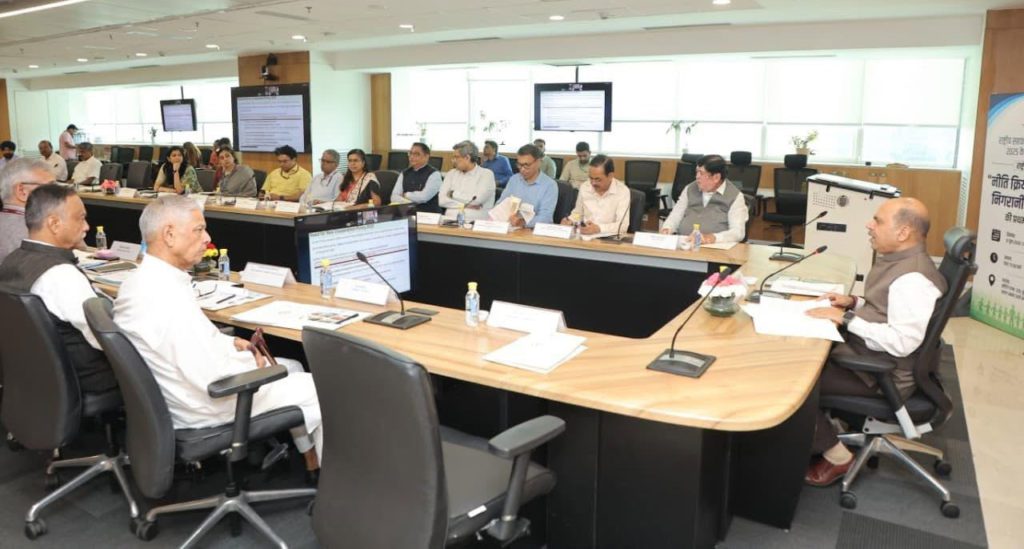
The first meeting of the National Level Policy Implementation and Monitoring Committee constituted under the National Cooperation Policy-2025 was held in New Delhi, marking a major step towards strengthening India’s cooperative movement through coordinated policy implementation and institutional reforms.
The meeting focused on preparing a comprehensive roadmap for effective execution of the National Cooperation Policy-2025 in coordination with States, Union Territories, Central Ministries and cooperative institutions.
The committee discussed strategies to modernise cooperative institutions and make them more transparent, professionally managed and technology-enabled in line with the vision of “Sahkar se Samriddhi.”
The meeting was chaired by Dr. Ashish Kumar Bhutani, Secretary, Ministry of Cooperation, who said that strong, transparent and modern cooperative institutions would energise the rural economy and contribute significantly to the vision of Viksit Bharat @2047. He emphasised that the National Cooperation Policy-2025 aims to create a future-ready cooperative ecosystem driven by accountability, innovation and people-centric governance.
The Ministry of Cooperation noted that the policy has been framed under the guidance of Prime Minister Narendra Modi’s vision of “Sahkar se Samriddhi” and the leadership of Union Home and Cooperation Minister Amit Shah. The policy seeks to modernise the cooperative sector while preserving its democratic and community-oriented character.
During the discussions, committee members highlighted the importance of coordinated action among Central Ministries, State governments, National Federations and cooperative institutions for successful implementation of the policy. Special emphasis was laid on digital transformation, financial transparency, skill development and professional management practices within cooperatives.
Senior cooperative leader Dileep Sanghani played a prominent role in the deliberations, stressing the need for stronger grassroots cooperatives and greater member participation to ensure inclusive rural development. Sanghani underlined that cooperatives must evolve into professionally managed institutions capable of addressing the economic aspirations of farmers, rural entrepreneurs and weaker sections.
Sanghani also stressed that cooperatives have a vital role in strengthening rural livelihoods, agricultural value chains and local employment generation. He advocated greater involvement of youth and women in the cooperative movement and called for capacity-building programmes to prepare cooperative institutions for emerging economic challenges.
The committee reviewed various initiatives already undertaken by the Ministry of Cooperation to strengthen and modernise the sector, including reforms in governance systems and efforts to improve operational efficiency. Participants agreed that the National Cooperation Policy-2025 could become a transformative framework for revitalising India’s vast cooperative network across agriculture, dairy, fisheries, housing and rural industries.
The meeting concluded with a commitment to accelerate implementation efforts through regular monitoring and institutional coordination. Cooperative leaders expressed confidence that the policy would help create resilient and member-driven cooperative institutions capable of contributing meaningfully to India’s long-term economic and social development goals.