
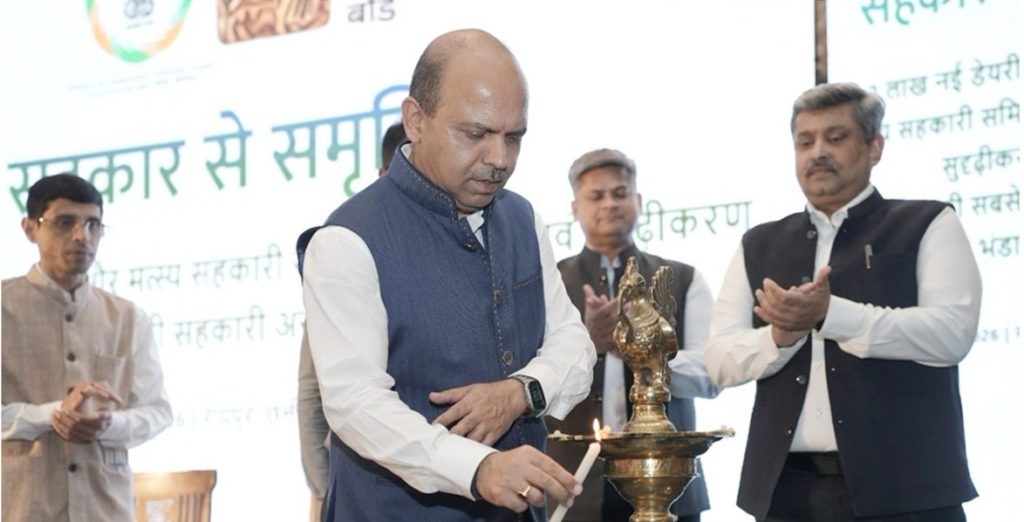
A regional workshop held in Raipur reviewed the progress of the Centre’s ambitious initiatives including the World’s Largest Grain Storage Plan in the cooperative sector, White Revolution 2.0 and the formation of two lakh new cooperative societies across the country.
The workshop brought together senior officials from Bihar, Chhattisgarh, Jharkhand, Madhya Pradesh, Odisha and West Bengal along with representatives of NABARD, FCI, NAFED, NCCF, NDDB and Warehousing Corporations.
Organised by the Ministry of Cooperation, the workshop focused on strengthening Multipurpose PACS (M-PACS), dairy and fisheries cooperative societies while expanding rural infrastructure and farmer-centric cooperative systems.
The initiative is being implemented under the vision of Prime Minister Narendra Modi to promote “Sahkar se Samriddhi” and under the leadership of Union Home and Cooperation Minister Amit Shah.
Addressing the workshop, Dr. Ashish Kumar Bhutani, Secretary, Ministry of Cooperation, described the cooperative sector as the backbone of the rural economy. He said the dairy sector has already demonstrated its transformative potential in states like Gujarat through women empowerment, nutrition security and economic prosperity.
Highlighting the untapped potential of Eastern and Central India, he noted that the abundance of fertile land, water resources and livestock could drive the next phase of dairy growth in the region.
Dr. Bhutani urged participating states to work collectively, exchange ideas and openly discuss implementation challenges to ensure effective execution of cooperative schemes. He assured that the Centre would provide all necessary support and coordination for strengthening the cooperative ecosystem.
The workshop placed special emphasis on the role of dairy cooperatives in women-led rural transformation. Officials noted that women associated with dairy cooperative societies are increasingly emerging as entrepreneurs rather than remaining confined to household roles.
Through organized dairy networks, women are gaining better access to markets, financial services, livelihood opportunities and decision-making platforms, thereby strengthening the rural cooperative financial ecosystem.
The Ministry also reviewed the progress of White Revolution 2.0 and discussed targets for formation of 75,000 new Dairy Cooperative Societies and strengthening of 46,000 existing societies over the next five years.
Discussions stressed that the dairy sector should move beyond milk production and adopt sustainable circular economy models involving bio-gas, organic fertilizers, whey protein production, carbon credits and renewable energy generation.
Officials observed that global energy imbalances, supply-chain disruptions and economic uncertainties have increased the importance of self-reliant rural models. The Ministry stated that initiatives such as Compressed Bio Gas projects, GOBARdhan-based models and bio-energy generation can reduce dependence on imported energy while creating additional income opportunities for farmers and cooperative institutions.
Dr. C.R. Prasanna, Secretary of the Cooperation Department, Government of Chhattisgarh, highlighted the state’s focus on dairy development, grain storage infrastructure and bio-gas projects.
Technical sessions during the workshop covered implementation of the grain storage plan, WDRA onboarding of PACS, diversification of cooperative business activities, revival of non-functional cooperatives and expansion of dairy value-added products.
The workshop also reviewed progress related to Bharatiya Beej Sahakari Samiti Limited, National Cooperative Exports Limited, National Cooperative Organics Limited and other initiatives aimed at strengthening self-reliance in the cooperative sector.
In the concluding session, speakers emphasized regular monitoring, better coordination among states and mission-mode implementation to accelerate the growth of India’s cooperative movement.