





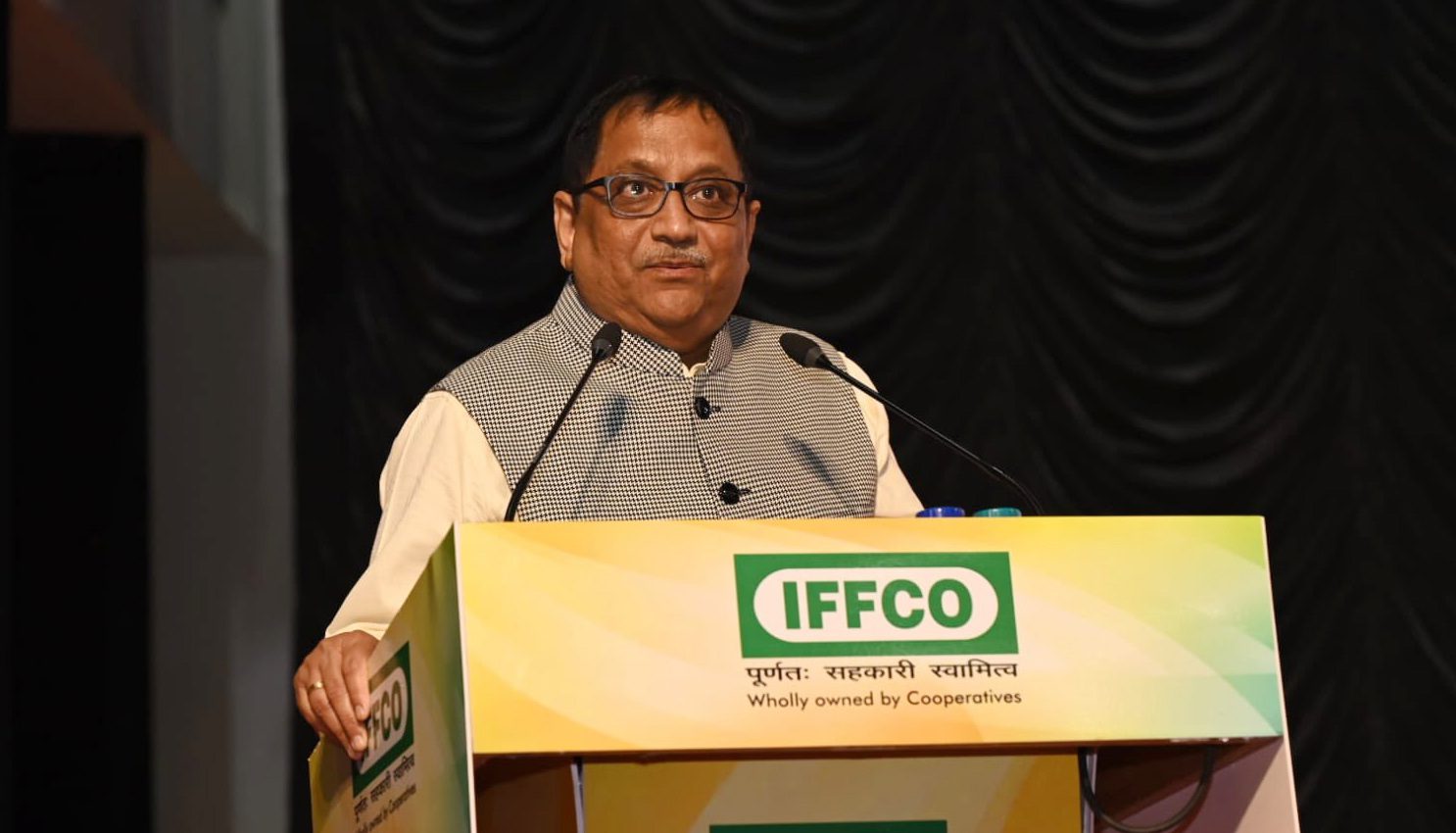
IFFCO Managing Director K. J. Patel has reiterated that securing long-term access to key raw materials has become a critical national priority, essential for keeping fertiliser prices affordable and protecting the stability of India’s farm economy.
In a recent media interaction, he warned that dependence on unstable or expensive global supply chains exposes the country’s agricultural backbone to disruptions. He emphasised that raw material security is directly linked to fertiliser affordability, food system resilience and the economic well-being of millions of Indian farmers.
Patel said IFFCO, as a cooperative built for farmers, is pursuing an aggressive backward-integration strategy to stabilise production costs and strengthen the domestic supply chain. This is not merely a corporate approach, he stressed, but a national imperative at a time when geopolitical tensions, supply chain bottlenecks and rising global commodity prices have made fertiliser imports increasingly unpredictable.
India, which remains heavily dependent on imported rock phosphate, phosphoric acid, potash and other intermediates, continues to face the dual pressure of volatile international markets and increasing domestic demand.
To counter these challenges, IFFCO is preparing to expand its global footprint through joint venture manufacturing projects that can guarantee long-term access to critical inputs. Patel revealed that the cooperative is actively exploring partnerships in Sri Lanka, Jordan and Senegal, each chosen for its strategic raw-material base.
In Sri Lanka, IFFCO is examining the feasibility of a joint venture to produce di-ammonium phosphate or phosphoric acid by tapping the country’s high-grade rock phosphate reserves. In Jordan, IFFCO already holds a 52 per cent stake in the Jordan India Fertiliser Company, and Patel said plans are underway to increase phosphoric acid production from the existing 0.5 million tonnes to 1 million tonnes annually. Senegal, one of Africa’s major rock-phosphate exporters, is also being considered for a similar backward-integration arrangement with buy-back agreements to supply India directly.
These international ventures follow a global trend, where fertiliser-producing nations and companies are securing overseas mining and processing capacities to shield themselves from market shocks.
India’s vulnerability became sharply visible during the recent years of supply disruption triggered by global conflicts and commodity price spikes, particularly after the Russia-Ukraine conflict. Forward contracts and JVs, Patel noted, provide predictability, cost control and long-term security for India’s fertiliser sector.
Alongside raw material security, Patel highlighted the transformative role of Nano Fertilisers, which he described as the future of sustainable and efficient agriculture. He said nano-urea and nano-DAP can reduce input costs, enhance productivity and significantly cut India’s reliance on imported fertiliser intermediates. Innovation and global integration, he emphasised, will together form the backbone of a resilient, self-reliant fertiliser ecosystem.
Patel reaffirmed that IFFCO remains committed to ensuring that India’s farmers and the nation’s food security are protected through stable supplies, technological advancement and strategic international partnerships.