
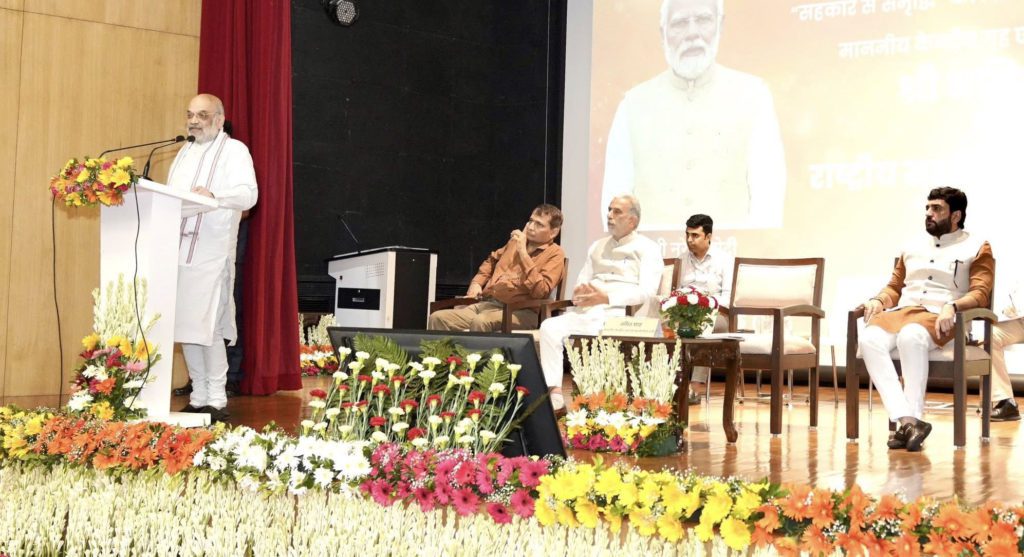
Union Minister Amit Shah has unveiled the National Cooperative Policy – 2025, charting a bold roadmap for rejuvenating India’s rural economy through cooperatives. At the heart of the policy lies a grassroots transformation strategy focused on rural women, farmers, Dalits, and tribals, all aimed at building a Viksit Bharat by 2047.
Unveiled in New Delhi in the presence of key dignitaries, the policy marks a historic move by the Modi government to push the cooperative sector to the forefront of development. It calls for the creation of at least one cooperative society in every village and five model cooperative villages in each tehsil. These model villages, pioneered in Gandhinagar with NABARD’s support, will showcase the full potential of modernized cooperative institutions powered by technology and community ownership.
With Prime Minister Modi’s establishment of a dedicated Ministry of Cooperation in 2021, Shah emphasized how this structure has restored pride and relevance to the sector. In just four years, cooperatives, once dismissed as irrelevant, have evolved into dynamic, opportunity-rich institutions, now viewed on par with corporates in performance and governance.
Central to the new policy is its focus on sectors that touch everyday rural life. Beyond traditional agriculture and dairy, cooperatives will now engage in tourism, insurance, taxi services, and green energy. The idea is to anchor economic activity directly in rural areas while empowering local populations, particularly youth and women, with sustainable livelihoods.
The White Revolution 2.0, embedded in this policy, aims to make women’s participation a cornerstone of rural revival. Meanwhile, young people are being encouraged to consider careers in the cooperative sector, aided by the upcoming Tribhuvan Sahkari University, which will provide tailored education and training.
The policy’s architecture is built on six pillars: foundation strengthening, vibrancy, future readiness, inclusivity, expansion into new sectors, and youth engagement. A 30% increase in the number of cooperative societies is targeted, along with active participation of 50 crore citizens.
According to Shah, the cooperative model’s strength lies in its ability to mobilize small savings into large-scale enterprises, a form of economic democratization unmatched by other systems. The policy places trust in member-centric governance and transparent digital infrastructure. For instance, over 4,000 PACS have already been sanctioned to operate Jan Aushadhi Kendras, while others are entering fuel, water, and energy distribution.
A key highlight is the introduction of the ‘Sahkar Taxi’ initiative, where profits flow directly to the driver, reinforcing the member-first principle. PACS will also help implement key government schemes like “Har Ghar Nal Se Jal” and PM Surya Ghar Yojana, further linking cooperatives with public service delivery.
Legal amendments every 10 years are planned to keep the policy agile and relevant. A cluster-monitoring framework will ensure that cooperative units remain accountable and efficient. The government is also working to end the second-class treatment of scheduled cooperative banks, ensuring they’re recognized on par with commercial banks.
As the world enters a new cooperative era, designated the International Year of Cooperatives, India is gearing up with a grassroots-first policy that redefines development from the village upward. Shah stressed that this approach will not only ensure GDP growth but also deliver employment, dignity, and self-respect to the last citizen.
With this landmark policy, the government seeks to turn villages into vibrant hubs of enterprise, firmly embedding the spirit of “Sahkar Se Samriddhi” in India’s development journey.