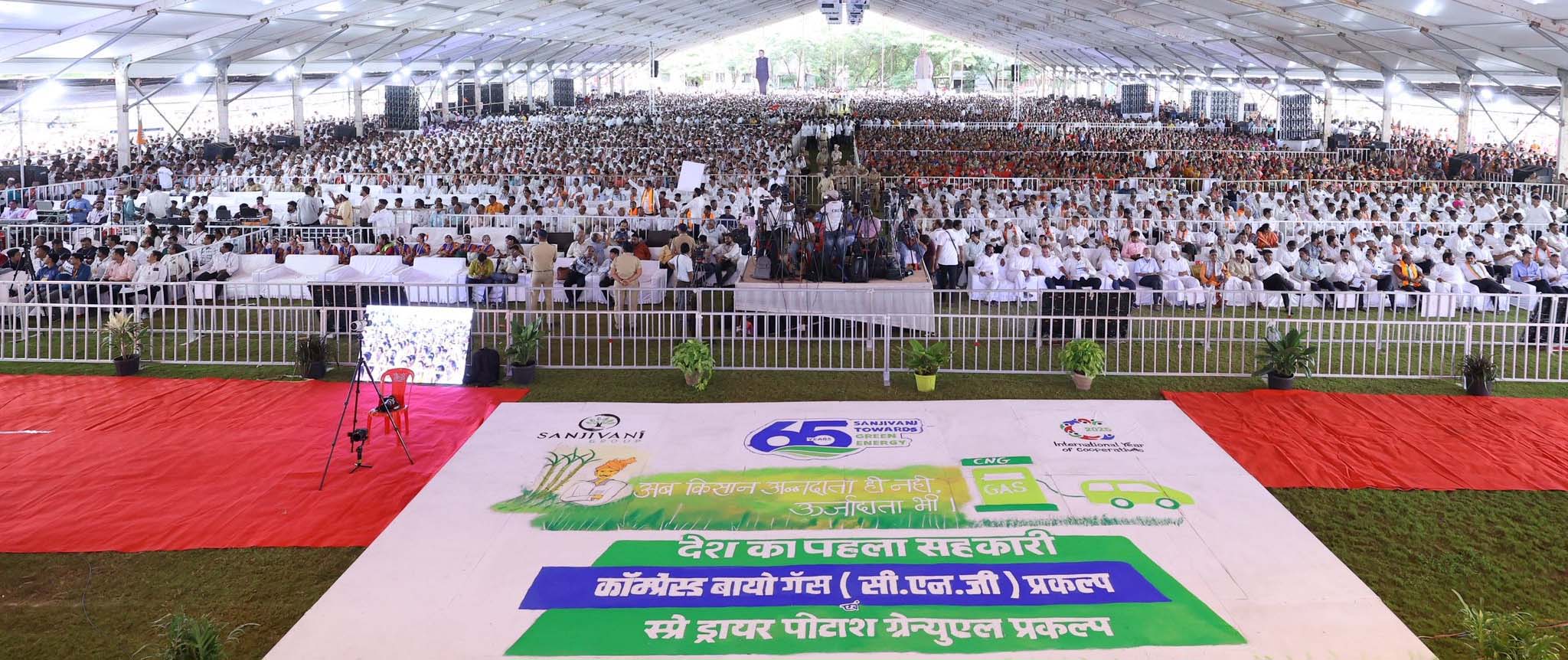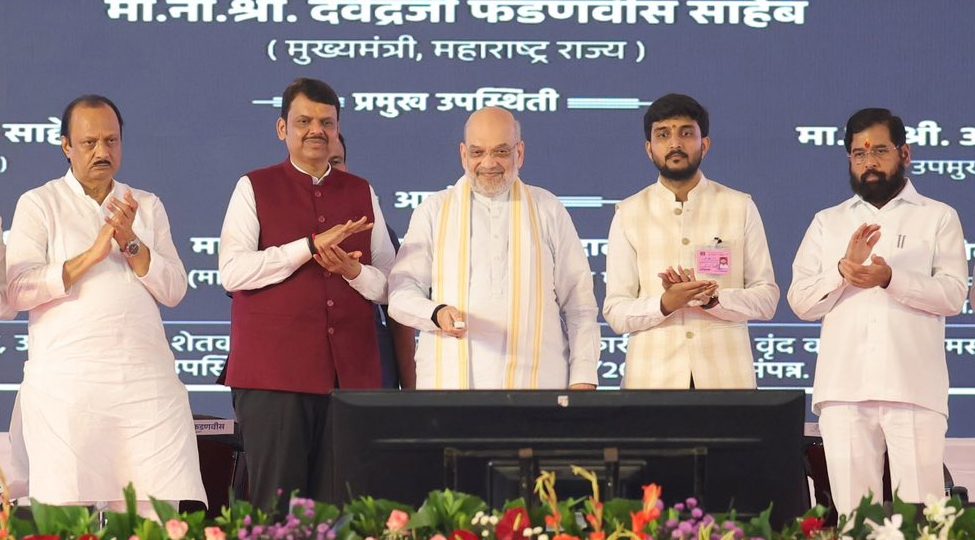
Union Home Minister and Minister of Cooperation Amit Shah on Monday inaugurated India’s first cooperative multi-feed Compressed Biogas (CBG) plant at the Maharshi Shankarrao Kolhe Sahakari Sakhar Karkhana in Kopargaon, Ahilyanagar district of Maharashtra, marking a historic milestone for the country’s cooperative movement.
Addressing a massive gathering alongside Maharashtra Chief Minister Devendra Fadnavis, Deputy Chief Ministers Eknath Shinde and Ajit Pawar, and Union Minister of State for Cooperation Murlidhar Mohol, Shah declared that this project was not just a technological achievement but a testament to the transformative capacity of cooperatives when backed by visionary political will.
He announced that the Centre would extend full support through the National Cooperative Development Corporation to 15 cooperative sugar mills across India to set up similar CBG and potash granule plants, signalling a nationwide transition of sugar factories towards clean energy and zero-waste circular economies.
The newly inaugurated unit, built at an investment of Rs 55 crore, will produce 12 tonnes of compressed biogas and 75 tonnes of potash daily using molasses and jaggery byproducts, two commodities that India currently imports. Shah said that by converting agricultural residue into energy and fertiliser, sugar cooperatives can become engines of rural sustainability while reducing import dependency.
Reiterating Prime Minister Narendra Modi’s commitment to farmer welfare through cooperatives, he cited the Cabinet’s recent approval of the ‘Mission for Aatmanirbharta in Pulses’ worth Rs 11,340 crore to ensure self-reliance in arhar, urad and masoor.
By enabling farmers to register with NAFED and NCCF for 100 percent MSP procurement, Shah said the government was placing cooperative agencies at the heart of procurement reforms. He also recalled the Cabinet’s increase in MSP for major crops and reduction of GST to 5 percent on equipment like tractors, harvesters, drip systems and organic pesticides, decisions he claimed would directly benefit small farmers and PACS members.
Praising the pioneering work of the Sanjeevani Group and the Kolhe sugar cooperative, Shah described the plant as a national model of how cooperatives can achieve industrial innovation while uplifting rural households.
He reminded the audience that cooperatives were born in the sugar belts of Maharashtra, and it was only fitting that the vision of a 100 percent circular economy for sugar mills should once again originate from cooperative soil. He urged every profit-making sugar factory to diversify into ethanol, fruit processing, fisheries, and allied value chains through the cooperative model so that rural capital remains in rural hands.
Reflecting on the larger journey of the cooperative sector, Shah said that Prime Minister Modi’s decision to carve out a separate Ministry of Cooperation at the Centre had restored confidence among millions of cooperative members after decades of policy neglect. “The uncertainty around cooperatives is over,” he declared. “Today, the cooperative sector is not just alive, it is emerging as a strong pillar of the national economy.”
Calling upon citizens to adopt indigenous products and plant trees in honour of their mothers and Mother Earth, Shah concluded by asserting that India’s economic ascent from 11th to 4th place globally was driven by the collective resolve of its people, and that its rise to the top would be led by cooperatives.