





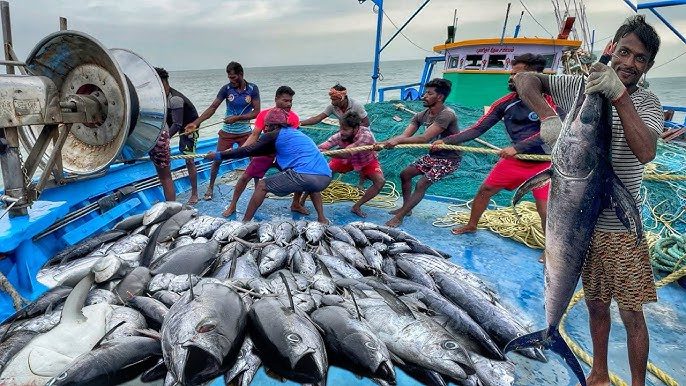
In a decisive move for the country’s marine economy, the Ministry of Fisheries, Animal Husbandry & Dairying (MoFAHD) on 4 November 2025 formally notified the Sustainable Harnessing of Fisheries in the Exclusive Economic Zone of India Rules, 2025, marking a renewed focus on deep-sea fishing and the role of fisheries co-operatives and Fish Farmer Producer Organisations (FFPOs).
That emphasis on co-operatives and community-led models could reshape how India’s small-scale fishers engage with offshore resources. Under the new framework, fishermen co-operative societies and FFPOs are prioritised for deep-sea fishing licences, access to advanced vessels, value-addition and export operations, moving beyond traditional near-shore capture to higher-value marine fisheries.
The rules set out a digital access-pass regime for mechanised and large motorised vessels operating in the EEZ, exempting traditional and small-scale fishers on non-motorised craft, thus offering a protection layer for coastal communities.
The co-operative dimension is especially significant. By giving fishing co-operatives preferential access to deep-sea resources, infrastructure support and export value-chain linkages, the government aims to strengthen collective enterprise rather than solely relying on large private vessels. Training, capacity-building, credit access (including via flagship interventions such as the Pradhan Mantri Matsya Sampada Yojana (PMMSY)) and market integration are flagged.
In tandem, the reforms move to prohibit harmful fishing practices – such as LED?light fishing, pair?trawling and bull trawling – and to impose minimum legal sizes for species, along with stakeholder-driven Fisheries Management Plans. These steps support the sustainability of marine ecosystems and ensure equity for small-scale fishers and their co-ops.
For India’s island regions – the Andaman & Nicobar Islands and Lakshadweep – which together comprise nearly half of the country’s EEZ area, the mother-and-child vessel concept, deep-sea tuna fisheries clusters and cold-chain infrastructure promotion are expected to provide huge export potential. Co-operatives based in these zones stand to gain significantly from the value-addition focus.
From a financial perspective, the Budget 2025–26 underlined this ambition: an allocation of Rs 2,703.67 crore for the fisheries sector, and a special emphasis on unlocking the EEZ and high seas potential.
By placing co-operatives and small-scale fishers at the centre of the reform agenda, the government aims both to modernise India’s marine fisheries and to ensure that the benefits flow to organised community-based structures rather than only large firms. For fishing co-operatives this is a moment of opportunity, to transition from traditional coastal operations into deep-sea ventures, export markets and value chains, backed by supportive regulatory and digital infrastructure.
In sum, the Sustainable Harnessing Rules may become a watershed for India’s blue economy, particularly for fisheries co-op societies and FFPOs, by aligning sustainable resource access with inclusive, community-led enterprise.