
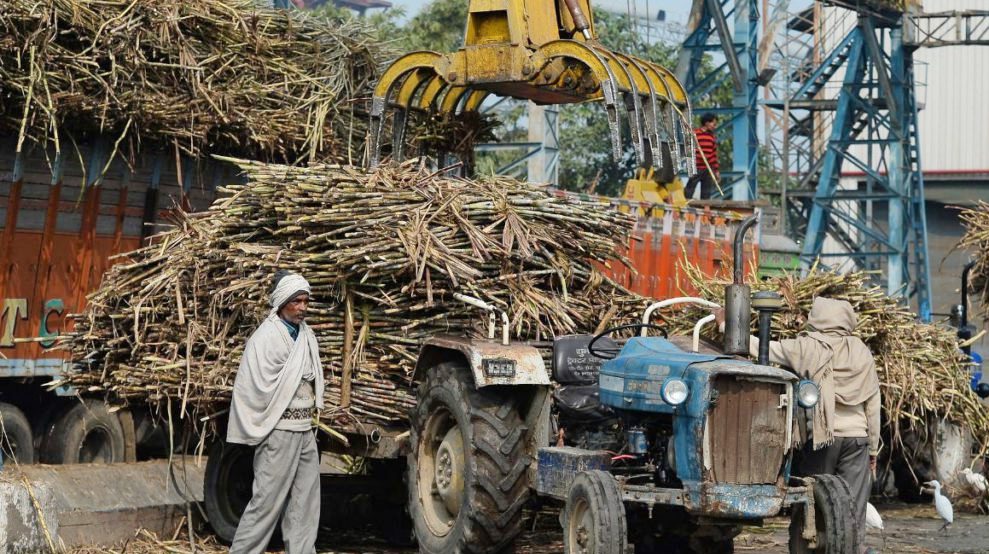
India’s cooperative sugar mills are navigating one of the most intense and uncertain crushing seasons in recent years, as crushing operations gather momentum across major cane-growing regions while ambiguity persists over the long-pending revision of sugar’s Minimum Selling Price (MSP) and ethanol prices.
According to data compiled by the National Cooperative Sugar Federation (NCSF), mills had crushed 486 lakh tonnes (LTs) of sugarcane by 30 November 2025, significantly higher than 334 LTs recorded during the corresponding period last year. This has resulted in 41.35 lakh tonnes of sugar production, far outstripping last year’s 27.60 LTs, with the average sugar recovery improving to 8.51 percent, compared to 8.27 percent last season.
A favourable monsoon and timely retreating rains have enabled cooperative mills to run crushing lines at full capacity in most regions, though isolated pockets of Maharashtra and Karnataka continue to witness Rasta Roko agitations by farmers seeking quicker payments and better cane prices.
Despite these disruptions, cooperatives remain central to national sugar output projections. For the 2025–26 season ending September 2026, gross production is estimated at 350 LTs, of which 35 LTs may be diverted toward ethanol under Cycle-1 allocations. Net sugar production is thus expected to stand at 315 LTs, with cooperative-dominated Maharashtra contributing 110 LTs, Uttar Pradesh 105 LTs, Karnataka 55 LTs, and Gujarat 8 LTs.
Domestic consumption is projected at 290 LTs, and with an opening stock of 50 LTs, mills fear that as much as 75 LTs may end up locked in godowns. This immobilised inventory blocks working capital and increases interest burden on cooperatives.
Given the financial strain, NCSF has urged the Centre to permit an additional 10 LTs of sugar exports beyond the already-announced quota of 15 LTs. Even this supplementary export tranche, the federation argues, would not destabilise global sugar prices due to its relatively small size but would significantly ease liquidity pressure on domestic cooperative mills.
The cooperative sugar sector’s biggest concern, however, is the six-year delay in revising the MSP. Conversion costs, labour charges, storage expenses and overheads have all risen, compressing mill margins to unsustainable levels.
NCSF President Harshvardhan Patil reiterated the federation’s demand for revising the MSP to Rs 41 per kg, noting that farmers in Brazil and Thailand receive about 60 to 65 percent of the final sugar revenue without any guaranteed FRP.
In India, farmers already receive 75 to 80 percent even under an MSP of Rs 41 per kg. Additionally, new state laws in Maharashtra and Karnataka mandate a 75:25 revenue-sharing formula between farmers and mills for upside realisations, which further tightens the financial framework for cooperative units.
Another area of concern is the ethanol policy. India has 513 distilleries with a combined capacity of 1953 crore litres per year, but Cycle-1 allocations have heavily favoured grain-based distilleries. The sugar sector received only 288.60 crore litres, while 759.80 crore litres went to grain-based units.
NCSF Managing Director Prakash Naiknavare stressed the urgent need for an upward revision of ethanol prices for sugar-based feedstock and a correction in allocation patterns to ensure equitable utilisation of molasses-based assets in which cooperatives have invested significantly.
As crushing peaks nationwide, cooperative mills remain the backbone of rural economies, but their sustainability now depends on swift policy intervention to correct pricing distortions and ease liquidity pressures.