
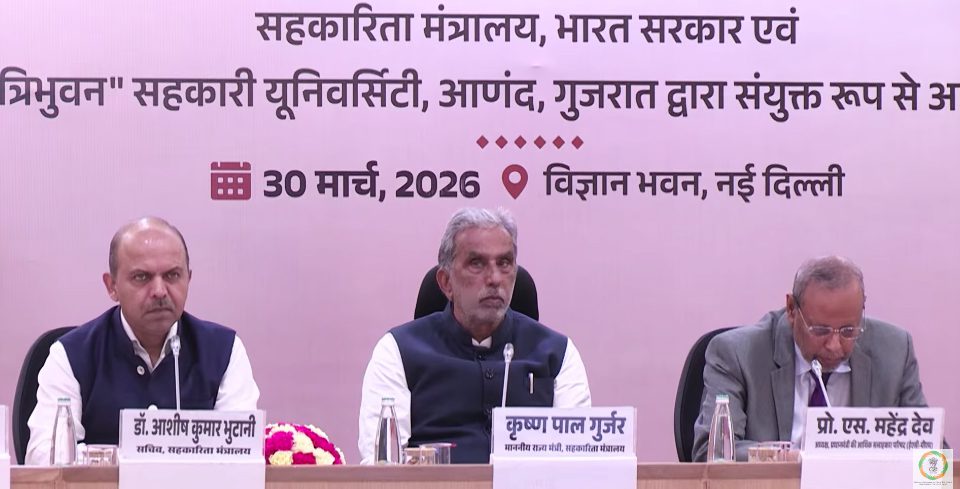
A national push to transform India’s cooperative landscape gathered momentum as a high-level conclave at Vigyan Bhawan brought together policymakers, experts and sector leaders to fast-track the implementation of the National Cooperation Policy 2025.
The event, jointly organised by the Ministry of Cooperation and Tribhuvan Sahkari University, focused on translating Narendra Modi’s vision of “Sahkar Se Samriddhi” into tangible outcomes at the grassroots level.
The conclave underscored the Centre’s intent to position cooperatives as a second engine of national growth, complementing the private and public sectors. Addressing the gathering, Krishan Pal Gurjar highlighted the historical role of cooperatives in empowering rural India and said the new policy provides a forward-looking roadmap aligned with evolving economic aspirations.
He emphasized that the framework aims to accelerate inclusive development, energize rural economies and contribute significantly to India’s goal of becoming a developed nation by 2047.
The policy has emerged from an extensive nationwide consultation process involving 17 meetings and four regional workshops conducted by a 48-member committee. Its key pillars include strengthening grassroots institutions, expanding cooperative structures, promoting professionalism and transparency, enhancing member participation, and encouraging youth engagement. States are also being encouraged to formulate their own cooperation policies to align with national objectives and deepen the cooperative movement.
The Ministry of Cooperation, under the leadership of Amit Shah, has already initiated several reforms in line with the policy. These include transforming Primary Agricultural Credit Societies (PACS) into multi-functional economic units capable of undertaking more than 25 activities, the establishment of a national cooperative university, and the rollout of initiatives such as a National Cooperative Database and Cooperative Ranking Framework. The government is also pushing new initiatives like Bharat Taxi to diversify cooperative participation into emerging sectors.
A major focus area highlighted during the conclave was the modernization and digitization of PACS. Secretary, Ministry of Cooperation, Ashish Kumar Bhutani, noted that over 80,000 PACS are being computerized to improve efficiency and transform them into business-oriented entities. Decentralized storage at the PACS level is also being prioritized to ensure better price realization for farmers, reduce post-harvest losses and cut logistics costs, thereby strengthening the rural supply chain.
Experts at the conclave stressed the untapped potential of cooperatives in driving economic growth. S. Mahendra Dev, Chairman of the Economic Advisory Council to the Prime Minister, outlined strategies to triple the sector’s contribution to the economy, describing cooperatives as a powerful vehicle for inclusive and sustainable development. Reinforcing this view, Satish Marathe pointed out that the cooperative sector remains the most effective mechanism for delivering affordable credit to the last mile, particularly in rural and underserved regions.
The conclave also hosted multiple thematic sessions on digital public infrastructure, strengthening PACS as engines of growth, member education, women and youth participation, leadership in organic markets, and cooperative credit systems. Breakout sessions and open discussions generated practical recommendations aimed at ensuring time-bound and effective implementation of the policy across states.
Overall, the deliberations reflected a strong consensus on leveraging technology, improving governance and expanding the scope of cooperatives to make them more competitive and people-centric. The National Conclave is expected to serve as a catalyst in accelerating the operationalisation of the National Cooperation Policy 2025, reinforcing cooperatives as a key pillar of India’s development strategy and advancing the vision of inclusive prosperity through collective effort.