
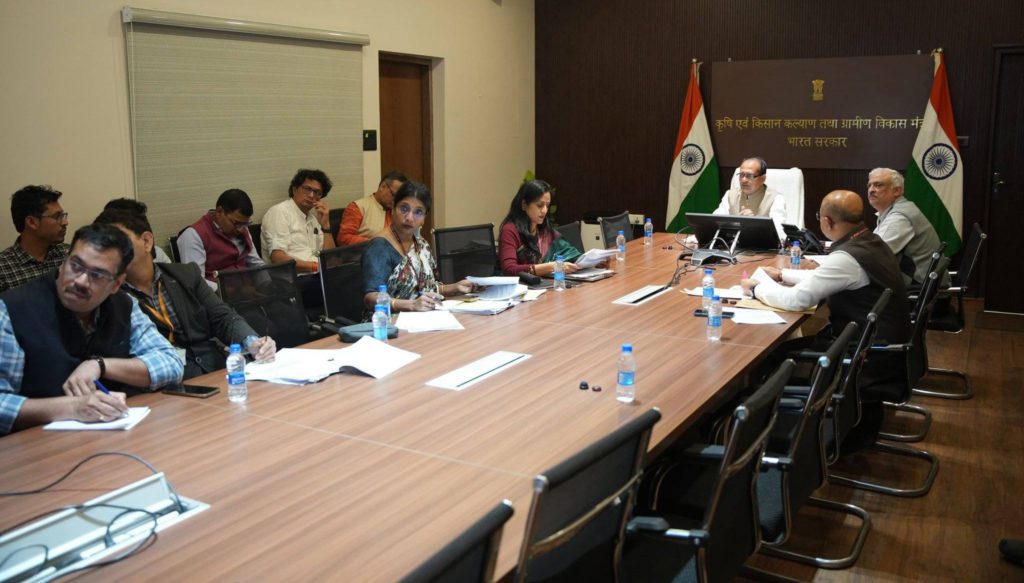
Union Agriculture and Farmers’ Welfare Minister Shivraj Singh Chouhan on Tuesday chaired a virtual meeting with Agriculture Ministers and senior officials from several states to review the progress of key central schemes, including the Rashtriya Krishi Vikas Yojana (RKVY) and the Krishi Unnati Scheme.
The meeting focused on ensuring effective implementation and timely utilisation of funds as the financial year draws to a close, alongside strengthening price support measures for farmers during the Rabi 2026 season.
Ministers and officials from Assam, Arunachal Pradesh, Bihar, Gujarat, Uttarakhand, Tripura, Maharashtra, Rajasthan, Kerala, Madhya Pradesh and Haryana participated in the review. Chouhan stressed that funds released by the Central Government must be fully and efficiently utilised by March 31 so that farmers receive maximum benefits. He underlined that delays or partial spending defeat the purpose of farmer-oriented schemes and weaken their intended impact at the grassroots level.
A total of 18 schemes are currently being implemented under RKVY and Krishi Unnati, and the Centre wants their tangible benefits to reach every village and farm through effective field-level execution.
Reiterating the Government of India’s commitment to protecting farmers from price volatility, Chouhan highlighted large-scale procurement operations under the Pradhan Mantri Annadata Aay Sanrakshan Abhiyan (PM-AASHA). He explained that the umbrella initiative includes the Price Support Scheme (PSS), Price Deficiency Payment Scheme (PDPS), Market Intervention Scheme (MIS) and the Price Stabilisation Fund (PSF), all designed to ensure remunerative and assured prices for agricultural produce.
Under the Price Support Scheme for the Rabi 2026 season, procurement approvals have been granted for 7,61,250 metric tonnes of gram in Maharashtra, 4,13,250 metric tonnes in Gujarat, 5,80,000 metric tonnes in Madhya Pradesh and 5,53,000 metric tonnes in Rajasthan. For mustard, 13,78,750 metric tonnes have been approved in Rajasthan and 1,33,000 metric tonnes in Gujarat, while 6,01,000 metric tonnes of lentil procurement has been cleared for Madhya Pradesh.
Chouhan explained that the Price Support Scheme is activated when market prices of notified pulses, oilseeds and copra fall below the Minimum Support Price during peak harvesting periods, thereby protecting farmers from distress sales. He noted that assured procurement at MSP strengthens farmers’ trust in government mechanisms and stabilises incomes during periods of declining prices.
The Minister also spoke about the proposed Self-Reliance in Pulses Mission, under which by 2030-31 the entire quantity of pigeon pea (arhar), urad and lentil offered by pre-registered farmers will be procured through central nodal agencies.
He said this long-term structural intervention aims to reduce dependence on imports, stabilise the pulses economy and provide farmers with assured markets and prices. According to him, guaranteed procurement will encourage expansion of pulses cultivation, promote adoption of improved technologies and contribute to better soil health, crop diversification and nutritional security.
Reaffirming the Centre’s commitment to increasing farmers’ incomes and strengthening the agricultural sector, Chouhan stated that initiatives such as PM-AASHA, RKVY, Krishi Unnati and the Self-Reliance in Pulses Mission together form a comprehensive protective framework.
He urged states to act as active partners by ensuring efficient fund utilisation, timely implementation and close monitoring so that the benefits of these schemes reach farmers on the ground and contribute to building a resilient and prosperous agricultural economy.