





CAMPCO has released a comprehensive new volume titled Areca Nut – History, Constituents, Cancer & Beyond, authored by Dr. Prasanna Belur, offering an extensive scientific and socio-economic examination of one of South and Southeast Asia’s most debated agricultural commodities.
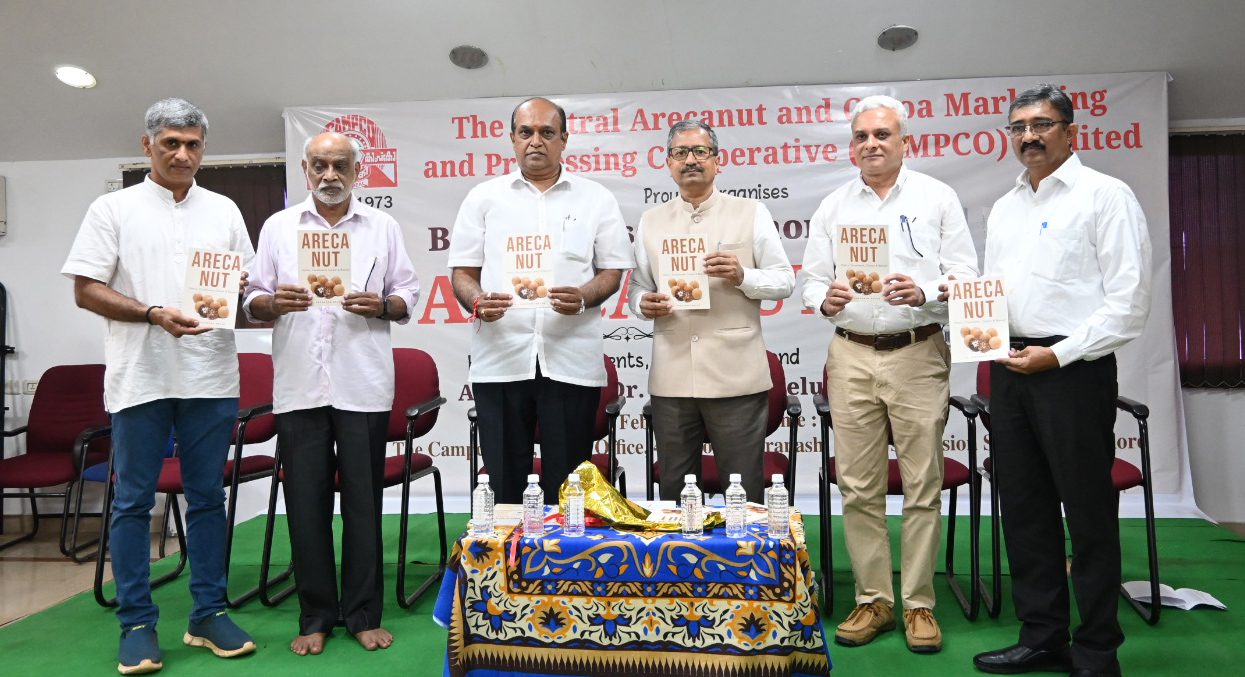
The book was unveiled on February 18, 2026, marking a significant academic contribution to discussions surrounding areca nut, a crop deeply intertwined with India’s civilizational heritage and rural economy.
Authored by Dr. Prasanna Belur, Professor at the National Institute of Technology Karnataka and a chemical engineer with a Ph.D. in biochemical engineering, the publication presents a multidisciplinary perspective on areca nut. It traces the crop’s historical roots, cultural symbolism, biochemical composition, medicinal references, and its place in contemporary public health debates.
The release function was attended by Prof. B. Ravi, Director of the National Institute of Technology Karnataka; Sri S.R. Sathishchandra, President of CAMPCO; Sri Mahesh Puchhappady, President of the All India Areca Growers Association; and Sri Vigneshwara Varmudy, retired Associate Professor and former Head of the Department of Economics at Vivekananda College.
Areca nut, botanically known as Areca catechu, has for centuries played a prominent role in religious rituals, hospitality traditions and social customs across India, China and Southeast Asia. India today remains the world’s largest producer and consumer of the crop, with millions of farming families depending on arecanut cultivation for their livelihood.
The book underscores how the crop has historically shaped trade networks, influenced agricultural systems and sustained rural economies, particularly in Karnataka and other producing states.
Beyond its economic footprint, the volume delves into traditional medicinal systems. Ancient Ayurvedic texts describe multiple benefits of Tambula, a preparation combining arecanut with betel leaf, slaked lime and spices. Traditional Chinese Medicine similarly lists numerous formulations incorporating areca nut for therapeutic purposes. Dr. Belur documents these classical references while examining them through the lens of modern scientific research.
A central feature of the book is its scientific analysis of areca nut’s chemical constituents, including alkaloids such as arecoline, along with polyphenols, tannins and other bioactive compounds. It discusses biochemical pathways, physiological effects and the evolving body of global research assessing health outcomes. Importantly, the author distinguishes between pure areca nut and commercial products that include tobacco or additives, a differentiation often blurred in public discourse.
The book acknowledges ongoing concerns in public health circles regarding oral health risks associated with areca consumption. However, it notes that available experimental data remain insufficient to conclusively determine the carcinogenicity of certain individual components, particularly in controlled animal studies, highlighting the need for further rigorous research.
Chapter 6, titled “Is Areca Nut Carcinogenic?”, offers a detailed review of international reports, scientific studies and regulatory perspectives, encouraging evidence-based dialogue rather than assumption-driven conclusions.
In a comparative discussion, the book also references research on cocoa-derived compounds, such as procyanidins, which have demonstrated measurable effects on endothelial function in clinical studies. This broader perspective situates areca nut within the wider scientific framework used to evaluate plant-based bioactive substances.
Published by White Falcon Publishing, the volume reflects CAMPCO’s stated commitment to fostering informed and balanced discussions on areca nut through scientific engagement and research-backed analysis.