
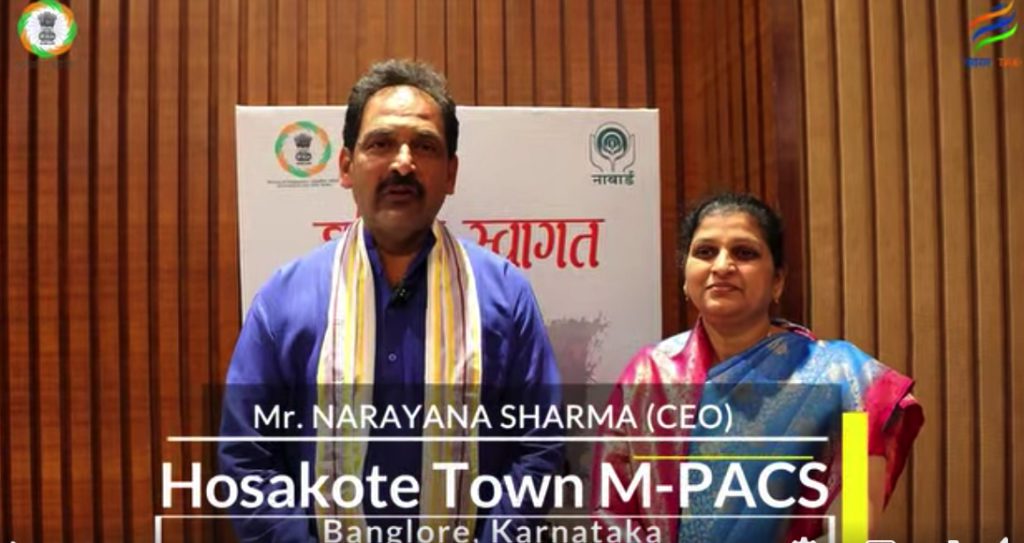
In a notable example of grassroots economic transformation, the Hoskote Primary Agricultural Credit Society (PACS) in Bengaluru has emerged as a model of cooperative success, achieving a remarkable annual turnover of Rs 1000 crore. The society’s journey, shaped by decades of perseverance and community-driven growth, reflects the transformative potential of India’s cooperative movement.
At the heart of this success story is Narayan Sharma, who has been associated with the PACS for nearly 30 years. Recounting its evolution, Sharma highlights the early struggles faced by the institution, from limited financial resources to low farmer participation. However, sustained efforts, transparent governance, and a deep-rooted belief in collective progress enabled the PACS to steadily expand its operations and impact.
Guided by the principle of “Prosperity through Cooperation,” the Hoskote PACS has grown beyond its traditional credit role. Today, it plays a pivotal part in agricultural input distribution, particularly fertilizers, across 41 villages in the region. This extensive outreach has strengthened the rural supply chain, ensuring timely availability of essential inputs to farmers and enhancing agricultural productivity.
The society’s growth aligns with the broader push to revitalize PACS across India under initiatives supported by the Ministry of Cooperation. In recent years, the government has emphasized diversification of PACS activities, digitalization, and improved governance standards to make them viable multi-service centers in rural economies. Hoskote PACS stands as a successful example of how these objectives can be realized on the ground.
Beyond numbers, the impact of the PACS is visible in improved livelihoods and greater financial inclusion among farmers. By providing accessible credit, agricultural inputs, and other services, the cooperative has reduced dependence on informal lending channels and strengthened the local rural economy. Its role as a reliable intermediary between farmers and markets has further enhanced income stability in the region.
Sharma underscores that the journey was not without challenges. Periods of financial stress, operational inefficiencies, and evolving market demands required constant adaptation. However, he credits the resilience of members and the commitment of the management for overcoming these hurdles. According to him, the key lesson is simple yet powerful: consistent effort, when backed by dedication and capability, inevitably leads to success.
The Hoskote PACS story also reflects a larger narrative unfolding across India, where cooperatives are increasingly being seen as engines of inclusive growth. With renewed policy focus, technological integration, and community participation, PACS are gradually transforming into dynamic institutions capable of addressing diverse rural needs.
As India looks to strengthen its rural economy, success stories like Hoskote PACS offer both inspiration and a practical roadmap. They demonstrate that when communities come together with a shared vision, even modest beginnings can lead to extraordinary outcomes.