





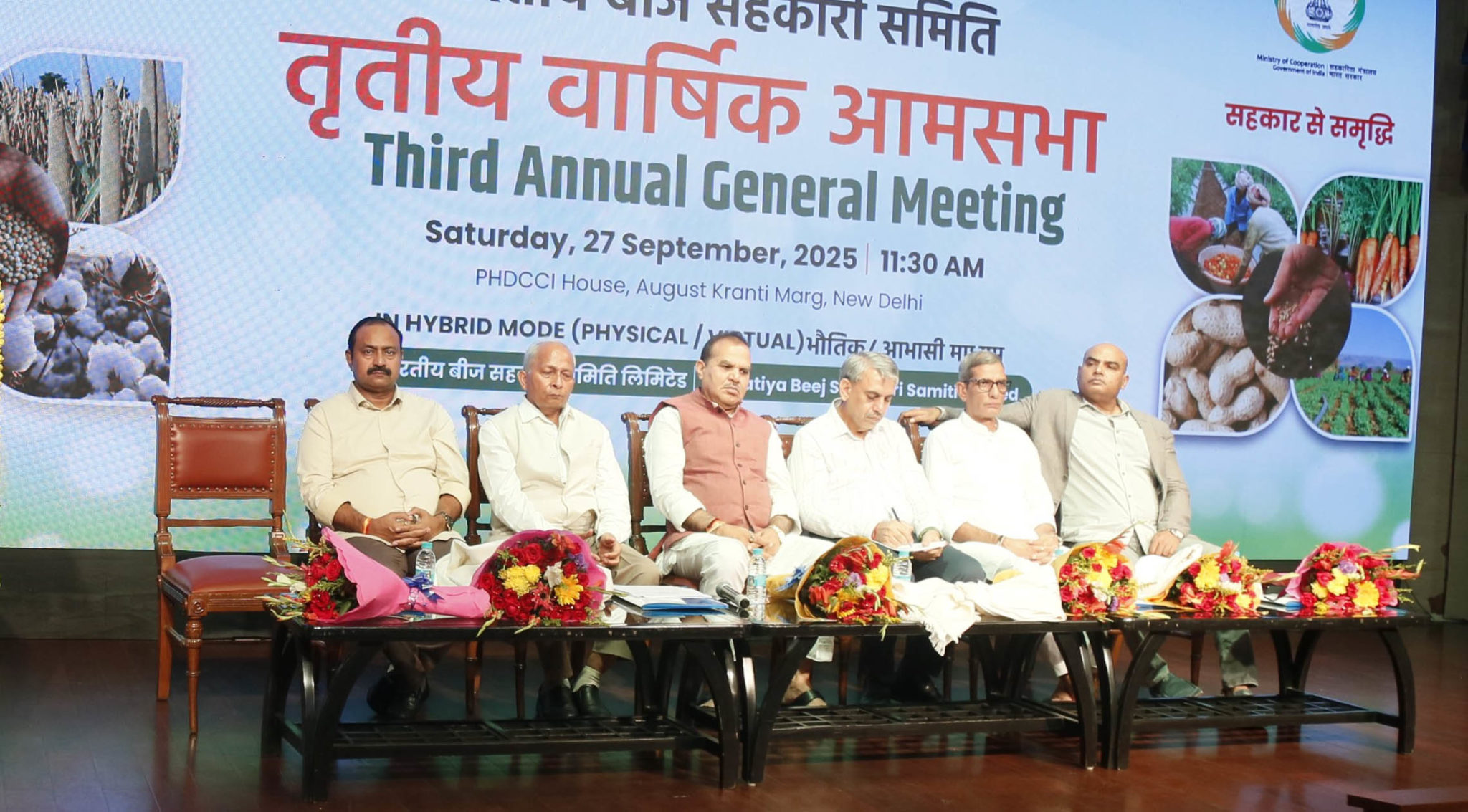
The Third Annual General Meeting (AGM) of Bharatiya Beej Sahakari Samiti Limited (BBSSL) was convened on 27 September 2025 at the PHD Chamber of Commerce and Industry (PHDCCI), New Delhi, in a hybrid format. The gathering brought together the Board of Directors, representatives from Primary Agricultural Credit Societies (PACS), and cooperative institutions from across India, providing a platform to review past performance, deliberate on future strategy, and reinforce cooperative synergies.
During the meeting, participants were apprised of BBSSL’s strong performance over the past year. The AGM spotlighted key achievements in scaling production and distribution of high-quality certified seeds, expanding network linkages with PACS, and improving access to seed inputs in under-served regions. Members discussed the organization’s financial results, consolidation of reserves, and operational milestones achieved across states.
Since its inception, BBSSL has been actively promoting a cooperative seed value chain model. Under this model, breeder seeds are sourced from public research bodies (e.g. ICRISAT, IRRI, CIMMYT), while downstream multiplication, processing, certification, and distribution are channeled through cooperative networks including PACS.
The AGM also underscored BBSSL’s commitment to preserving and promoting indigenous seed varieties, a move aligned with national goals of biodiversity, climate resilience, and food sovereignty. In partnership with organizations such as The Art of Living’s Sri Sri Institute of Agricultural Sciences & Technology (SSIAST), BBSSL has signed MoUs to promote seed banks, farmer training, and blockchain-based seed traceability.
A key theme of the AGM was the need for deeper collaboration across PACS, state cooperatives, and central coordinating bodies to ensure timely and equitable availability of certified seeds. To that end, the Board pledged to strengthen inter-cooperative coordination, invest in logistics and storage infrastructure, and support capacity building in local cooperatives.
BBSSL reaffirmed its cooperative-centric philosophy with the motto “Sahakar Se Samriddhi” (Cooperation for Prosperity). Members committed to reinforcing democratic governance, transparency in profit appropriation, and fair distribution of surpluses. According to BBSSL byelaws, at least 25 % of net profits must be transferred to reserves, 1 % to cooperative education funds, and 10 % to a contingency reserve, with the balance used for dividends, training, or cooperative development.
A further emphasis was placed on leveraging government policy support. In December 2024, for example, Union Minister Amit Shah set an ambitious target for BBSSL to connect with 20,000 additional cooperative societies by 2025–26, to deepen outreach and rural penetration. He also urged BBSSL to prioritize seed varieties requiring less water and fewer pesticides, aligned with sustainability goals.
The AGM concluded on a resolute note. Stakeholders collectively resolved to strengthen the seed cooperative movement across India, deepen farmer participation, and ensure that high-quality certified seeds reach the last mile. Emphasis will also be placed on innovation (e.g. digital seed-traceability, blockchain), stronger linkages with research institutions, and scaling indigenous seed systems.
As BBSSL continues to expand its cooperative network, it seeks to contribute meaningfully to the national agenda of agricultural resilience, self-reliance, and rural prosperity. By reinforcing cooperative principles and combining them with modern tools and policy support, BBSSL aspires to be a pivotal force in transforming India’s seed ecosystem.