





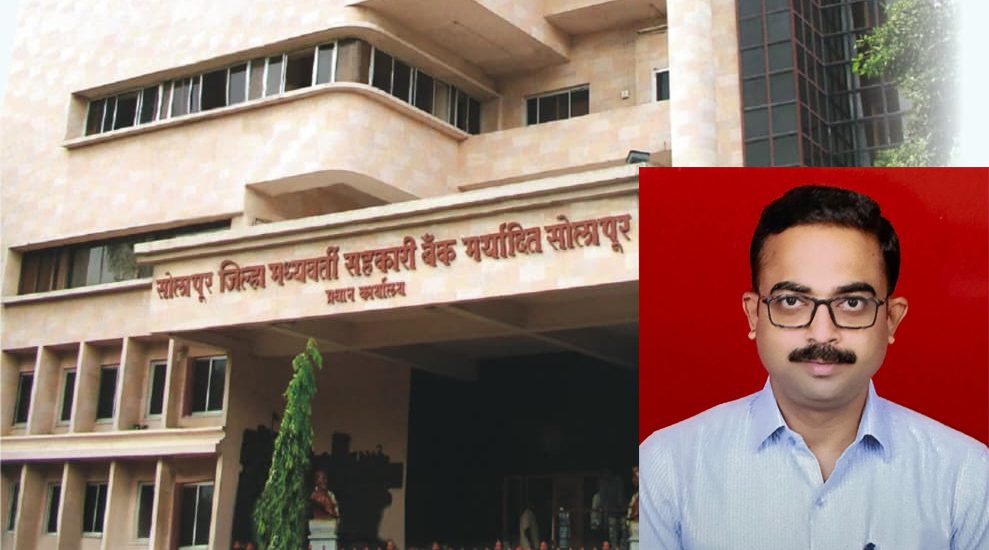
Maharashtra based Solapur District Central Cooperative Bank (DCC Bank) has staged a remarkable financial turnaround, crossing Rs 10,000 crore in total business and reporting a profit of around Rs 250 crore as of March 31, 2026.
Once struggling under financial stress and uncertainty following the dissolution of its board in 2018, the bank has regained stability and credibility under the leadership of former administrator Shailesh Kothimare and current Administrator Kundan Bhole along with their teams.
The bank’s total business has grown significantly from Rs 4,545 crore in 2017–18 to Rs 10,230 crore in 2025–26. Deposits have more than doubled, rising from Rs 2,330 crore to Rs 5,757 crore, while total investments have increased from Rs 844 crore to Rs 2,079 crore. The loan portfolio has also expanded from Rs 2,214 crore to Rs 4,473 crore, indicating renewed lending activity and improved customer confidence.
One of the notable aspects of this turnaround is improved operational efficiency despite a reduced workforce. The number of employees has declined from 1,216 in 2018 to 777 at present, yet the bank has delivered stronger performance.
Besides, share capital has increased from Rs 189 crore to Rs 243 crore, while the Capital to Risk (Weighted) Assets Ratio (CRAR) has improved to 13 percent, comfortably above the regulatory requirement of 9 percent. The bank has also invested around Rs 1,600 crore in government securities, strengthening its financial stability.
Speaking to Indian Cooperative on the achievement, Administrator Kundan Bhole said that the bank initially focused on recovery, which was the biggest challenge. A structured business development plan was implemented with clear targets for branches and staff at all levels.
“Initiatives such as expanding savings accounts, promoting microfinance, extending loans to self-help groups and joint liability groups, and introducing salary loan schemes helped drive growth. The bank also deployed mobile ATMs and cash vans to improve rural outreach,” he added.
Bhole emphasized that technology is playing a crucial role in the bank’s transformation. The core banking system has been strengthened, cybersecurity measures have been enhanced, and efforts are underway to introduce mobile banking and internet banking services. He added that adopting modern technologies, including AI-based solutions, will be the next step in making the bank more competitive and customer-friendly.
The bank is also addressing its legacy non-performing assets (NPAs). Gross NPA in 2018 was around 42 percent and net NPA at about 23 percent. However, through One-Time Settlement (OTS) schemes and focused recovery drives, the bank has successfully brought the net NPA below 5 percent and aims to reduce gross NPA to under 15 percent in the near future.
With this strong comeback, Solapur DCC Bank has not only improved its financial position but also restored trust among depositors and stakeholders. It may also serve as an example for other DCCBs such as Buldhana, Wardha, Nashik and Nagpur, which have been in losses for years, to draw lessons from.