
Delivering a clear and cautionary message to the cooperative banking sector, RBI Central Board Director Satish Marathe said that urban cooperative banks must quickly adapt to changing dynamics or risk becoming irrelevant in day-to-day banking operations.
Speaking at a seminar held in Pune, Marathe highlighted the growing intensity of competition in the banking sector. He noted that both investors and borrowers have become more aware and selective in their financial decisions. In such an environment, he stressed that maintaining credibility alone is no longer sufficient. “Banks must actively work towards enhancing banking literacy to remain relevant,” he said.
Drawing attention to a critical gap, Marathe pointed out that nearly half of India’s population still remains outside the formal banking system. This, he said, underscores the urgent need to expand financial awareness and inclusion.
He further explained that while the number of investors and borrowers is steadily increasing, declining interest rates are making it even more important for customers to make informed financial choices. In this context, he welcomed the release of a new book on banking literacy, stating that it would contribute meaningfully to bridging the awareness gap.
Marathe also spoke about governance reforms in the cooperative banking sector. He noted that limiting directors to two terms is a progressive step that can encourage youth participation and bring in fresh leadership. He reiterated that regulations issued by the Central Government are binding on all banks and added that the RBI has established a dedicated forum to address the concerns of urban cooperative banks.
Adding to the discussion, Dr. Uday Joshi observed that the broader regulatory approach appears to be aimed at reducing the number of banks, while clarity on new licenses remains limited. He pointed out that no new banking licenses have been issued for cooperative banks since the early 2000s, leading to a rapid rise in credit societies.
Founder Chairman of Buldana Urban, Radheshyam Chandak, emphasized the need to strengthen social banking initiatives to boost deposits. Meanwhile, Anil Kavade highlighted efforts to digitize cooperative elections, reduce costs, and improve transparency through EVM-based systems.
Milind Kale shared that 19 banks have been merged into Cosmos Bank so far, mainly those affected by poor business decisions, while institutions impacted by corruption were excluded. He noted that such mergers create opportunities for expansion into new regions.
Concluding the session, Ajay Brahmecha said that although obtaining new banking licenses has become increasingly difficult, the conversion of credit societies into banks could offer a practical way forward.
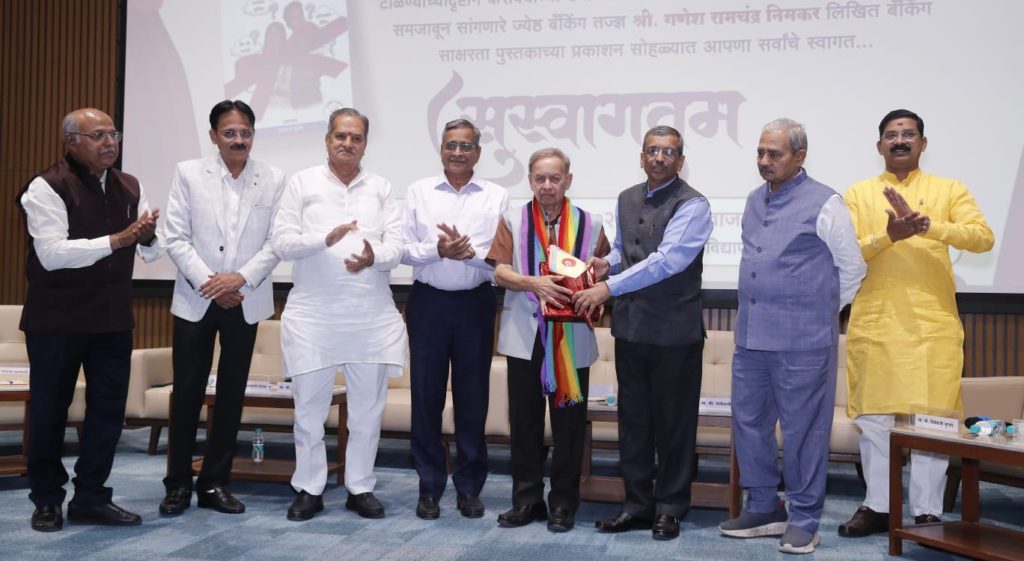
On the occasion, a book on ‘Banking Literacy’ was released. Author Ganesh Nimkar explained the objective behind the publication, while publisher and Sahakar Sugandh editor Bhalchandra Kulkarni welcomed the guests.