
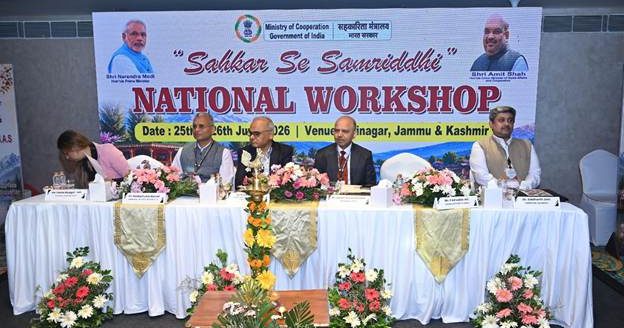
Ground-level realities, implementation challenges and future opportunities dominated discussions at the 8th National Conference on Cooperation held in Srinagar, where policymakers, state governments and cooperative institutions deliberated on the next phase of growth for India’s cooperative sector.
The conference, themed “Sahkar se Samriddhi, From Vision to Ground Reality,” reviewed the progress made since the creation of the Ministry of Cooperation and charted a roadmap for accelerating cooperative development across the country. Senior officials from States and Union Territories, Registrars of Cooperative Societies, national federations and other stakeholders participated in the deliberations.
Addressing the conference, Secretary, Ministry of Cooperation, Dr. Ashish Kumar Bhutani, said the cooperative movement has entered a new phase where the focus must shift from merely achieving numerical targets to ensuring quality, accountability, professional management and measurable impact at the grassroots level. He noted that major reforms undertaken over the past five years, including computerisation of Primary Agricultural Credit Societies (PACS), adoption of model bye-laws, business diversification and formation of multipurpose cooperatives, have strengthened the sector’s foundation.
Dr. Bhutani emphasized the need for technology-driven governance, warning that cooperative banks must modernise their digital infrastructure to remain competitive in an era increasingly dominated by UPI-based payments and digital financial services. He advocated common technology platforms, stronger governance frameworks and improved service delivery standards for both rural and urban cooperative banks.
A major focus of the conference was sustainability. The Secretary highlighted opportunities for cooperatives in circular economy initiatives involving dairy, compressed biogas and sugar by-products. Such projects, he said, can generate additional income for members while supporting clean energy and sustainable agricultural practices.
The conference also discussed the upcoming National Cooperative Database 2.0, which will allow cooperatives to directly update and validate data, strengthening evidence-based policymaking and improving monitoring mechanisms. States were urged to accelerate infrastructure development under the World’s Largest Grain Storage Plan to reduce post-harvest losses and improve agricultural value chains.
State-led discussions formed a distinctive feature of the conference, with participants sharing successful models, innovations and local challenges. Particular attention was given to expanding the cooperative network through new multipurpose PACS, dairy and fishery cooperatives in uncovered Panchayats. Delegates also exchanged ideas on business diversification and transforming PACS into vibrant, professionally managed rural enterprises.
National institutions including NABARD, NDDB, IFFCO, KRIBHCO, NAFED, NCCF and NCDC contributed perspectives on financing, capacity building and market support. The conference concluded with actionable recommendations and six-month targets aimed at translating policy initiatives into tangible benefits for cooperative members across India.