






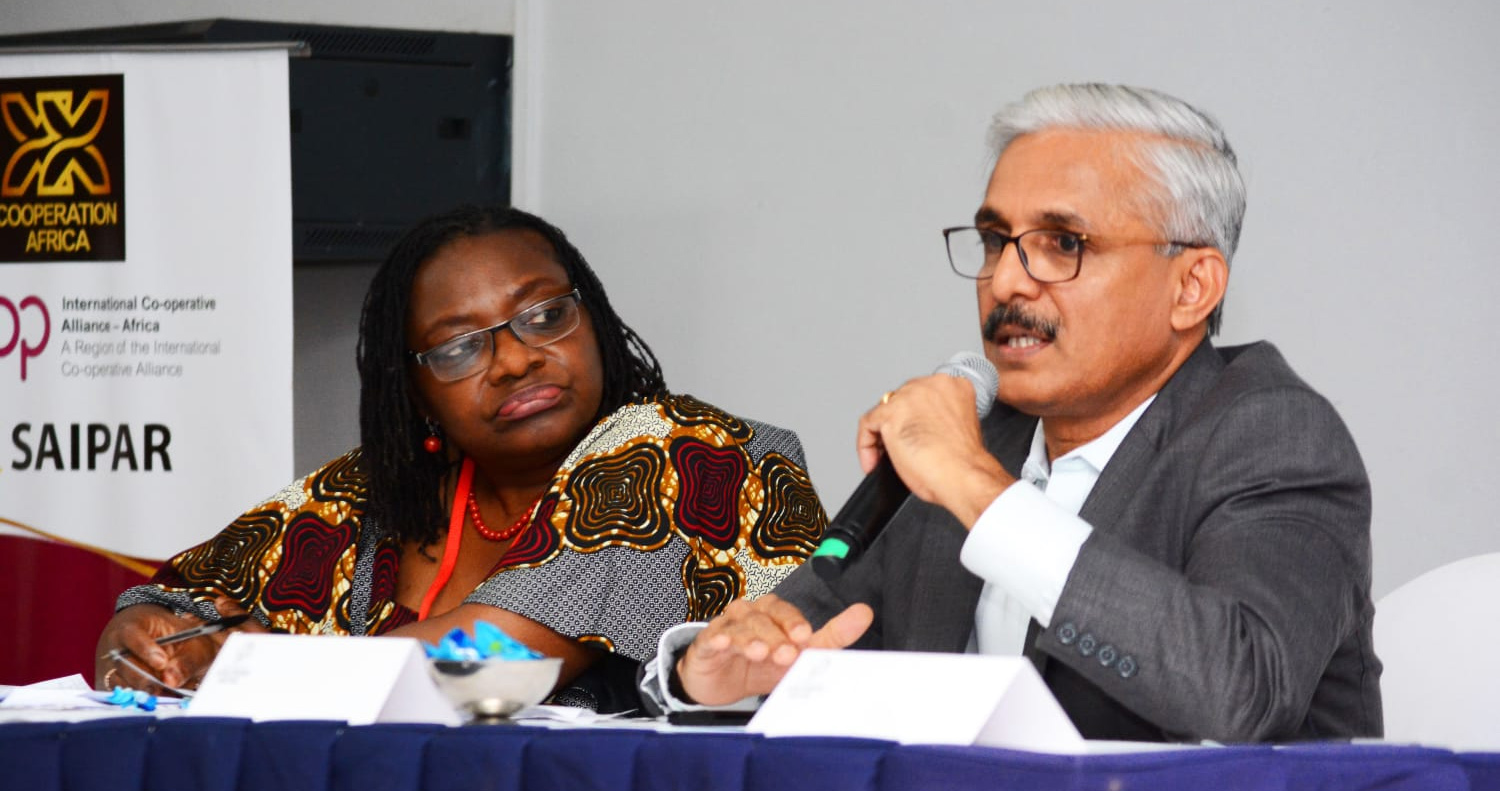
Kishor Kumar T.K., Chief Project Coordinator of Kerala-based Uralungal Labour Contract Cooperative Society Ltd. (ULCCS), has highlighted the potential of worker cooperatives to create decent jobs, promote entrepreneurship and empower young people at an international conference in Lusaka, Zambia.
Kishor Kumar participated as a Distinguished Speaker and Mentor at the International Conference on Worker Cooperatives and Decent Youth Employment in Africa, held from August 24 to 26, 2026. The conference was organised by Cooperation Africa in partnership with the International Cooperative Alliance–Africa (ICA-Africa).
Delivering a presentation titled “Worker Cooperatives and Job Creation – Examples from Around the World and Africa,” he shared ULCCS’s journey as a worker-owned cooperative and explained how collective ownership, entrepreneurship and innovation can drive sustainable employment.
A major focus of his intervention was youth participation in cooperatives. He stressed that young people should not be treated merely as beneficiaries but as entrepreneurs, members, innovators, decision-makers and future leaders of the cooperative movement.
As part of the Africa Cooperative Entrepreneurship (ACE) Programme, Kishor Kumar also mentored young African cooperative ambassadors, encouraging them to view cooperative entrepreneurship as a pathway to decent work, enterprise development and economic empowerment.
Addressing the challenge of youth unemployment across Africa, he called for greater investment in youth-led cooperatives, cooperative education, innovation and leadership development.
“Empowering young people through cooperatives is not simply about creating jobs; it is about creating entrepreneurs, owners and leaders who can shape a more inclusive and sustainable economy,” he said.
ULCCS provides a particularly relevant Indian example for this discussion. Established in 1925 in Kozhikode, Kerala, the cooperative was created to provide workers with dignity, stability and employment through collective ownership.
Over a century, it has evolved from a labour-contract society undertaking small public works into a major infrastructure organisation, completing thousands of projects including roads, bridges and other public infrastructure. The Kerala Government describes ULCCS as a globally recognised example of a worker-owned enterprise capable of undertaking large-scale infrastructure projects.
Significantly, ULCCS has also diversified beyond construction into information technology, tourism, education, skill development and agribusiness. Its expansion into IT through UL Technology Solutions and UL Cyberpark, along with its emphasis on skilling, demonstrates how a traditional worker cooperative can adapt to the changing economy and create new opportunities for younger generations.
The cooperative’s experience is therefore particularly relevant to Africa’s employment challenge, where worker ownership can combine livelihood security with entrepreneurship and professional skill development. Its model shows that cooperatives need not remain confined to traditional occupations but can embrace technology, innovation and new sectors while retaining democratic ownership.
Kishor Kumar’s participation consequently strengthened India-Africa cooperative knowledge exchange while showcasing ULCCS as a practical example of how worker-owned enterprises can contribute to employment generation, youth empowerment and inclusive economic growth.