
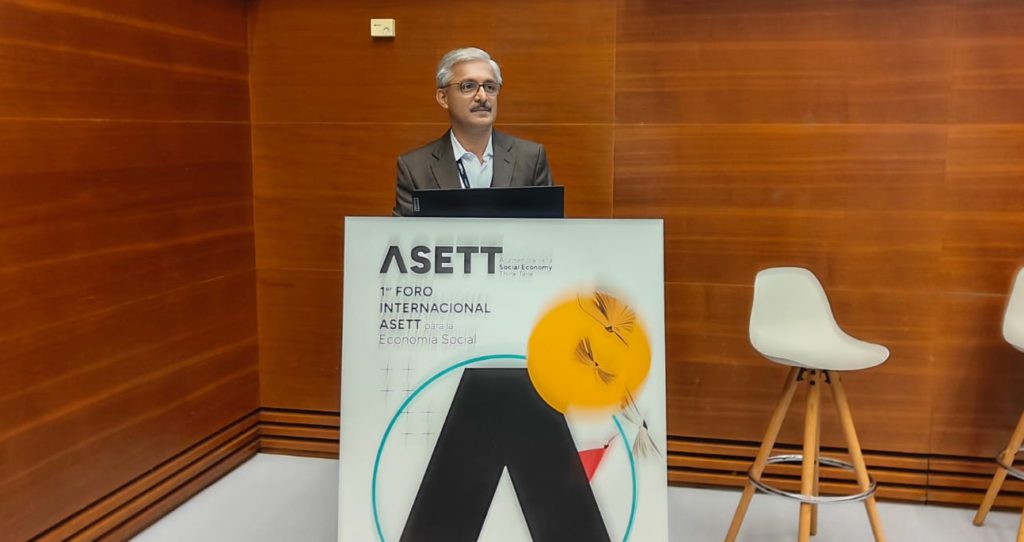
The Uralungal Labour Contract Cooperative Society (ULCCS) was recognized as one of the world’s finest models at the International Forum on Social Economy held in San Sebastián, Spain.
Ministers and delegates from various countries attended the event, where ULCCS’s pioneering initiatives were showcased. A book detailing the society’s model was also released during the summit, and subsequent discussions prominently featured ULCCS.
T.K. Kishor Kumar, Chief Project Coordinator of ULCCS and Director of the National Labour Federation, presented a paper titled ‘The Uralungal Model: A Global Benchmark in Socio-Economic Systems.’ Notably, ULCCS was the only organization from India invited to the forum, apart from SEWA (Self-Employed Women’s Association), a Gujarat-based national women’s collective.
Kishor Kumar shared the inspiring journey of ULCCS, a cooperative born a century ago in a poverty-stricken Indian village grappling with colonial rule and caste discrimination. Today, it stands as a global symbol of social willpower, value-driven entrepreneurship, and innovative collectivism. He highlighted key factors behind its success: strong social commitment, unwavering focus on quality, fostering ownership among workers, transparency, ethical governance, diversification strategies, and investment in human capital.
The forum, ‘Arizmendiarrieta Social Economy Think Tank’, was the first-of-its-kind three-day summit focused on reducing inequality and strengthening social labor systems, with participation from delegates representing 50 countries.
The event was organized by Spain’s Business Confederation of Social Economy (CEPES), with support from the Spanish Ministry of Labour and Social Economy.
Prominent attendees included Mrs. Yolanda Díaz, Second Vice President and Minister of Labour and Social Economy; Dione Aliou, Minister of Microfinance and Social and Solidarity Economy of Senegal; Patrick Kiburi Kilemi, Principal Secretary, State Department for Cooperatives, Kenya and Mrs. Enas Dahadha Attari, Minister of Labour of the Palestinian Authority.
Other noteworthy attendees included Mr. Gilberto Carvalho, National Secretary for Solidarity Economy of Brazil and Mr. Maxime Baduel, Ministerial Delegate for Social and Solidarity Economy of France. [Many nations today have dedicated ministries for Social Economy and Social and Solidarity Economy, prioritizing social welfare and justice over mere economic gains.]
The summit emerged as a crucial platform for policymakers, institutions, governments, and academia to explore transformative cooperative models, social enterprises, and labor movements. It successfully brought global attention to alternative socio-economic frameworks.
By presenting Kerala’s indigenous success story on this prestigious stage, the Uralungal Model has cemented its place in global discourse, reinforcing its relevance as a sustainable and equitable development paradigm.