
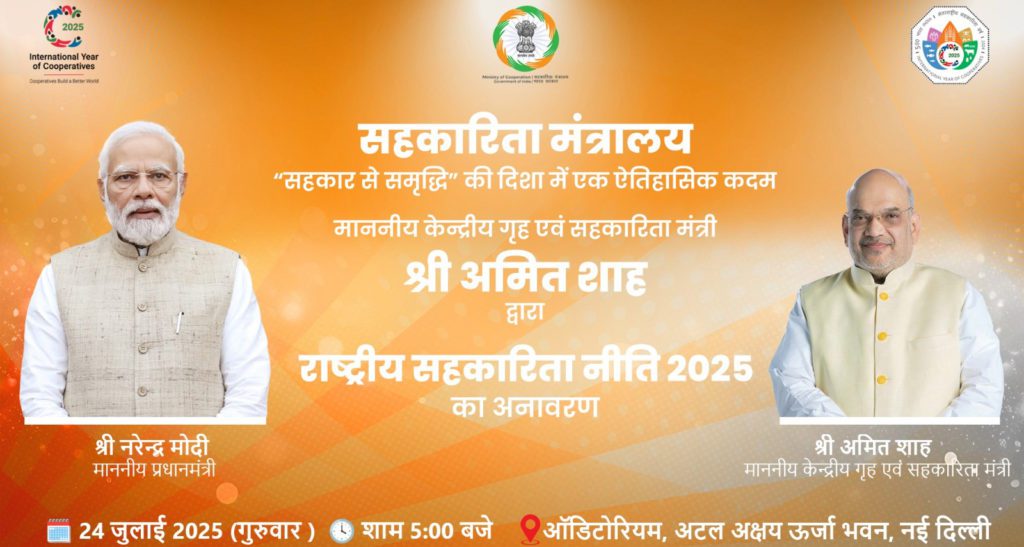
Union Home and Cooperation Minister Amit Shah will unveil the much-anticipated National Cooperative Policy 2025 at a high-profile event on July 24 at Atal Akshay Urja Bhawan in New Delhi. The policy, which has been in the making for several months, is set to shape the cooperative movement in India for the next two decades, from 2025 to 2045.
The policy has been developed under the leadership of Prime Minister Narendra Modi and aims to modernize and energize India’s vast cooperative ecosystem. At its core is the government’s vision of “Sahkar se Samriddhi” (Prosperity through Cooperation), which aligns with the broader national goal of Viksit Bharat 2047.
The new policy is expected to serve as a blueprint for institutional reform and capacity building in the cooperative sector, especially at the grassroots level. It focuses on improving governance, ensuring transparency, boosting employment opportunities, particularly in rural India, and making cooperatives professionally managed and future-ready.
This will be the second national-level policy for cooperatives; the first was introduced in 2002. Since then, the sector has witnessed significant shifts driven by globalization, digitization, and changing socio-economic conditions. The updated policy seeks to address these realities with a fresh and comprehensive framework.
The 48-member National Level Committee, chaired by former Union Minister Suresh Prabhu, has crafted the policy after extensive consultations. The committee included representatives from national and state cooperative federations, government officials, sectoral experts, and academics. Over 648 suggestions were received and examined through 17 committee meetings and four regional workshops held in Ahmedabad, Bengaluru, Gurugram, and Patna.
Key structural reforms proposed under the new policy include the creation of centralized recruitment boards at both national and state levels. Modeled after UPSC and State PSCs, these boards will ensure transparent, merit-based hiring across cooperative societies and federations, thereby eliminating political favoritism and widespread irregularities that have long plagued the system.
To further strengthen regulatory oversight, the Centre is expected to propose the establishment of a supervisory authority similar to the Reserve Bank of India but dedicated solely to the cooperative sector. This new regulator will be supported by a Cooperative Audit and Accounting Board and a dedicated arbitration tribunal to resolve disputes efficiently. Together, these measures are aimed at improving accountability, restoring public trust, and minimizing the risk of future scams.
The policy is also likely to include fiscal incentives. Sources indicate that the government may announce tax relief for cooperative institutions by either reducing or eliminating the income tax surcharge. A cut in the Minimum Alternative Tax (MAT) is also being considered, which would ease financial pressures and make cooperatives more growth-oriented and competitive.
Senior officials from the Ministry of Cooperation, National Cooperative Development Corporation (NCDC), National Council for Cooperative Training (NCCT), and Vaikunth Mehta National Institute of Cooperative Management (VAMNICOM) are expected to attend the launch event. Full details of the policy will be announced by the Union Minister on July 24.