

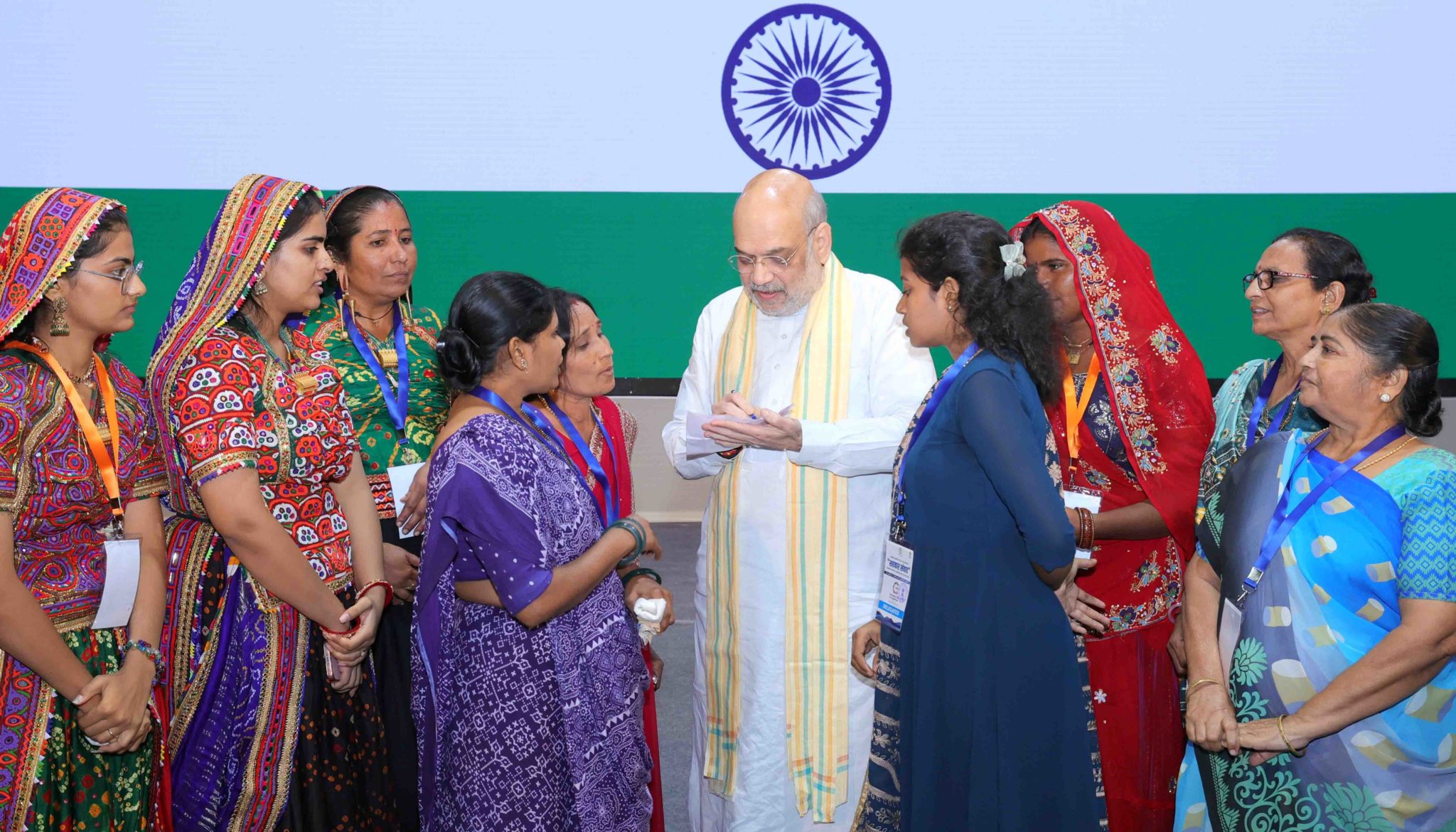
Union Home and Cooperation Minister Amit Shah emphasized the transformative power of India’s cooperative movement during a special ‘Sahkar Samvad’ held in Ahmedabad with women cooperative workers from Gujarat, Madhya Pradesh, and Rajasthan.
The event was part of celebrations marking the International Year of Cooperatives 2025 and spotlighted the evolving role of cooperatives in empowering rural communities, especially women.
In his address, Shah announced the establishment of “Tribhuvan” Sahkari University in Anand, Gujarat, in honour of the legendary cooperative pioneer Tribhuvandas Patel. Hailing Patel as the true architect of India’s cooperative sector, Shah credited him with laying the groundwork for the success of institutions like Amul, which has enabled over 36 lakh women in Gujarat to collectively manage a dairy business worth Rs 80,000 crore.
The minister detailed several new initiatives aimed at deepening cooperative engagement in rural India. He said the government is revamping cooperative dairies with a focus on cow dung utilization, animal health, and feed management.
Efforts are underway to convert cow dung into bio-manure and biogas, and plans are being finalized to bring most milk-producing families into the cooperative fold. Shah projected that soon 400 out of every 500 such families in villages would be members of cooperatives, with even the collection and management of animal waste integrated into cooperative functions.

Turning to Primary Agricultural Credit Societies (PACS), Shah said they are being reoriented as multi-service centres. Now linked to around 25 services including Common Service Centres (CSCs), Micro ATMs, Bank Mitras, and rural water supply schemes, PACS are poised to become income-generating hubs. He urged PACS to promote Jan Aushadhi Kendras by raising awareness about low-cost medicines among villagers.
For farmers growing maize and pulses, Shah encouraged registration on the NCCF app, which would allow them to receive Minimum Support Price through procurement by NCCF and NABARD. He noted that farmers could still sell in open markets if prices were better, ensuring flexibility and maximum benefit.
Shah passionately advocated for natural farming, describing it as both ecologically sound and economically rewarding. Sharing personal experience, he said he had witnessed a 1.5x rise in yield through natural methods without chemical fertilizers. Earthworms, he added, act as natural fertilizers, preserving soil health and saving water. The Cooperation Ministry has created a dedicated cooperative body for organic produce procurement and export, ensuring that export profits reach farmers directly.
Shah further said, “Natural farming is not only beneficial for our health but also improves soil health and increases productivity.”
In a poignant closing, Shah reflected on his dual responsibilities, calling the Ministry of Cooperation more meaningful than even the Home Ministry. “This ministry serves the poorest of the poor, farmers, animals, and rural India,” he said.
The minister also revealed ongoing research into the medicinal properties of camel milk and announced that he would organize 10 more ‘Chaupals’ across different states to gather grassroots insights and shape future policies for cooperative growth.