
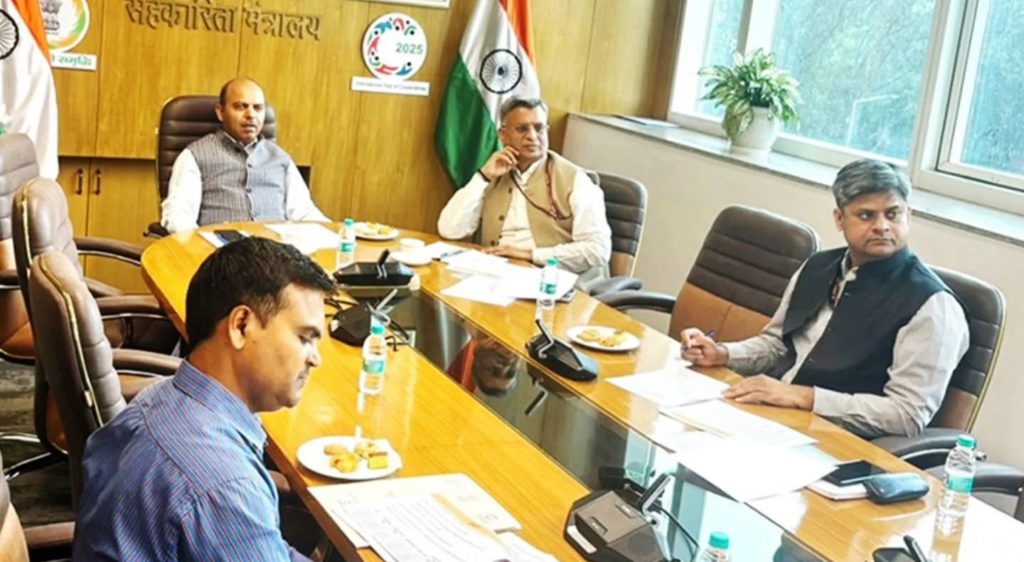
In a concerted effort to restore the prominence of cooperative banks in India’s agricultural financing system, the Ministry of Cooperation (MoC) and the National Bank for Agriculture and Rural Development (NABARD) held a high-level virtual meeting chaired by Cooperation Secretary Dr. Ashish Kumar Bhutani.
The meeting focused on the declining share of cooperative banks in agricultural credit and identified strategic measures to strengthen their role within the rural credit architecture.
Dr. Bhutani stressed that cooperative banks-especially the three-tier structure comprising State Cooperative Banks (StCBs), District Central Cooperative Banks (DCCBs), and Primary Agricultural Credit Societies (PACS)-form the backbone of rural credit delivery.
With their deep roots in villages and community-based approach, these institutions have historically ensured access to affordable finance for small and marginal farmers. However, their share in agricultural credit has eroded significantly in recent decades, necessitating immediate institutional and policy action.
The meeting was attended by senior officials including Pankaj Kumar Bansal, Additional Secretary (MoC); Raman Kumar, Joint Secretary (MoC); and Shaji K. V., Chairman of NABARD, along with representatives from both organizations. The participants reviewed the status of agricultural lending by cooperatives and discussed ways to modernize the cooperative credit structure through digital integration, professional training, and improved coordination across all levels.
Recent studies highlight the depth of the problem. Cooperative banks’ share in short-term agricultural credit, which was around 66 per cent in 1995–96, dropped to about 59 per cent by 2021–22, according to research published by NABARD.


To reverse the trend, the meeting underscored four key strategies. First, the accelerated computerisation and digital linkage of PACS with district and state cooperative banks, an initiative already being implemented under the Centrally Sponsored Project for PACS Computerisation.
Second, institutional capacity-building and staff training to improve risk management and governance. Third, targeted policy interventions and incentives to enhance cooperatives’ ability to lend to small and marginal farmers. And fourth, diversification of PACS into non-credit activities-such as input supply, storage, and marketing-to improve financial viability.
The discussion reflected a shared understanding between MoC and NABARD that revitalising cooperatives is essential for achieving inclusive and sustainable agricultural growth, ensuring that the benefits of rural credit reach the farmers who need them most.
Data gathered shows that in FY2024, cooperative banks disbursed Rs 2.3 lakh crore in agricultural credit, accounting for 9.2% of the total Ground-Level Credit (Rs 25.1 lakh crore), slightly below their target of Rs 2.6 lakh crore. Commercial banks held a 79% share, with RRBs contributing 12%.
In FY2025, cooperative banks increased disbursement to Rs 2.4 lakh crore (8.4% of total agricultural credit of Rs 28.7 lakh crore), still below their target of Rs 3.0 lakh crore. While absolute disbursement rose by Rs 0.1 lakh crore, their share declined slightly. Commercial banks retained an 81% share, followed by RRBs at 10.8%.