






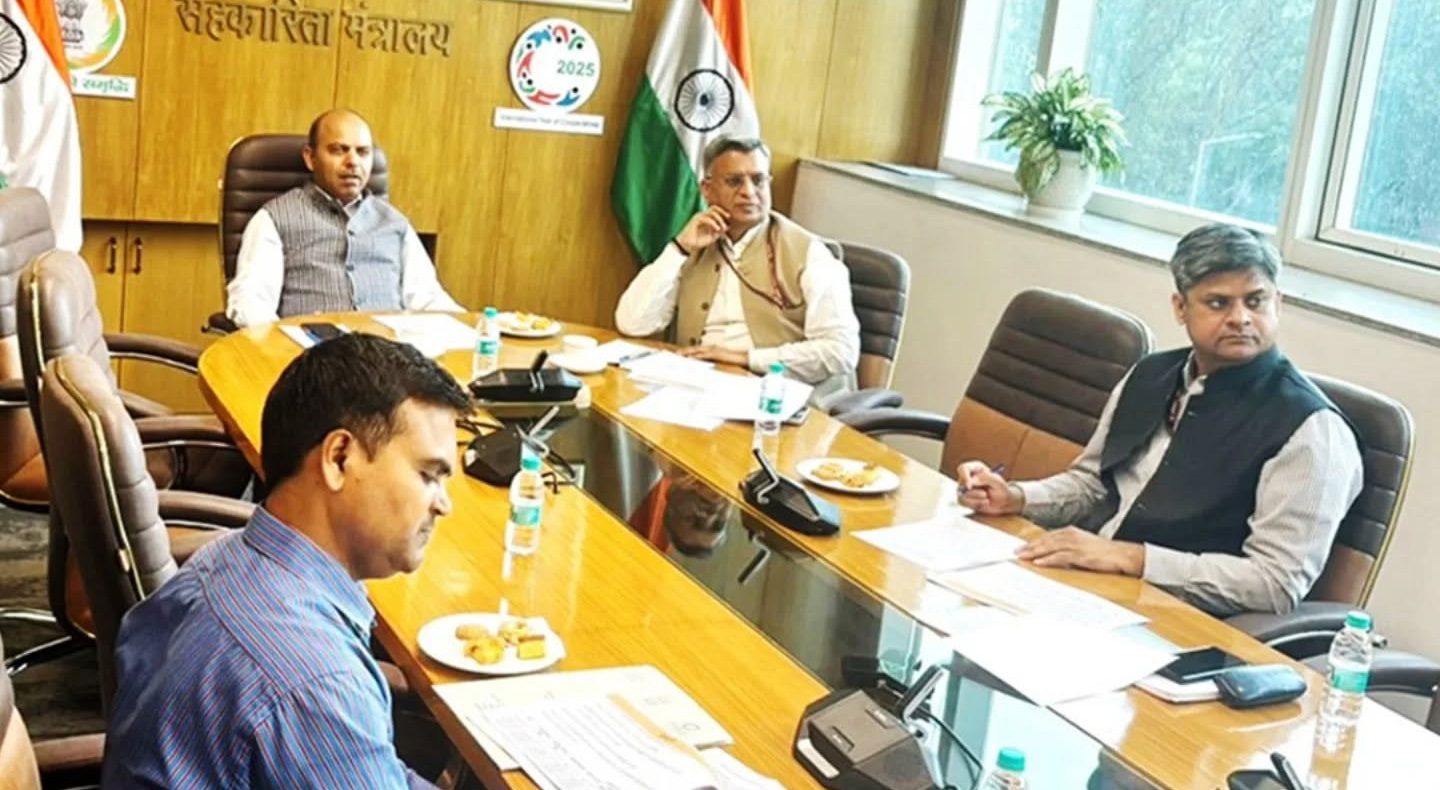
In a concerted effort to restore the prominence of cooperative banks in India’s agricultural financing system, the Ministry of Cooperation (MoC) and the National Bank for Agriculture and Rural Development (NABARD) held a high-level virtual meeting chaired by Cooperation Secretary Dr. Ashish Kumar Bhutani.
The meeting focused on the declining share of cooperative banks in agricultural credit and identified strategic measures to strengthen their role within the rural credit architecture.
Dr. Bhutani stressed that cooperative banks-especially the three-tier structure comprising State Cooperative Banks (StCBs), District Central Cooperative Banks (DCCBs), and Primary Agricultural Credit Societies (PACS)-form the backbone of rural credit delivery.
With their deep roots in villages and community-based approach, these institutions have historically ensured access to affordable finance for small and marginal farmers. However, their share in agricultural credit has eroded significantly in recent decades, necessitating immediate institutional and policy action.
The meeting was attended by senior officials including Pankaj Kumar Bansal, Additional Secretary (MoC); Raman Kumar, Joint Secretary (MoC); and Shaji K. V., Chairman of NABARD, along with representatives from both organizations. The participants reviewed the status of agricultural lending by cooperatives and discussed ways to modernize the cooperative credit structure through digital integration, professional training, and improved coordination across all levels.
Recent studies highlight the depth of the problem. Cooperative banks’ share in short-term agricultural credit, which was around 66 per cent in 1995–96, dropped to about 59 per cent by 2021–22, according to research published by NABARD.
 Other analyses show that their overall share in agricultural lending has fallen from nearly 86 per cent in the early 1970s to below 20 per cent in recent years. The decline has been attributed to a combination of factors-limited capital base, outdated technology, weak governance, and competition from commercial and regional rural banks.
To reverse the trend, the meeting underscored four key strategies. First, the accelerated computerisation and digital linkage of PACS with district and state cooperative banks, an initiative already being implemented under the Centrally Sponsored Project for PACS Computerisation.
Second, institutional capacity-building and staff training to improve risk management and governance. Third, targeted policy interventions and incentives to enhance cooperatives’ ability to lend to small and marginal farmers. And fourth, diversification of PACS into non-credit activities-such as input supply, storage, and marketing-to improve financial viability.
The discussion reflected a shared understanding between MoC and NABARD that revitalising cooperatives is essential for achieving inclusive and sustainable agricultural growth, ensuring that the benefits of rural credit reach the farmers who need them most.
Data gathered shows that in FY2024, cooperative banks disbursed Rs 2.3 lakh crore in agricultural credit, accounting for 9.2% of the total Ground-Level Credit (Rs 25.1 lakh crore), slightly below their target of Rs 2.6 lakh crore. Commercial banks held a 79% share, with RRBs contributing 12%.
In FY2025, cooperative banks increased disbursement to Rs 2.4 lakh crore (8.4% of total agricultural credit of Rs 28.7 lakh crore), still below their target of Rs 3.0 lakh crore. While absolute disbursement rose by Rs 0.1 lakh crore, their share declined slightly. Commercial banks retained an 81% share, followed by RRBs at 10.8%.














































One of the main issues to be addressed for strengthening of the STCCS is strengthening process should begin from PACS. And in the PACS putting in place of qualified staff is the primary requirement. Computerisation, business diversification etc are laudable and are highly essential, but if qualified staff are not in place, it would be difficult for these initiatives to succeed. Steps should be initiated to implement the HR Policy for PACS (prepared by NAFSCOB) on a priority basis for all other initiatives to succeed and make the STCCS stronger and contribute to the mandate of Viksit Bharat significantly.
Another impotant aspect is the shrinking quantum or proportion of low cost refinance to coop banks. As their lending rate is fixed by RBI / GoI at 7 %, it is not viable for them to finance out of deposits or owned funds
Those who are very much concerned for reduction of market shared of cooperatives have never gone through the root cause of the problem. The share has been continuously declining since 70s. Earlier Co-op were only catering the need of Agri, thereafter all big players have been directed to join this sector making mandatory for them. Com banks, RRBs, then LAB, then SFB, all having huge resources started pouring funds to meet their mandatory requirements without going the real financing pattern which is followed by Co-op. They don’t follow any scale of finance system but granting loan based on the value of land. This is resulted in huge funding from those big players which has reduced the market share.
Secondly, co-op are regualted very hard in all respects, having low resources and with lack of funds they can’t increase their share substantially in comparison with other players.
Only technology and computerisation will not solve this issue. Co-op should be given free hand in rural and Agri sector development without competition. This can slowly start increasing market share.
Professionals in Board should be inducted and should be given more powers deciding policies.
Not only Agri sector but entire Rural development plan should be made with Coops.
The crop loan ticket size of co-op bank is small as compared to commercial bank bcz co-op bank finances the actual small/marginal farmers as per scale of finance on the other side commercial bank have big crop loan ticket size which need to be verify if it really financed for crop loan. Commercial bank including pvt bank are also providing agricultural loan against gold.
So if we see in practical, the Cooperative are real banker of rural farming community.
In Odisha As per SLBC report 2024-25, the crop loan share of co-op bank is 43% and Commercial Bank is 57%.If this data is correct, than why the crop insurance share of co-op bank only for notified crop is more than 50%. How it is possible? Do really the commercial bank have financed crop loan is a matter of discussion.
The share of crop loan of Commercial bank/pvt as reported in SLBC need to be checked in granular data base to know if it has been financed to farmers for farming crop.
No doubt commercial bank have major stake in agricultural term loan due to their robust, strong, transparent system based credit appraisal where the banker work very easily but in case of co-op bank everything is manual all responsibility are of the loan officer for any fault.
The commercial bank have Agricultural officer but co-op bank have no agriculture officer post and NABARD should know and suggest the same.
The co-op bank have political board which should have also 70 % professional director that to from RBI,NABARD, officer , Professor, senior officer from Nationalsed Banks and senior IAS (retired or working) which is strengthen the Co-op Bank