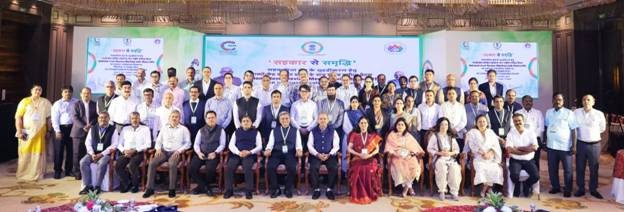






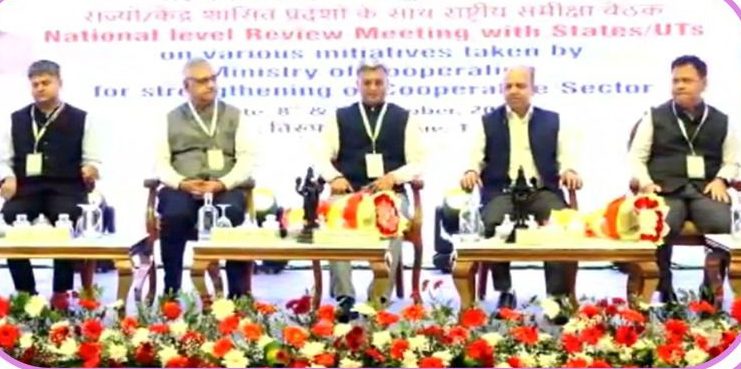
The two-day National-Level Workshop and Review Meeting on Strengthening the Cooperative Sector was held in Tirupati, Andhra Pradesh, organized by the Ministry of Cooperation, and inaugurated by Dr. Ashish Kumar Bhutani, Secretary, Ministry of Cooperation, in the presence of senior officers and dignitaries.
The workshop brought together representatives from State and Union Territory governments, Secretaries and Registrars of Cooperative Societies, as well as key stakeholders from the cooperative sector.
In his keynote address, Dr. Bhutani highlighted the pivotal role of the cooperative movement in advancing the vision of Sahkar Se Samriddhi, noting that cooperatives are increasingly extending beyond traditional sectors like agriculture and credit into healthcare, services, and value-chain integration. He emphasized the Ministry’s commitment to combining technological advancement with institutional and human capacity development to ensure cooperatives remain people-centric and future-ready.
A major focus of the workshop was the computerization and digital transformation of Primary Agricultural Credit Societies (PACS), ARDBs, and offices of Registrars of Cooperative Societies. Sessions highlighted efforts to fully digitize PACS operations, enhance the digital capabilities of PACS staff and members, and enable PACS to serve as one-stop shops providing integrated services including agricultural inputs, credit, procurement, and storage.
NABARD presented updates on software development, hardware procurement, and capacity-building support to strengthen the digital ecosystem of cooperatives. The workshop also discussed the World’s Largest Grain Storage Plan in the Cooperative Sector, with a pilot involving 500 PACS and plans to expand to 29,000 PACS nationwide.
 Discussions emphasized mapping PACS based on land availability, infrastructure, and cooperative strength, as well as ensuring economic viability and providing technical and managerial support.
Formation and strengthening of two lakh Multipurpose PACS, Dairy, and Fishery Cooperatives across panchayats and villages was another key theme. Sessions focused on identifying potential districts and blocks for new cooperative formations, activating and diversifying business in existing societies, and enhancing last-mile connectivity to support rural livelihoods.
The International Year of Cooperatives (IYC-2025) was highlighted, with states encouraged to organize major events and campaigns such as the “Ek Ped Maa Ke Naam” plantation drive and to institute Cooperative Awards to recognize progress based on benchmarking parameters. Outreach through social media to showcase innovations and best practices was also emphasized.
The workshop included discussions on challenges in the cooperative banking sector, with active participation from senior RBI officials. States and UTs shared best practices under the theme “Expanding the Horizons of PACS through Business Diversification.”
Progress of national-level multi-state cooperative societies under the Atmanirbharta Abhiyan, including National Cooperative Exports Limited, National Cooperative Organics Limited, and Bharatiya Beej Sahakari Samiti Limited, was reviewed. Implementation of the National Cooperative Database, covering over 8.4 lakh cooperatives and 32 crore members across 30 sectors, was also assessed to ensure balanced development and informed decision-making.
In his closing address, Dr. Bhutani appreciated the deliberations and emphasized PACS and multi-state cooperatives as catalysts for rural development, Atmanirbharta, and digital transformation. He urged enhanced collaboration between central and state agencies, effective use of digital tools and data, timely implementation of schemes, financial transparency, and sustainable management of cooperative resources.
States were encouraged to follow the theme of ‘Reform, Perform, Transform, and Inform’ to strengthen the cooperative sector and share data with the National Cooperative Database. The workshop concluded with a vote of thanks by the Joint Secretary, acknowledging the contributions of state representatives, central officials, and stakeholders.