
The global cooperative movement received renewed recognition with the release of the World Cooperative Monitor (WCM) 2025 by the International Cooperative Alliance (ICA) and the European Research Institute on Cooperative and Social Enterprises (EURICSE).
The 13th edition of the report, unveiled in Doha on the eve of the World Social Summit, underscores the growing power of cooperatives in transforming the global economy through people-centered, inclusive, and sustainable business models.
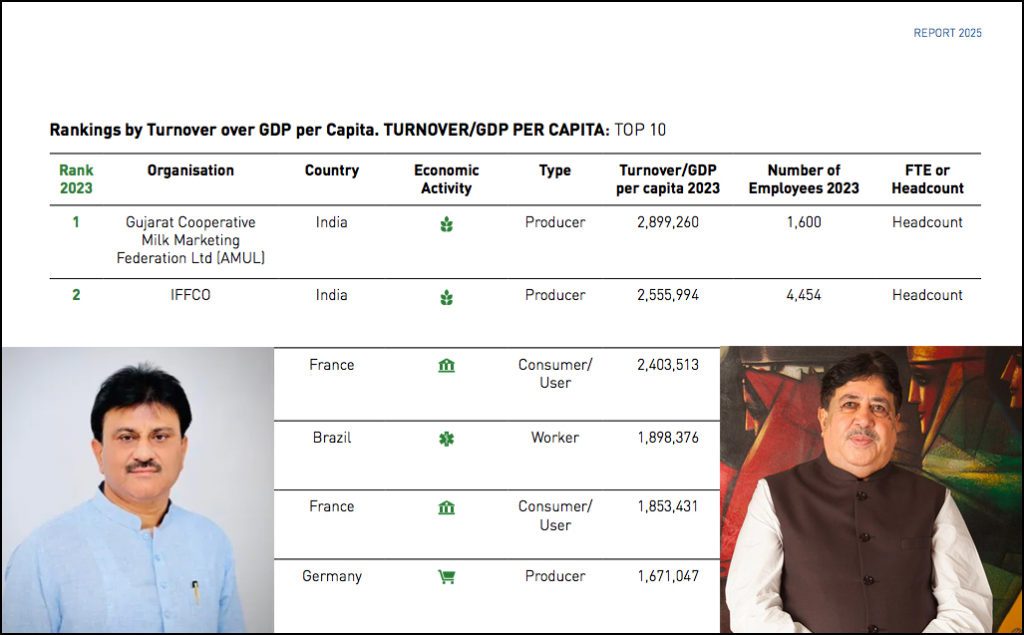
The report highlights that the Top 300 cooperatives and mutual enterprises across the world collectively achieved a turnover of USD 2.79 trillion in 2023. Among these, India’s cooperative giants, the Indian Farmers Fertiliser Cooperative Limited (IFFCO) and Gujarat Cooperative Milk Marketing Federation (Amul, have once again demonstrated remarkable global leadership.
The two have topped the global rankings by turnover relative to GDP per capita, affirming the resilience and relevance of India’s cooperative model in an era of economic uncertainty and ecological transition.
IFFCO’s performance is particularly notable as it continues to embody the principles of cooperation by empowering millions of farmers through sustainable fertilizer production, digital platforms, and environmental stewardship. With its farmer-centric structure, IFFCO has consistently reinvested profits into community welfare, green initiatives, and technological innovation, positioning itself as a global benchmark in cooperative success.
Similarly, Amul’s dairy network, built on the spirit of rural self-reliance and collective ownership, has transformed the livelihoods of millions of farmers while symbolizing India’s cooperative strength in food security and agribusiness.
Globally, the WCM’s latest findings reveal that agriculture and insurance dominate the cooperative sector, accounting for 35.7% and 31.7% of total turnover respectively, followed by wholesale and retail trade at 18%. Prominent international players such as Groupe Crédit Agricole of France, State Farm of the USA, and Germany’s REWE Group lead the list by turnover. However, the report points out that cooperatives from emerging economies, particularly India, are rapidly closing the gap through innovation, digital transformation, and local empowerment.
ICA Director General Jeroen Douglas said that the findings reaffirm the cooperative model as a key driver of global sustainability and social equity. “This year’s Monitor shows that cooperatives are not only vital to local economies but are central to addressing global challenges,” he said.
“Our new strategy for 2026–2030, Practice, Promote, Protect, reaffirms our mission to advance sustainability, social justice, and economic democracy across the world.”
The 2025 Monitor also includes in-depth interviews with cooperative leaders worldwide, showcasing how cooperatives are addressing issues such as food security, climate change, healthcare, education, and financial inclusion. These stories reflect the deep social and economic roots of the cooperative movement, emphasizing that the model offers a viable and humane alternative to profit-driven systems.
EURICSE Secretary General Gianluca Salvatori noted that the cooperative framework remains uniquely equipped to guide global transitions. “Cooperatives demonstrate that it is possible to innovate without losing sight of fairness, inclusion, and democratic governance,” he said. “Their contribution is not only socially relevant but strategically essential for a sustainable future.”
As the world marks the UN International Year of Cooperatives, the *World Cooperative Monitor 2025* reinforces that the cooperative spirit, exemplified by institutions like IFFCO and Amul, continues to drive equitable growth and resilience. From the grassroots of India’s villages to the global economic stage, cooperatives are proving that collective effort remains one of humanity’s most powerful tools for transformation.