






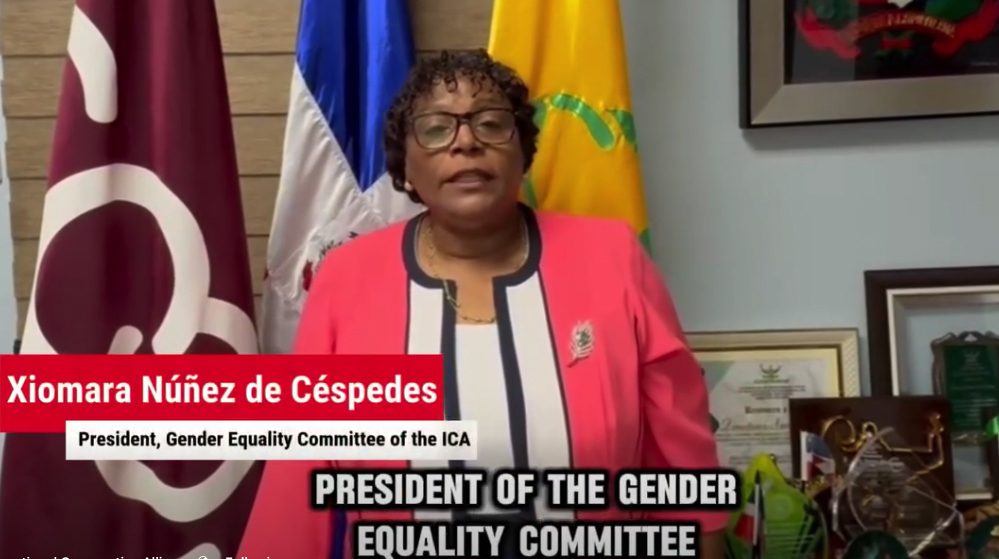
The International Cooperative Movement has renewed its commitment to promoting equality and justice for women, stressing that cooperatives can play a key role in creating fair and inclusive systems for women and girls across the world.
Marking International Women’s Day, Xiomara Núñez de Céspedes issued a message highlighting the importance of strengthening women’s rights and participation in economic and social life.
In her message, she said that although cooperatives are founded on values of equality and inclusion, much more work still needs to be done to remove the barriers faced by women. Around the world, millions of women continue to struggle with structural challenges such as discriminatory laws, unequal access to land and credit, and limited representation in decision-making bodies.
According to Núñez de Céspedes, cooperatives offer practical solutions to many of these challenges. When women come together in cooperatives, they are able to share resources, strengthen their collective voice and create democratic spaces where their concerns can be heard. This, she said, helps women improve their economic opportunities and become active participants in local development.
She is also participating in the opening of the Commission on the Status of Women, the United Nations’ largest annual gathering focused on women’s rights and gender equality. The event brings together policymakers, activists and organisations from across the world to discuss policies and strategies to advance women’s empowerment.
The theme of this year’s meeting is “access to justice for women and girls.” Núñez de Céspedes said the theme is closely linked to the daily experiences of women working in cooperatives across different sectors and regions.
She pointed out that access to justice is not limited to courts and legal systems. It also means ensuring that women are able to claim their economic, social and collective rights. Many women, particularly in rural areas, still face obstacles such as limited financial inclusion, lack of access to productive resources and underrepresentation in leadership roles.
Núñez de Céspedes emphasised that cooperatives, being people-centred and democratically run organisations, can help overcome these barriers. By bringing people together and promoting equal participation, cooperatives can contribute to women’s economic empowerment and stronger community-level justice systems.
She also highlighted that 2026 has been declared the International Year of the Woman Farmer, which should act as a catalyst for deeper reforms. Women farmers play a crucial role in ensuring food security and sustainable development, yet they often face discrimination in access to land, credit, markets and legal protection.
Calling for policy reforms, she urged governments to review discriminatory laws and practices that limit women’s participation in economic life. She also stressed the need to recognise the role of cooperatives in national policies aimed at gender equality and access to justice, particularly for rural and grassroots women.
Courtesy: ICA